When you prepare to suggest an upgrade to a client, you might pause and wonder if you are truly offering value or simply becoming a nuisance. This moment of hesitation is a signal that your approach to upselling needs to shift from a transactional mindset to a consultative one. Effective upselling is not about the product or the discount; it is about whether the client genuinely needs the solution, whether they trust your guidance, and whether the timing aligns with their current progress.
Recent data from our 2026 Sales Trends Report, which surveyed over 1,000 sales professionals, reveals that the most successful representatives do not rely on aggressive tactics. Instead, they focus on understanding the customer’s specific objectives and building a foundation of trust. By the time they introduce an upgrade, it feels like a natural next step in a collaborative partnership rather than an attempt to increase the deal size. Here are ten data-backed strategies to help you navigate these conversations with integrity.
1. Prioritize Customer Goals Over Features
The most effective upselling strategy is rooted in a deep understanding of what the customer is trying to achieve. Forty-two percent of sales professionals identify understanding customer needs and goals as their primary approach. Instead of highlighting features, start by asking open-ended questions about the client’s current processes and the daily challenges they face. When you understand the specific metrics that define success for your client, you can position your recommendation as a bridge to that success.
Shift the Conversation from Product to Outcome
Most sales conversations fail because they remain stuck in the realm of product specifications. Features are static; outcomes are dynamic. When you ask a client about their daily challenges, you uncover the friction points that your product can alleviate. For instance, if a client mentions that their team spends hours manually compiling reports, the feature you should highlight is not the “automated reporting engine” but rather the “reclaimed hours for strategic analysis.” This shift in language reframes the upsell from a cost to an investment in efficiency.
Document and Reflect
Document these goals in the client’s own language to ensure alignment. When you can reflect their needs back to them accurately, you create a shared vision. This process removes the friction often associated with sales pitches because the conversation becomes about solving their problems rather than pushing your agenda. Send a brief recap email following your discovery sessions to confirm these goals; this simple act of documentation builds the buy-in necessary for future growth conversations. It also serves as a reference point that prevents scope creep and keeps the focus on the agreed-upon value drivers.
2. Cultivate Trust Through Genuine Rapport
Forty percent of successful sales professionals cite trust and rapport as the deciding factor in their ability to upsell. You do not need to be personal friends with your clients, but you must demonstrate that you understand their business landscape and possess the expertise to guide them. As lead quality has improved for 68% of sales teams over the last year, there is more opportunity to invest time in meaningful relationship building rather than high-volume outreach.
Demonstrate Business Acumen
Trust is built when a client perceives you as a peer who understands their industry. Show that you are paying attention by asking follow-up questions that delve deeper into their operations. If a client mentions a goal like increasing leads, ask about their specific lead sources and the internal process that follows once a lead is captured. By showing interest in parts of their business that your product does not even touch, you signal that your primary concern is their overall success, which in turn makes them far more receptive to your future recommendations.
Consistency Builds Credibility
Rapport is not a one-time event; it is the result of consistent, reliable interactions. Ensure that every touchpoint, whether it is a quarterly business review or a casual check-in, reinforces your commitment to their success. When clients know you are not just waiting for the next renewal date to pitch them, they are more likely to view your suggestions as helpful advice rather than sales tactics. This long-term perspective is crucial for maintaining the high level of engagement required for successful upselling.
3. Establish Value With Quick Wins
Providing consistent value is a cornerstone of the sales process, with 39% of top performers prioritizing this approach. Rather than waiting for a large-scale implementation to show impact, find ways to deliver immediate results. This could involve a brief audit, a process tweak that saves time, or an analysis that offers a fresh perspective on their current data.
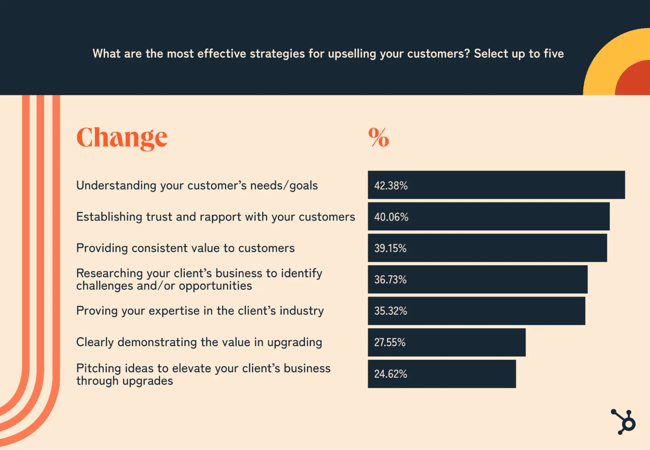
This visual highlights that understanding customer needs and building trust are the most effective ways to approach upselling. By pairing each small victory with an impact recap—outlining the baseline, the change, and the resulting benefit—you prove your competence. When clients see you deliver on small promises, their confidence in your ability to manage larger, more complex upgrades increases significantly.
The Psychology of Small Wins
Small wins create a psychological momentum that makes larger decisions easier. When a client experiences a quick, tangible benefit from your guidance, their perception of your value rises. This is particularly important in upselling scenarios where the perceived risk of change is high. By demonstrating that you can deliver value with minimal effort on their part, you lower the barrier to entry for more significant investments.
Communicate the Impact
Do not assume that your efforts are visible. Always communicate the impact of your quick wins. Send a short note or email that explicitly states what was changed, why it was changed, and the result. This documentation serves as evidence of your ROI and provides a clear narrative that you can leverage when discussing future expansions. It transforms abstract support into concrete value.
4. Perfect Your Timing
Timing is often the difference between a rejected pitch and a signed expansion. Thirty-seven percent of sales reps find the most success when they introduce an upgrade immediately after helping a client achieve a goal. At this stage, your credibility is at its peak, and the value of your previous contributions is clearly demonstrated.
Capitalize on Success Moments
Identify the key milestones in your client’s journey with your product. These are the moments when they have successfully implemented a feature, achieved a target, or solved a critical problem. These are the ideal times to introduce an upsell because the client is already in a positive mindset and is likely thinking about the next step in their growth.
Avoid Premature Pitches
Avoid the urge to pitch an upsell while the client is still waiting to see results from their initial purchase. Build a checkpoint into your milestones that allows for a natural transition. For example, you might suggest, “If we hit our target conversion rate this month, let’s explore advanced tracking tools to scale these results.” By linking the upgrade to a future success, you make the conversation feel like a logical progression. This approach ensures that the upsell is seen as a tool for sustaining momentum rather than a distraction from current goals.
5. Leverage AI for Personalization
Artificial intelligence has become a standard tool for modern sales teams, with 84% of representatives using it to optimize their processes. You can utilize AI to analyze call transcripts for expansion opportunities, research prospects to find relevant case studies, or draft personalized follow-ups that address a client’s specific pain points.

As this grid illustrates, AI provides significant advantages in personalizing interactions and improving productivity. By letting AI handle the heavy lifting of data analysis and research, you free up time to focus on the human elements of the relationship, such as strategy and empathy, which remain the most critical components of long-term client retention.
Enhance, Do Not Replace
It is important to view AI as an enhancement to your sales skills, not a replacement for them. Use AI to gather insights and prepare for conversations, but rely on your own judgment and interpersonal skills to deliver the message. The most effective upselling conversations are those that feel personal and tailored to the client’s unique situation. AI can help you achieve this level of personalization at scale, but it cannot replace the genuine connection that builds trust.
Identify Hidden Opportunities
AI tools can also help you identify hidden upselling opportunities that you might have missed. By analyzing usage data and communication patterns, AI can flag clients who are underutilizing their current features or who are facing challenges that could be solved by an upgrade. These insights allow you to approach clients with targeted recommendations that are highly relevant to their current needs.
6. Be Selective With Your Upsell Candidates
Not every customer is a candidate for an upgrade. Focus your efforts on those who are already actively using your product and achieving their goals. Before you make a recommendation, ask yourself if the client is seeing real value from their current setup and if the upgrade will genuinely accelerate their progress. If you cannot clearly articulate the problem the upgrade solves or the specific benefit the client will receive, it is better to wait.
Assess Readiness and Fit
Selectivity is key to maintaining a high success rate and preserving client relationships. Upselling to a client who is not ready or who does not need the additional features can damage trust and lead to churn. Take the time to assess each client’s readiness for an upgrade. Look for signs of engagement, such as regular usage, positive feedback, and active participation in support interactions.
Respect the Client’s Journey
Every client has a unique journey, and forcing an upsell before they are ready can disrupt that journey. Respect their pace and be patient. Sometimes, the best upselling strategy is to wait for the client to reach out to you with a need. By being selective, you ensure that every upsell conversation is meaningful and adds value to the client’s experience.
7. Maintain Transparency Regarding Pricing and ROI
Thirty-five percent of buyers report that they fail to close because they do not perceive the value for the money. To counter this, make your math obvious. Provide a clear breakdown of costs, including setup, training, and ongoing fees, and offer realistic ROI scenarios. By creating a defensible calculation that the buyer can share with their internal team, you make it easier for them to justify the investment to their stakeholders.
Simplify the Financial Case
Complex pricing structures can be a major barrier to upselling. Simplify the financial case by breaking down the costs into understandable components. Use clear language and avoid jargon. Provide examples of how other clients have achieved ROI with similar upgrades. This transparency helps build trust and reduces the perceived risk of the investment.
Align with Business Objectives
Ensure that your ROI scenarios are aligned with the client’s business objectives. If the client is focused on reducing costs, highlight the cost savings associated with the upgrade. If they are focused on growth, highlight the revenue potential. By aligning your financial case with their priorities, you make the upsell more compelling and relevant.
8. Lead with the Plan, Not the Product
When suggesting an upgrade, pivot from pitching features to presenting a strategic plan. Start by identifying the problem you have uncovered, then explain your recommended approach, and show proof that this approach works. Only at the end of the conversation should you reveal the specific tools or investments required to execute the plan. This consulting-led approach ensures that the buyer views the upgrade as a necessary step to reach their goals rather than an additional expense.
Frame the Upgrade as a Solution
By leading with the plan, you shift the focus from the product to the solution. This framing helps the client see the upgrade as a means to an end, rather than an end in itself. It also allows you to demonstrate your expertise and strategic thinking, which further builds trust and credibility.
Provide Evidence and Validation
Support your plan with evidence and validation. Share case studies, testimonials, or data that show how similar plans have succeeded for other clients. This evidence helps to validate your recommendations and reduces the perceived risk of the upgrade. It also provides the client with the confidence they need to make a decision.
9. Utilize Strategic Social Proof
Before you propose an upsell, have relevant social proof ready. Forty percent of buyers rely on user reviews, and 37% look to customer stories when making decisions. Keep a library of bite-sized success blurbs that match the client’s industry and goals. A short, three-sentence story featuring a key metric is often more persuasive than a lengthy case study, as it provides quick, actionable evidence that your solutions deliver results for peers in their sector.
Tailor Social Proof to the Client
Generic social proof is less effective than tailored social proof. Make sure that the stories and reviews you share are relevant to the client’s industry, size, and goals. This relevance helps the client see themselves in the story and makes the success more relatable and achievable.
Use Multiple Forms of Social Proof
In addition to written reviews and case studies, consider using other forms of social proof, such as video testimonials, webinars, or live demos. These formats can be more engaging and memorable, helping to reinforce the value of the upgrade.
10. Align Sales and Marketing Efforts
Effective upselling requires a unified approach. Poor communication between sales and marketing is a significant challenge for 40% of organizations. Ensure both teams are working from the same definition of an upsell-ready customer. When marketing creates case studies and ROI calculators that are easily accessible to the sales team, you can respond to client needs faster and with more confidence. Strong alignment ensures that the right information reaches the right client at the right time.
Break Down Silos
Break down the silos between sales and marketing by fostering regular communication and collaboration. Share insights and feedback regularly to ensure that both teams are aligned on goals and strategies. This collaboration helps to create a seamless experience for the client, where marketing materials and sales conversations are consistent and complementary.
Leverage Shared Resources
Leverage shared resources, such as a central repository of case studies, ROI calculators, and other sales enablement materials. This ensures that the sales team has access to the most up-to-date and relevant information, allowing them to respond to client needs quickly and effectively.
Upselling is a natural extension of a healthy client relationship. The most successful professionals are those who prioritize understanding, trust, and consistent value. By shifting your focus from quotas to outcomes, you create an environment where your clients feel supported in their growth, making the decision to invest further an easy one. When you focus on helping the client win, the commercial results often follow as a byproduct of that success.


