On This Page· 5
A $3,000 monthly agency retainer is often out of reach for a solo plumber or landscaper. The gap between that price tag and a sub-$200 budget does not mean you must ignore search visibility. The core question is not which single tool is best. It is how two or three AI visibility tools complement each other without duplicating spend. By pairing a content engine with a technical tracking layer, a local operator can cover both sides of the search equation. This approach turns a massive budget constraint into a manageable, strategic stack.

The $3,000 Agency Gap vs. the $200 Solo Reality

For many solo operators, the barrier to entry in digital marketing is not skill but cost. A standard agency retainer for local SEO starts around $3,000 per month, consuming a significant portion of a solo business’s entire operating budget. In contrast, the average AI visibility tools for small businesses are priced between $49 and $199 monthly. This price difference represents more than just savings; it changes how you approach your digital presence. You are no longer hiring for labor; you are purchasing a capability.
The most effective way to utilize this lower budget is to stop looking for a single, all-in-one solution and start building a stack. An all-in-one platform often tries to do everything and ends up doing nothing well for your specific niche. Instead, the goal is to pair two or three complementary tools that cover the full range of your search visibility needs. This ensures you are not paying for unused features while filling strategic gaps with specialized tools.
This stack typically serves three distinct roles in your marketing operation:
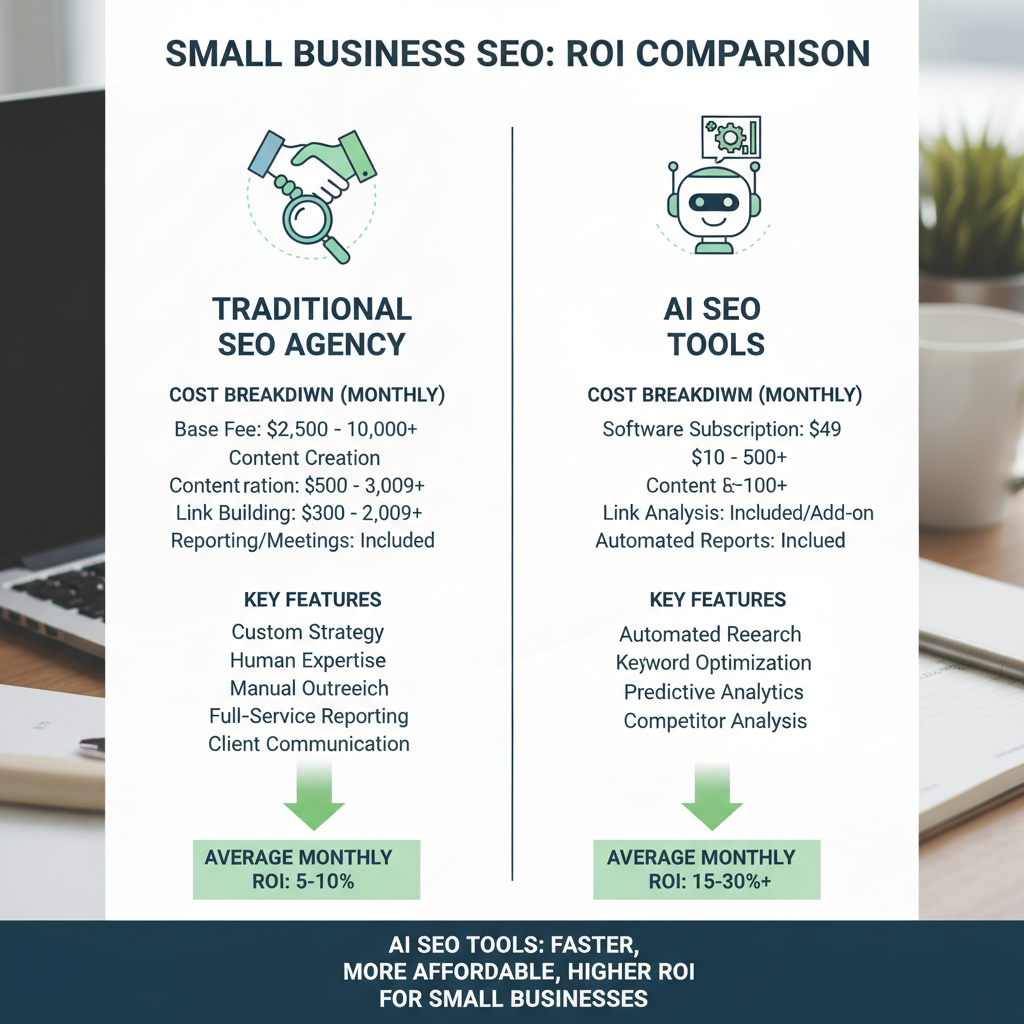
- Content Generation: Automatically creating and publishing relevant material that targets your local service area. This replaces the need for a dedicated copywriter or content creator.
- Technical and AI Visibility: Optimizing your site for structured data and ensuring your brand is recommended by AI assistants like ChatGPT and Gemini. This is the technical layer that makes you discoverable.
- Keyword and Research Support: Identifying the terms your potential clients are actually using, allowing you to focus your efforts on high-intent queries.
By combining these three functions, you create a comprehensive system. A solo plumber or cleaning company can maintain a strong digital presence for less than the cost of a single month of traditional agency services. The shift is from relying on a third party’s labor to managing a set of specialized tools that work in concert. This allows you to maintain control over your strategy while staying within a realistic monthly budget.
Content and Technical Automation as Your AI Visibility Foundation
For a solo operator, the most critical component of your stack is the layer that handles both content generation and technical execution simultaneously. Moonrank serves as this anchor, operating at $99 per month to automate daily content creation while managing the technical elements that determine how search engines and AI assistants interpret your site. This includes implementing schema markup, structured data, and ensuring your pages meet Core Web Vitals standards, all without requiring you to hire a developer.
The logic behind consolidating these functions into a single platform is straightforward. When content creation and technical optimization are handled by separate tools, you often create a gap where the content is high-quality but technically invisible, or vice versa. By using one system to write and optimize the content, you ensure that every article is structured for immediate indexing and comprehension. This integrated approach often outperforms the manual process of writing in one tool and configuring schema in another, justifying the $99 investment as the core of your AI visibility strategy. It eliminates the friction of data transfer between platforms and reduces the risk of technical misalignment.
Targeting the New Search Landscape
Traditional local SEO software focuses on Google rankings, but the search landscape has shifted. Modern AI visibility tools are designed to ensure your business is recommended by AI assistants like ChatGPT, Gemini, and Perplexity. For a local service provider, being cited by an AI assistant is often more valuable than appearing on the first page of a traditional search result, as it places you directly in the customer’s decision-making process.
Moonrank is specifically engineered to optimize for these generative search engines. It does not just chase keywords; it structures content so that LLMs can extract and recommend your services accurately. This dual focus on traditional rankings and AI citations ensures you remain visible as users migrate from typing queries into browsers to asking AI assistants for recommendations. This is where affordable AI marketing moves beyond basic optimization into strategic presence in the emerging AI search ecosystem, ensuring your brand is part of the answer, not just the search.
Balancing the Budget: Semrush, Surfer, or Lighter Alternatives
The second layer of your AI visibility stack addresses the data you need to make the content work. This is where you decide between deep, all-encompassing analysis or a lighter, more focused approach. If you want comprehensive coverage of keyword gaps and technical site audits, Semrush at $129/month is the standard choice. It provides automated site audits, keyword gap analyses, and content suggestions based on competitors. However, that power comes with a steeper learning curve. You must be willing to spend time digging through reports to find the signals that matter for your specific service area.
If you prefer a lighter touch, Surfer SEO shifts the focus away from broad technical audits toward content scoring and optimization. It provides real-time content scoring during the writing process and generates content briefs based on hundreds of ranking factors. This makes it a practical local SEO software for operators who want to ensure every article is optimized before it goes live. For those looking for an even lower entry point, Ubersuggest offers keyword difficulty analysis, content gap identification, and site audits at a lower cost. It is a solid alternative if you want to stay at the bottom of the budget range while still getting actionable data.
The right choice depends on how much time you have to spend analyzing data versus how much you need to get right. The table below compares these three options to help you allocate your remaining budget effectively.
| Tool | Price | Best For | Key Benefit |
|---|---|---|---|
| Semrush | $129/mo | Comprehensive analysis | Automated site audits and deep competitor gap analysis |
| Surfer SEO | Varies | Content optimization | Real-time scoring and detailed content briefs |
| Ubersuggest | Varies | Lightweight research | Cost-effective keyword difficulty and site audits |
We often see operators start with the lighter option to test the waters. Once you understand which data points actually drive your local leads, you can decide if the comprehensive view of a tool like Semrush justifies the extra cost. The goal is not to buy the most expensive local SEO software, but to buy the one that fits your current operational capacity.
Does Your AI Visibility Stack Fit a Solo Operator’s Budget?
You do not need to purchase the entire stack on day one. Starting with a single tool is a viable and common entry point for solo operators. However, the data suggests that pairing content automation with technical visibility delivers better results than using either in isolation. A practical approach is to begin with Moonrank as your anchor for AI search optimization. If you find yourself needing deeper data on search intent or competitor gaps, you can then add a lighter keyword research tool. This phased approach keeps your initial overhead low while allowing you to scale up only when the specific need arises.
The Timeline for Seeing Results
Patience is a factor in any organic growth strategy, but AI visibility tools tend to show early signals quickly. Most local service businesses see initial improvements in organic traffic and AI assistant recommendations within 30 to 60 days of implementation. These early wins often appear as increased visibility in AI-generated answers for local queries. Significant, compounding growth in traffic and lead generation typically materializes over a 3 to 6 month period. This timeline aligns with the time it takes for search engines and AI models to re-index and re-evaluate the consistency of your new, optimized content.
Accessibility for Non-Technical Users
A common barrier to entry is the fear that these tools require advanced coding or SEO knowledge. In reality, most AI visibility tools are designed with beginners in mind. Platforms like Moonrank and Ubersuggest emphasize automated optimization features and plain-English explanations. You do not need to manually write schema code or interpret complex audit logs. The software handles the technical heavy lifting, translating complex data into actionable steps you can execute in minutes. This focus on usability ensures that a solo operator can manage their digital presence effectively without hiring a specialist.
Building Your First Month: A Practical Starting Point
Your first month shouldn’t be about a full commitment. It should be a structured test. We recommend anchoring your stack with Moonrank at $99, which handles the heavy lifting of content and technical optimization. To stay under the $200 cap, pair it with a lighter tool for keyword research or content editing, such as Ubersuggest or Grammarly. This combination gives you broad coverage without duplicating the same functions across two expensive platforms.
Treat this period as an experiment rather than a permanent purchase. Set a baseline for your current lead generation and how often you appear in AI assistant recommendations. Monitor these metrics daily for 30 days. If the data shows no traction, adjust your keywords or content focus before scaling. If you see movement, you’ve validated the approach.
This shift is fundamental. It moves your burden away from hiring for niche expertise to managing data. For a solo operator, managing data is a far more scalable model than managing people. The transition from relying on generalist expertise to managing specific data streams represents a structural scaling advantage. When you replace a high-cost retainer with a targeted stack of AI visibility tools, you stop paying for human hours and start paying for consistent, measurable output. This model allows a single person to maintain the digital presence of a small team without the administrative overhead. As search behavior evolves toward AI-generated recommendations, the operator who controls their own data pipeline holds a distinct edge. The goal is no longer finding the right specialist, but ensuring the right information reaches the right algorithm at the right time.


