A content marketing platform (CMP) is a centralized software solution that enables teams to plan, produce, manage, distribute, and analyze digital content across diverse channels. Unlike a standard content management system, which focuses primarily on the technical act of publishing to a website, a CMP oversees the entire lifecycle of your content strategy. It serves as the connective tissue between ideation and measurement, helping teams maintain brand consistency while scaling production.
By acting as a single source of truth, these platforms ensure that every asset—from a blog post to a social media graphic—aligns with overarching business objectives. They transform content production from a series of disconnected tasks into a cohesive, repeatable process that supports long-term growth.
Why Teams Adopt Content Marketing Platforms
Marketing teams often reach a point where manual processes—such as tracking progress in spreadsheets or managing feedback through long email chains—become unsustainable. If your team is struggling with bottlenecks, managing content across multiple formats like video, social media, and blogs, or attempting to prove marketing ROI to stakeholders, a CMP provides the structure needed to move forward. By centralizing these tasks, you reduce the time lost to tool switching and data silos, allowing your team to focus on the quality of their work rather than the mechanics of production.
Beyond simple organization, adoption is driven by the need for visibility. When content production is scattered, leadership lacks a clear view of the pipeline. A CMP provides real-time dashboards that show exactly what is being created, who is working on it, and when it will go live. This transparency prevents duplicate work and ensures that the entire marketing department is pulling in the same direction.
Identifying Your Need for a CMP
Not every organization requires a dedicated platform. Small teams or those focused on a single channel can often manage their requirements with a simple CMS. However, you should consider a CMP if you find that your current setup prevents you from scaling effectively. For instance, if you cannot easily attribute revenue to specific pieces of content or if your team spends more time coordinating workflows than actually creating assets, a CMP will help you regain control. It is about creating a predictable, data-backed environment for your content operations.
Signs You Have Outgrown Current Tools
You likely need a CMP if your team experiences “version control anxiety,” where team members are unsure if they are working on the final draft of an asset. Additionally, if you find that your brand voice shifts inconsistently across different regions or departments, the lack of centralized governance in your current stack is likely the culprit. When your content operations reach a scale where manual intervention is required for every single update, the platform becomes a necessity rather than a luxury.
Essential Features for Scaling Your Content Strategy
When evaluating platforms, focus on features that provide long-term value rather than short-term convenience. A platform that merely organizes files is a digital library, not a marketing engine. To truly scale your website growth and prove your impact, you need tools that integrate deeply with your existing tech stack and provide actionable intelligence.
Data-Driven Personalization
Effective content personalization relies on the depth of your customer data. A high-quality CMP should pull insights from your CRM or customer data platform to tailor content experiences based on user behavior or account status. When you can swap page sections or email messaging based on a visitor’s lifecycle stage, you increase the likelihood of conversion. The best platforms make this data accessible directly within the editor, so your team doesn’t have to navigate between tabs to understand the audience they are addressing.
Revenue Attribution and Analytics
Proving the value of content requires more than vanity metrics like page views. You need a platform that connects your creative output to business results. Look for CMPs that support multi-touch attribution models, allowing you to see how a blog post or landing page influenced a closed deal. When you can report that a specific campaign directly contributed to pipeline growth, you build trust with leadership and justify further investment in your content strategy.
Integrated AI Workflows
AI is no longer just a tool for generating text; it is an essential component of an efficient workflow. Modern CMPs use AI to help with everything from drafting briefs to repurposing assets for different channels. The most sophisticated platforms enforce brand voice and tone guidelines, ensuring that automated content remains consistent with your identity. When evaluating AI features, look for those that are embedded into your daily tasks rather than isolated in separate windows.
Collaboration and Governance
As your team grows, maintaining brand standards becomes harder. A robust CMP offers customizable approval chains and editorial calendars that provide visibility into the entire production process. This is particularly important for industries with strict regulatory requirements, where legal or compliance reviews are necessary. By automating these touchpoints, you ensure that nothing goes live without the appropriate oversight, reducing the risk of errors while speeding up the time-to-publish.
Practical Steps for Feature Selection
Before committing to a vendor, create a checklist of your “must-have” integrations. Does the platform connect with your current email service provider? Can it push content directly to your social media management tool? Prioritize platforms that offer an open API or pre-built connectors to your existing software, as this will significantly reduce the friction of your initial implementation phase.
Leading Content Marketing Platforms for 2026
Selecting the right CMP is a matter of matching your specific operational needs with the strengths of the platform. The following options represent different approaches to solving the challenge of content operations, ranging from integrated suites to specialized production tools.
| Platform | Best For | Key Strength | Integration Focus |
|---|---|---|---|
| HubSpot for Marketers | SMBs to Enterprise | CRM-native personalization | Deep ecosystem syncs |
| Optimizely CMP | Enterprise Ops | Workflow complexity | Composable DXP integration |
| Adobe GenStudio | Large Enterprises | Multi-channel scale | Adobe-wide connectivity |
| Skyword Accelerator360 | B2B/B2C Teams | Talent network access | Analytics-agnostic |
HubSpot for Marketers
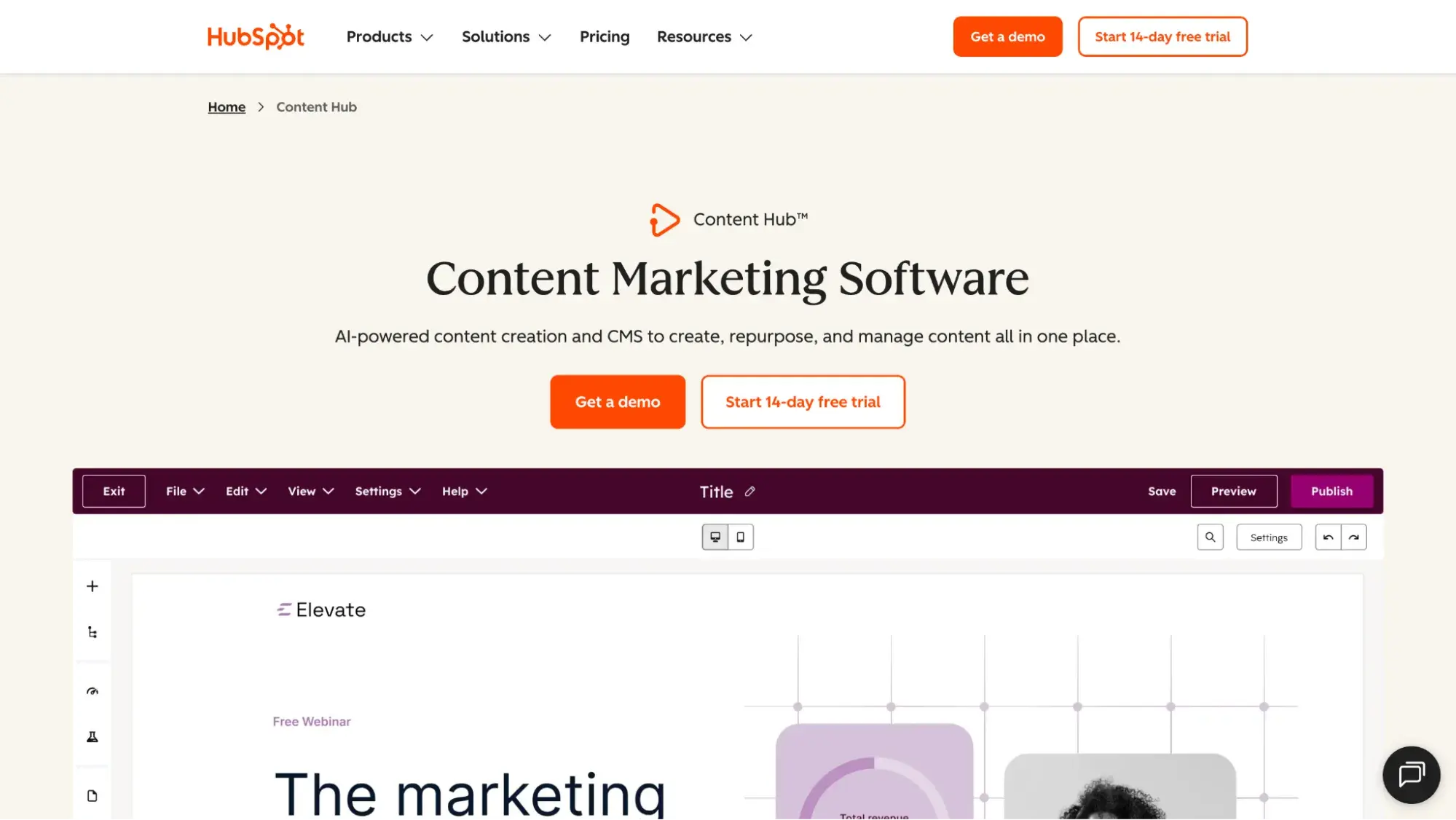
HubSpot is a strong choice for teams that want a platform built on a unified CRM. Because the content tools and the customer database exist in the same environment, personalization and attribution happen more naturally. You can create content tailored to specific audience segments and see exactly how that content performs against your sales pipeline. It is well-suited for businesses that need to connect their marketing efforts to revenue without managing disconnected software.
Optimizely CMP
Optimizely excels in complex enterprise environments where editorial governance is the primary concern. Its strength lies in its ability to manage multi-brand operations and highly structured approval workflows. If your organization requires detailed reporting on efficiency and task bottlenecks, Optimizely offers the granular visibility needed to optimize your production process. It is a powerful tool for teams that prioritize operational rigor above all else.
Adobe GenStudio
Adobe GenStudio serves large enterprises that are already deeply embedded in the Adobe ecosystem. By connecting content production with ad activation, it allows teams to push assets to paid channels like LinkedIn or TikTok directly from the platform. While it requires a significant investment in both time and licensing, it provides an enterprise-grade content supply chain that is difficult to replicate with smaller, fragmented tools.
Skyword Accelerator360
Skyword distinguishes itself by integrating a vetted freelance talent network directly into its platform. This is particularly useful for teams in specialized industries like finance or healthcare that require high-quality, expert-led content. While it relies on your existing analytics tools to measure ROI, its ability to source talent and manage briefs within a single interface makes it a unique solution for content-heavy organizations.
Implementing a Content Marketing Platform Successfully
Transitioning to a new platform is as much about people and processes as it is about software. A common mistake is to view a CMP as a “set it and forget it” solution. To succeed, you must designate clear roles for platform management. A content operations lead should oversee daily workflows, while a marketing operations specialist ensures that data integrations with your CRM or analytics tools remain healthy.
Building an Internal Governance Model
Before launching your new platform, define who has the authority to approve content at each stage. Establish clear guidelines for tagging, folder structures, and metadata usage to ensure that your library remains searchable as it grows. If you do not set these rules early, you risk turning your new, expensive platform into a chaotic repository that is just as hard to manage as your old spreadsheets.
Managing the Onboarding Timeline
Before choosing a provider, evaluate the onboarding process. Some platforms can be implemented in a week, while others, particularly those in the enterprise space, may take several months to fully deploy. Factor this time into your roadmap, and ensure your team has the training required to utilize the platform’s full feature set. By treating the CMP as a cross-functional system rather than just another marketing tool, you ensure that it becomes a permanent asset to your organization’s growth.
Ultimately, the goal of any CMP is to create an environment where high-quality content can flourish consistently. Whether you need the CRM-based insights of HubSpot or the workflow depth of Optimizely, the right choice will allow you to stop managing the chaos and start focusing on the strategy that drives your brand forward. Having a reliable system for content management is a prerequisite for maintaining visibility in an increasingly competitive digital marketing environment.


