Modern sales organizations are balancing a fundamental shift in how they identify and engage potential clients. Artificial intelligence now manages repetitive tasks that once claimed entire workdays, allowing teams to partner with technology to research leads and refine messaging. This evolution demands a clear understanding of when AI-driven systems provide a competitive edge and when human-led outreach remains the preferred choice. Success in this environment relies on a hybrid approach, ensuring your team maintains the capacity to foster genuine connections while scaling operations. The key is not to choose one side over the other, but to integrate both methodologies into a cohesive workflow that maximizes efficiency without sacrificing the personal touch that closes high-value deals.

The Advantages of AI-Driven Prospecting
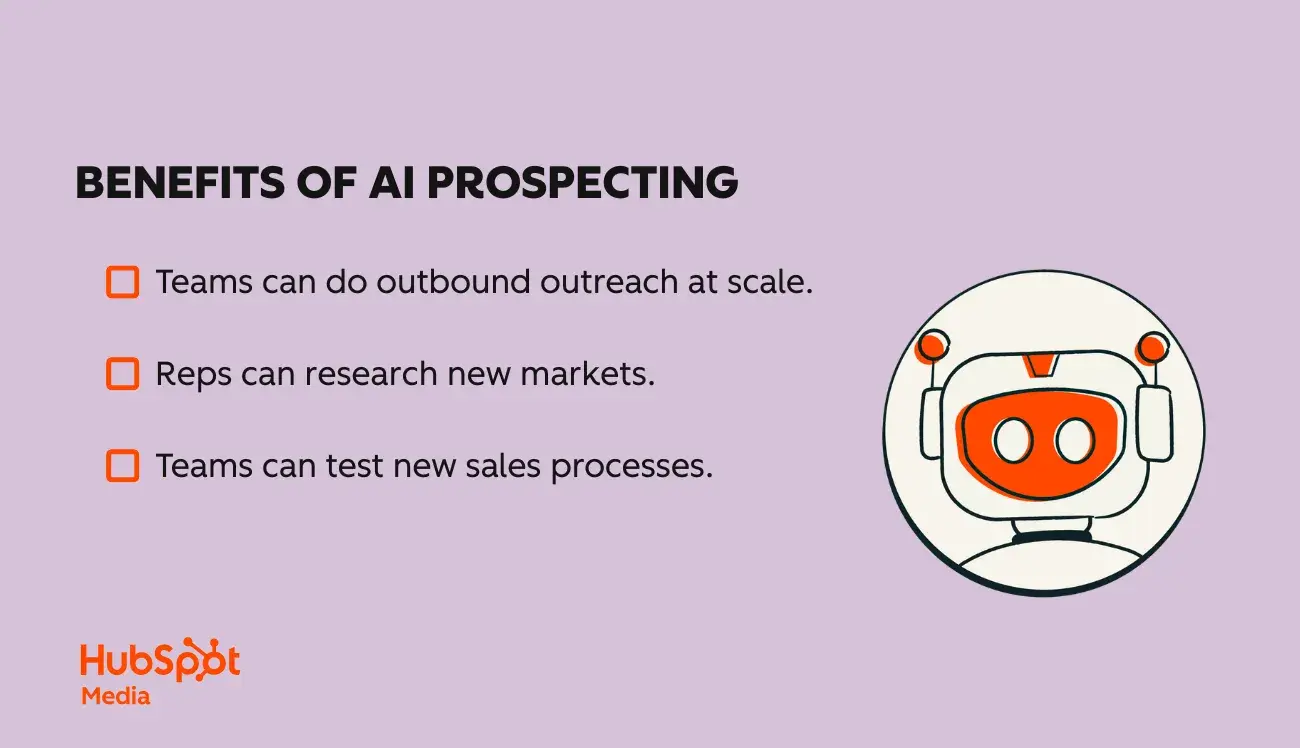
AI-driven prospecting excels at automating research, lead scoring, and the initial stages of outreach. By leveraging machine learning, these systems can analyze intent signals and identify prospects that align with your ideal customer profile with remarkable speed. Unlike static automation, modern AI agents can adapt sequences based on engagement data, continuously refining their performance through feedback loops. This capability transforms lead generation from a manual, time-intensive process into a dynamic, data-driven engine that operates around the clock.
Scaling Outbound Operations
Systems powered by AI can prospect at a volume that manual efforts simply cannot replicate. While a human researcher might spend hours reviewing profiles and company updates, AI can process thousands of records in minutes, surfacing behavioral signals that indicate a high likelihood of conversion. For organizations reliant on high-volume outreach, this capability acts as a significant force multiplier, ensuring that no potential lead is overlooked due to capacity constraints. This scalability is particularly crucial for startups and growing enterprises that need to build pipeline quickly without proportionally increasing headcount. By handling the heavy lifting of data aggregation and initial contact, AI allows sales teams to focus their limited energy on the most promising opportunities, thereby increasing the overall efficiency of the sales cycle.
Exploring New Market Verticals
Testing new markets often requires a balance between speed and precision. AI allows teams to create directional maps of adjacent territories quickly, identifying companies that match the characteristics of top accounts without requiring extensive manual discovery. This experimentation loop enables sales teams to validate messaging angles and outbound sequences rapidly, pivoting based on real-time data rather than intuition alone. When entering a new vertical, the lack of historical data can be a significant hurdle. AI mitigates this by analyzing patterns from similar industries or adjacent customer segments, providing a probabilistic view of which prospects are most likely to convert. This reduces the risk associated with market expansion and allows for more agile resource allocation, ensuring that marketing and sales efforts are directed toward segments with the highest potential return on investment.
Enhancing Data Accuracy and Enrichment
Beyond volume and speed, AI prospecting tools significantly enhance the quality of data available to sales teams. Traditional methods often rely on outdated or incomplete contact information, leading to bounced emails and wasted effort. AI systems continuously scrape and verify data from multiple sources, ensuring that the contact details, job titles, and company information are current. This level of data hygiene is critical for maintaining sender reputation and ensuring that outreach efforts reach the right decision-makers. Furthermore, AI can enrich basic firmographic data with technographic insights, revealing what software stacks a prospect is using. This information provides valuable context for personalization, allowing sales representatives to tailor their messaging to the specific technical needs and challenges of the prospect, thereby increasing the relevance and impact of each interaction.
When Manual Outreach Remains Essential
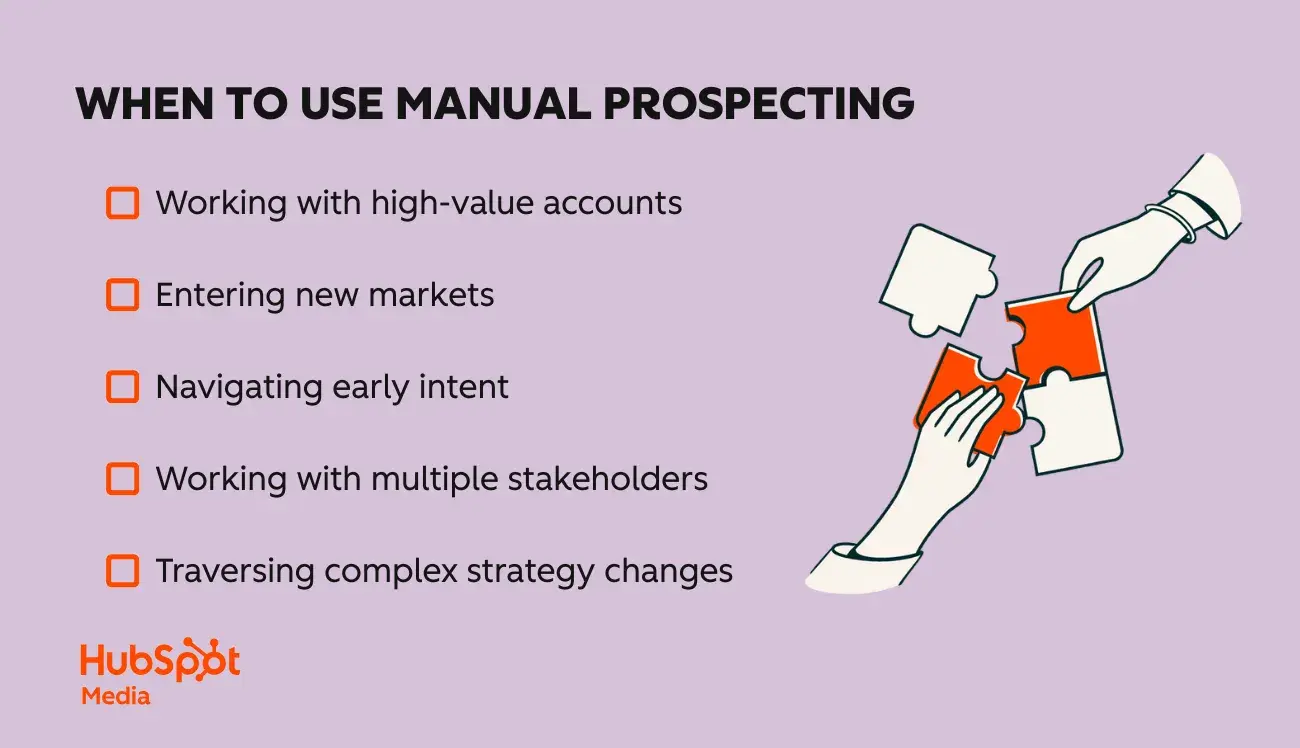
While automation offers efficiency, human-led prospecting remains the cornerstone for high-value relationships and complex decision-making. AI models are often limited by the data they are trained on, meaning they may miss opportunities that don’t fit expected patterns. When deals require deep trust, nuanced understanding of internal politics, or the interpretation of early, subtle signals, human judgment is irreplaceable. The ability to read between the lines, understand emotional cues, and adapt communication style in real-time are skills that technology has yet to fully replicate.
Navigating Complex Relationships
High-value accounts often involve multiple stakeholders and intricate power dynamics that an AI cannot map. A human representative can identify the subtle influences behind a budget decision or detect friction between departments. By engaging in manual outreach, sellers can build the trust necessary to penetrate complex organizations, a task that often requires second-degree connections and personalized, empathetic communication. In enterprise sales, the buying committee may include C-level executives, technical leads, and procurement specialists, each with different priorities and concerns. A human seller can navigate these diverse perspectives by adjusting their narrative to address the specific pain points of each stakeholder. This level of customization and strategic positioning is difficult to achieve through automated templates, making human intervention essential for closing large, strategic deals.
Detecting Early Intent
AI tools typically monitor clear, trackable signals like firmographic changes or job postings. However, early buying intent often manifests in less structured environments, such as community discussions or niche industry forums. Human intuition allows for the detection of these early signals, enabling a quick, authentic response that positions your brand as a helpful partner long before a formal RFP is issued. Sales professionals who actively participate in industry conversations can identify prospects who are expressing frustration with current solutions or seeking advice on emerging trends. By engaging in these discussions organically, sellers can establish credibility and trust before ever pitching their product. This “soft” approach to prospecting is particularly effective in industries where relationships and reputation are paramount, as it allows sellers to demonstrate expertise and empathy in a way that resonates with potential clients.
Building Trust Through Authenticity
Trust is the foundation of any successful sales relationship, and it is built through authentic, human interactions. While AI can help personalize messages, it cannot replicate the genuine empathy and understanding that come from human conversation. Prospects can often sense when they are interacting with a bot or a generic template, which can lead to disengagement or even resentment. Human-led outreach allows for spontaneous, unscripted conversations that can uncover hidden needs and build rapport. This authenticity is particularly important in industries where the stakes are high, such as healthcare, finance, or legal services. In these sectors, buyers are looking for partners who understand their unique challenges and can provide tailored solutions, rather than vendors who are simply pushing a product. By prioritizing human interaction in these contexts, sales teams can differentiate themselves from competitors and build long-lasting relationships that drive repeat business and referrals.
| Capability | AI Prospecting | Traditional Prospecting | Hybrid Prospecting |
|---|---|---|---|
| Scale & Volume | High, consistent volume | Limited by human capacity | Scaled reach with human focus |
| Personalization | Template-driven data | Deep, contextual insight | AI drafting, human refinement |
| Trust Building | Lower, often recognized | Strong, authentic connection | Scaled trust through human touch |
| Objection Handling | Pre-programmed responses | Real-time, adaptable dialogue | AI surfaces, humans negotiate |
| Consistency | Perfect timing & follow-up | Variable based on workload | Foundation of AI, human excellence |
Building a Hybrid Prospecting Strategy
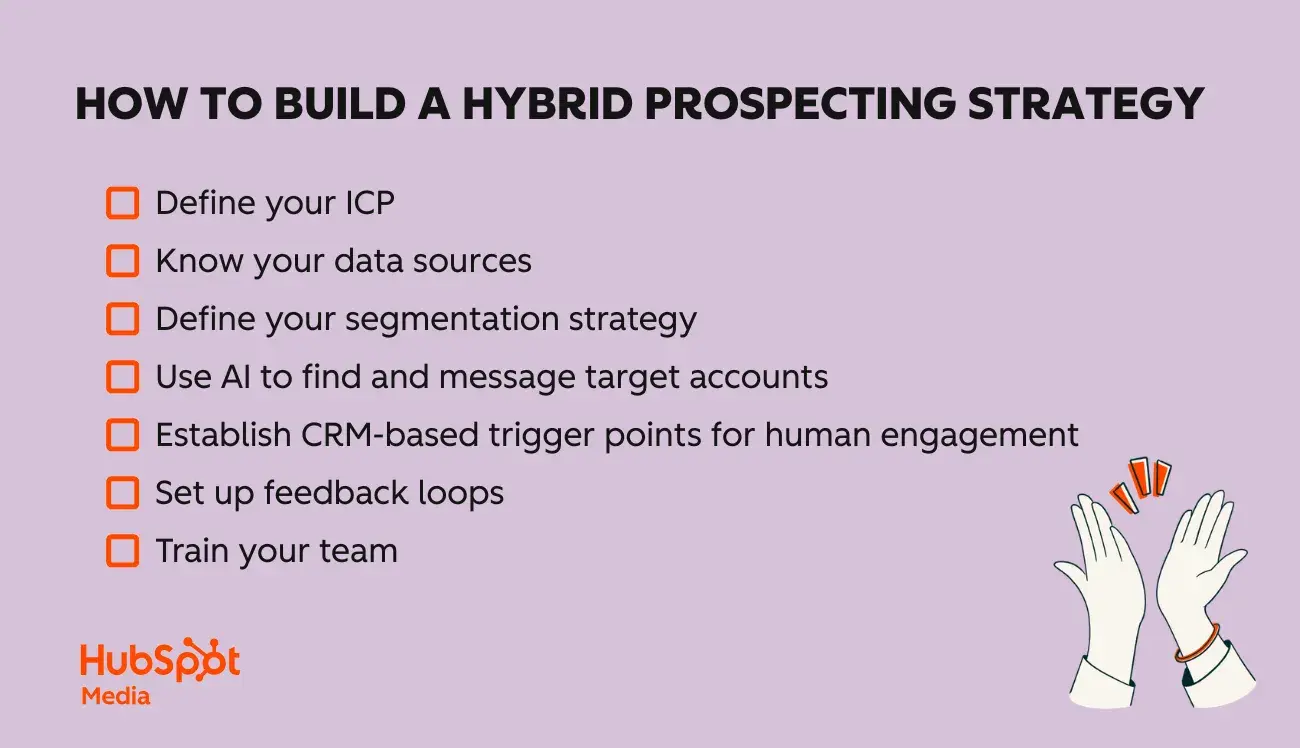
Effective prospecting is not an either-or choice; it is a strategic combination of automated efficiency and human expertise. A hybrid model ensures that your team uses AI as a tool to handle high-volume tasks while reserving human energy for the moments that demand empathy and critical judgment. Building this strategy requires aligning machine learning with human learning, treating your AI system like a high-potential team member that requires clear guardrails and ongoing coaching. The goal is to create a seamless workflow where technology and human intelligence complement each other, maximizing the strengths of both.
Defining Your Ideal Customer Profile
Before deploying AI, you must clearly define your ideal customer profile (ICP) based on current pipeline intelligence rather than outdated historical data. Ask yourself which deals move the fastest and who serves as an internal champion. By training your model on these specific attributes, you ensure that the AI focuses on the right opportunities. A well-defined ICP prevents the common issue of feeding AI tools overly broad criteria that dilute the quality of your lead list. It is essential to regularly review and update your ICP as market conditions change and your product evolves. This ensures that your AI prospecting efforts remain aligned with your business goals and that you are targeting prospects who are most likely to benefit from your solution. Additionally, segmenting your ICP into different buyer personas can help tailor your messaging and outreach strategies to address the specific needs and concerns of each group.
Implementing the Human-Check Layer
Even the most advanced AI models benefit from human oversight. Before any automated list goes live, it is prudent to apply a human-check layer to filter out obvious gaps or misalignments. This process ensures that your outreach remains strategic and relevant, preventing the “automation creep” that occurs when accounts are handled solely by technology despite requiring a more nuanced approach. This human-check layer can involve a quick review of the top prospects identified by the AI, ensuring that they meet certain qualitative criteria that the algorithm may not capture. For example, a human reviewer might check for recent news or events that could impact the prospect’s buying decision, or verify that the contact information is accurate and up-to-date. This additional step adds a layer of quality control that enhances the effectiveness of your outreach efforts and helps maintain a positive brand reputation.
Establishing Clear Handoff Triggers
In a hybrid workflow, the transition from AI to human engagement must be explicit. Your CRM should be configured to trigger a handoff when specific conditions are met, such as a direct reply from a prospect, a high engagement score, or a deal value that crosses a certain threshold. This seamless integration allows the AI to manage cold outreach while ensuring that human representatives step in the moment a conversation requires genuine negotiation or relationship building. Defining these handoff triggers clearly is crucial for maintaining a smooth customer experience. Prospects should not feel like they are being passed around between different systems or people. Instead, the transition should be invisible, with the human representative picking up the conversation naturally and building on the groundwork laid by the AI. This requires close collaboration between sales and marketing teams to ensure that the messaging and tone are consistent across all touchpoints.
Fostering Feedback Loops
AI prospecting requires continuous improvement based on field performance. If sales representatives frequently ignore suggested leads, this should be treated as a data problem that needs correction. By building mechanisms for reps to flag misalignments and rate lead quality, you refine the model over time and prevent the reinforcement of biases. Training your team to understand both the capabilities and the limitations of these tools is essential to maintaining trust and ensuring high adoption rates. Regular feedback sessions can help identify areas where the AI is underperforming or where the data needs to be updated. For example, if reps consistently report that certain leads are not a good fit, this information can be used to adjust the ICP or refine the lead scoring model. By treating AI as a learning system that improves over time, you can ensure that it remains a valuable asset to your sales team.
Operationalizing Your Prospecting Tasks
To effectively divide labor between AI and human representatives, it is helpful to categorize tasks based on the level of judgment required. While AI provides the speed necessary to maintain a consistent presence in the market, human expertise is required to turn that presence into lasting business relationships. This operationalization involves mapping out the entire prospecting journey and identifying which steps can be automated and which require human intervention.
Research and Discovery
AI systems should handle the bulk of initial discovery, including identifying target companies and gathering firmographic data. This leaves human representatives free to focus on strategic context, such as competitive positioning and organizational priorities. By automating the research workload, you allow your team to spend their time on the high-value activities that AI cannot perform. This includes analyzing the prospect’s business challenges, understanding their industry trends, and identifying potential pain points that your solution can address. Human researchers can also leverage their network and industry knowledge to uncover insights that are not available through public data sources. This deep understanding of the prospect’s context enables sales representatives to craft more compelling and relevant messaging that resonates with the prospect’s specific needs.
Personalization and Drafting
AI excels at generating initial message drafts that incorporate prospect-specific details. However, these drafts should always be treated as a starting point. Humans must refine the tone to match the brand voice and verify that the value proposition aligns with the prospect’s unique needs. This ensures that while you maintain scale, you do not sacrifice the quality and authenticity of your communication. The human touch in personalization goes beyond simply inserting the prospect’s name or company into a template. It involves crafting a narrative that speaks directly to the prospect’s pain points and demonstrates a genuine understanding of their business. This level of customization requires creativity and empathy, skills that are uniquely human. By combining AI-generated drafts with human refinement, sales teams can achieve a balance of efficiency and personalization that drives higher engagement and conversion rates.
Follow-Up and Meeting Preparation
Routine follow-up tasks, such as sending reminders or sharing resources, are ideal candidates for automation. Conversely, follow-up for active opportunities and high-value accounts should remain under human management. Similarly, AI can generate helpful briefing materials for meetings, but human representatives should review and enhance these documents with their own strategic insights before entering the conversation. This ensures that the human representative is fully prepared to address any questions or concerns that may arise during the meeting. AI can provide a summary of the prospect’s previous interactions, key pain points, and potential objections, but the human representative must interpret this information and tailor their approach accordingly. This preparation is critical for building trust and demonstrating expertise, as it shows the prospect that you have taken the time to understand their specific situation.
Ultimately, the goal is to leverage technology to handle the heavy lifting of prospecting without losing the human voice that defines your brand. By thoughtfully integrating AI into your workflow, you create a sustainable model that balances efficiency with the depth of connection required for long-term growth. As the landscape of search and engagement continues to evolve, maintaining this equilibrium will be the key to staying visible and relevant to your audience. Sales teams that embrace this hybrid approach will be better positioned to adapt to changing market conditions and deliver superior results for their organizations.


