Most teams treat Article schema and FAQ schema as a binary choice, forcing a selection for their structured data strategy. This is a false dilemma. Generative AI platforms do not read a single tag and ignore the rest; they extract signals from multiple structured data types simultaneously to build their answers. When you layer these signals, you give AI engines more verification points, directly impacting AI search visibility.

The mechanics of Article schema in generative search
Article schema, often implemented as the BlogPosting type, functions as a priority structured data format for establishing editorial credibility in AI-generated answers. When AI platforms process web content, they rely on specific metadata fields to validate the source’s trustworthiness. Key properties like author, datePublished, and articleSection act as critical signals. These elements help algorithms assess both the authority of the writer and the recency of the information, two factors that heavily influence citation decisions in generative search.
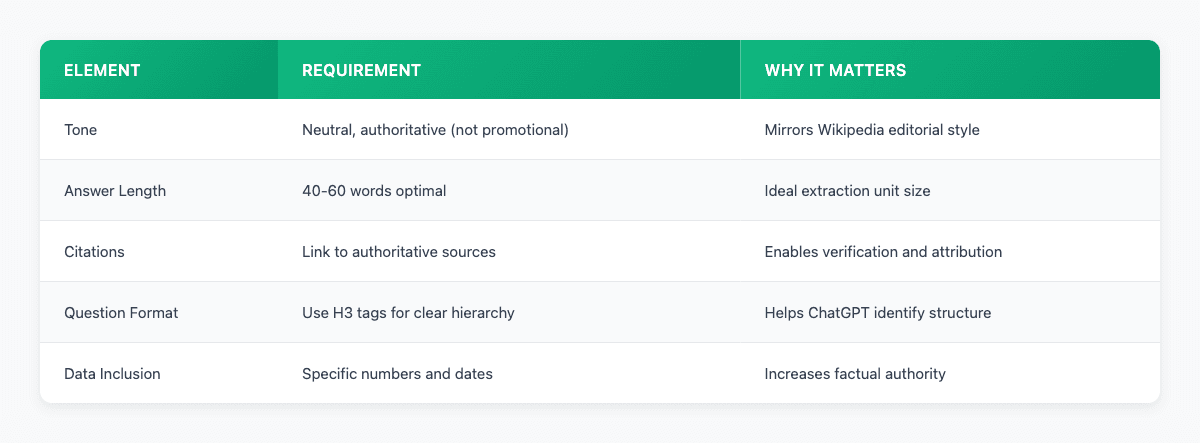
While FAQ schema has specific, documented citation metrics, the implementation details for Article schema discussed here draw from general industry knowledge. This distinction matters when comparing the two. Article schema primarily helps AI verify publication context. By explicitly marking who wrote the piece and when it was published, it reduces the interpretive burden on the language model. This clarity allows AI engines to confirm editorial ownership and distinguish established expertise from anonymous or undated content. In short, while FAQ schema signals extractability, Article schema signals provenance and authority, creating a distinct layer of structured data benefits for AI search visibility.
Why FAQ schema earns a higher citation rate in AI answers
FAQPage schema is recommended as a priority schema type with a high probability of being cited by generative AI systems. This classification stems from the format’s natural alignment with how large language models retrieve and present information. When AI platforms scan for sources, they prioritize structures that match their own output logic.
Format alignment drives extraction confidence
Generative AI engines do not just read text; they parse structure. Research indicates that 78% of AI-generated answers include list formats. This statistic reveals a critical insight: models prefer discrete, list-like data points over continuous narrative blocks. FAQ schema encodes content into precise question-answer pairs, which mirrors the list-based format AI systems naturally produce.
The structure reduces the interpretive burden on Natural Language Processing (NLP) models. In a standard article, an AI must infer where a specific answer begins and ends. With FAQ schema, the boundaries are explicitly defined in the markup. This clarity enables cleaner extraction. When a model can isolate a specific answer without parsing surrounding prose, it cites that source with higher confidence.
Evidence from citation patterns
The preference for structured, encyclopedic formats is visible in current citation data. Wikipedia, a heavily structured encyclopedic source, accounts for 47.9% of total ChatGPT citations. This dominance suggests that AI engines favor sources where information is organized into clear, retrievable units. FAQ schema provides a similar level of organization for web content, making it more accessible to these models than unstructured text.
For pages optimized for AI search visibility, this alignment is a significant advantage. While Article schema signals authority and recency, FAQ schema signals extractability. By matching the internal processing logic of AI platforms, FAQPage markup removes ambiguity from the citation process, leading to more consistent and frequent references in generated answers.
Which structured data type actually gets cited by AI
The question of which structured data type actually gets cited by AI comes down to a distinction between authority and extractability. Article schema signals to search engines who wrote the content and when it was published, providing the metadata needed to verify editorial ownership and recency. FAQ schema, by contrast, signals that the content is formatted for direct extraction, removing the interpretive burden on natural language processing models. While both types play a role in generative AI citations, they solve different parts of the visibility equation.
To understand how these two types operate in practice, consider the specific context in which each performs best. Article schema is best deployed when credibility and temporal relevance are the primary barriers to being selected by an AI engine. FAQ schema is best deployed when the goal is to provide a clean, quotable answer that matches the format of an AI-generated response.
| Attribute | Article Schema | FAQ Schema |
|---|---|---|
| Primary Signal | Authority and Recency | Extractability and Format Alignment |
| Best-Use Context | Editorial content, news, long-form guides | Question-driven content, how-to answers |
| Citation Behavior | Establishes context for trust | Provides the specific text to quote |
Platform preferences also influence which signals are prioritized. ChatGPT tends to favor authoritative structures, benefiting from the combined presence of both Article and FAQ markup to validate source credibility and answer relevance simultaneously. Perplexity places a higher value on practical, direct Q&A formats, making FAQ schema particularly useful for surfacing clear, actionable information. Google AI Overviews lean heavily on E-E-A-T signals, where Article schema provides the necessary context for trust, while also favoring snippet-ready answers that FAQ schema is designed to supply.
The combined approach
Rather than choosing one schema type over the other, the most effective strategy for AI search visibility is to combine both on the same page. AI platforms extract from multiple structured signals simultaneously, meaning they can use Article schema to verify the source and FAQ schema to locate the specific answer. This layered approach maximizes the structured data benefits by addressing both the authority and extractability requirements of different AI engines. By providing these distinct verification points, you ensure your content is ready to be cited regardless of which specific signal the model prioritizes at the moment of retrieval.
Article schema vs FAQ schema: practical questions on AI search visibility
Do you need both schema types on one page?
Yes. Layering Article and FAQ schema gives AI platforms multiple verification points for a single page. This redundancy helps engines confirm both the editorial context and the specific answer they intend to extract, reducing the risk of misinterpretation during generative AI citations.
Which schema should you prioritize if choosing one?
Choose based on your primary citation signal. If your content is question-driven, FAQ schema improves extractability for direct answers. If authority and recency are your main concerns, Article schema provides the metadata needed for AI engines to assess trust and timeliness effectively.
How does combining them affect AI search visibility?
Combining both types addresses the dual needs of authority and extractability. This approach maximizes AI search visibility across major platforms like ChatGPT, Perplexity, and Google AI Overviews by ensuring your content satisfies both structural and contextual verification requirements simultaneously.
What this means for your AI search visibility strategy
Neither schema type is redundant; they solve different parts of the AI citation equation. Article schema establishes authority and recency, while FAQ schema ensures your content is extractable and aligned with how generative AI presents information. The shift from traditional ranking to being directly cited changes how structured data pays off, making layered strategies essential. As AI search adoption grows, combining these signals will become table stakes for maintaining visibility across emerging ecosystems.
The shift from ranking to being cited is quietly rewriting the value of structured data. As generative search becomes a primary channel, the layered approach—combining authority signals with extractable answers—will likely move from an advantage to a baseline expectation. It is worth considering whether the next generation of AI answers will stop distinguishing between an article and a FAQ, collapsing both into a single, fluid context window for the model to read.


