Running a single check in Perplexity gives you a snapshot, not a metric. The moment you rely on that one-off result, you miss the majority of your actual presence in AI-generated answers. Data from an analysis of over 3.8 million citations shows that 76% of brand references appear through implicit citations—mentions buried in third-party sources like Reddit or YouTube—rather than direct links to your domain. A static check often fails to capture this layered visibility.

The problem is compounded by volatility. The average number of sources cited per answer has drifted from 4.0 to 5.0 over a recent nine-month period, meaning the context of your competition shifts constantly. Perplexity citation tracking requires more than a one-time audit; it demands a repeatable process that accounts for how generative engines prioritize different sources week by week. Without this ongoing monitoring, your AI citation share data decays quickly, leaving you to guess whether your visibility is improving or eroding as the model updates its source preferences.
The two lines you must track for AI citation share
When you check your brand on Perplexity, you often see a list of sources. But not all sources tell the same story. In the analyzed dataset, 76% of brand references were implicit, meaning the brand appeared via a third-party site rather than a direct link to its own domain.
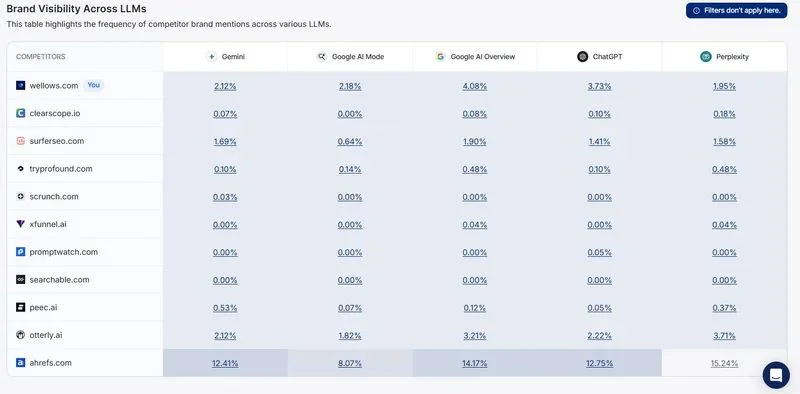
This distinction creates a critical blind spot for teams that only monitor their own website. Perplexity relies heavily on third-party validation, particularly from community-driven platforms. Reddit is the most-cited domain in Perplexity answers, while YouTube and LinkedIn also rank in the top five. If your visibility depends on these platforms but you only track your own domain, you are ignoring the majority of your actual presence.
The direct authority line
Explicit citations represent your direct authority. This occurs when Perplexity links to your domain as the primary source. It signals that the engine views your content as a definitive answer to the query. Tracking this line shows how well your own site performs in isolation. A drop in explicit citations suggests your on-page relevance or content depth may be falling out of favor compared to competitors.
The indirect influence line
Implicit citations represent indirect influence. These happen when a third party, such as a Reddit thread or a YouTube video, mentions your brand, and Perplexity cites that third party. This line captures your reputation in the broader ecosystem. Because 76% of references are implicit, this line often matters more for your total AI citation share. It reflects how well your brand is discussed and validated by others, not just how well your site is written.
To get a complete picture, you must track both lines simultaneously. One measures your direct control over content; the other measures your influence across the web. Only by monitoring both can you accurately assess your Perplexity visibility metrics and identify where your strategy is gaining or losing ground. This dual-track approach is the core of effective generative engine optimization.
Why your Perplexity visibility metrics shift every month
Perplexity visibility metrics fluctuate because the underlying source pool is not static. Over the nine-month tracking window, the average number of sources cited per answer increased from roughly 4.0 to 5.0. This expansion of the citation window means that a brand cited in one month might be crowded out in the next simply because the model chose to include an additional source to support its answer. Volatility is therefore not an error in measurement; it is a feature of how generative models synthesize information. When the denominator of cited sources grows, the share of any single brand within that set can shift even if the absolute quality of the content remains constant.
Another reason for instability lies in the engine’s internal logic. Analysis shows that 89.1% of the sources used by Perplexity for a given question are different from those used by ChatGPT. This high degree of non-overlap proves that visibility is not a universal asset. You cannot assume that a strong presence in one AI engine translates to visibility in another. Perplexity citation tracking must be treated as a discrete metric per platform. If your current workflow aggregates data across multiple models, you are likely averaging out significant variations that hide critical shifts in performance. Each engine has its own preferred sources, weighting algorithms, and update cycles, which means your AI citation share must be tracked independently for each platform to reflect reality.
Separating signal from noise in source prioritization
Recurring checks allow you to distinguish between temporary fluctuations and genuine trends in how the engine prioritizes sources. A single data point is often noise; a series of data points reveals signal. By running the analysis regularly, you can observe whether a brand is consistently gaining ground or simply experiencing a random spike. This distinction is vital for generative engine optimization, as it tells you which strategies are actually influencing the model’s decision-making. If a brand disappears from one run and reappears in the next, it may be a transient issue. If it consistently moves down in citation position, it suggests a structural loss of authority. Tracking these patterns over time converts raw data into actionable insights, allowing you to adjust your content strategy based on how the engine’s behavior evolves rather than reacting to isolated data points.
Building a repeatable workflow to track AI citations
Effective Perplexity citation tracking relies on consistency, not sporadic checks. A single snapshot tells you where you stand today, but only a time-series reveals whether your strategy is actually moving the needle. To build a reliable trend line, you need a structured process that removes guesswork from your data collection. The following four-step workflow ensures your Perplexity visibility metrics reflect true performance rather than random noise.
Step 1: Define an intent-driven query set
Start by constructing a list of queries that mirror how buyers actually search, rather than isolated keywords. If your team only tracks product names, you will miss the broader conversational context where recommendations happen. Instead, focus on questions that reflect purchase intent, such as “best alternatives for [competitor]” or “how to choose [service category].” This set should remain consistent across all runs. Changing the questions mid-cycle breaks the comparison, making it impossible to attribute changes to your efforts versus your methodology. A stable query set is the foundation of any credible tracking exercise.
Step 2: Capture your baseline
Run the full set of queries once to establish your starting point. Record both explicit citations, where your domain is directly linked, and implicit citations, where your brand is mentioned via third-party sources. Given that the majority of brand references appear through indirect channels, ignoring implicit wins creates a blind spot. This baseline is your reference point. Without it, a rise or drop in future data points has no context. It does not matter if your initial score is high or low; what matters is that you have a verified anchor from which to measure change.
Step 3: Schedule recurring checks
Set a recurring cadence, such as weekly or bi-weekly, to run the same query set again. Because the number of sources cited per answer has fluctuated from roughly 4.0 to 5.0 over the recent tracking period, your visibility can shift without any action on your part. Regular runs allow you to distinguish between organic engine updates and the impact of your own content updates. Consistency is key here. If you check monthly, you may miss short-term fluctuations; if you check daily, you may overreact to noise. A weekly rhythm often provides the best balance between effort and insight.
Step 4: Export and analyze trends
Export the results of each run to a CSV file. This simple format allows you to overlay multiple runs in a spreadsheet or data tool. Look for patterns over time. A single data point is meaningless; a trend is informative. For example, if your explicit citation rate stays flat while your implicit mentions grow, your third-party presence is strengthening even if direct authority signals have not shifted. This AI citation share data helps you separate real gains from random variance. By reviewing these exports regularly, you can identify which content updates are driving visibility and which are not, allowing you to refine your generative engine optimization strategy with evidence rather than assumption.
Reading the data to optimize your generative engine optimization
Interpreting the numbers requires looking beyond raw frequency. A drop in citation position, such as moving from slot 2 to slot 4, is not a minor fluctuation. It is a clear signal that your authority signals are weakening relative to competitors. When this happens, reinforce the content that Perplexity previously relied on, ensuring the arguments remain current and the source attribution stays precise. If you track AI citations consistently, these shifts become visible before they impact your overall share.
Sentiment and visibility in the final score
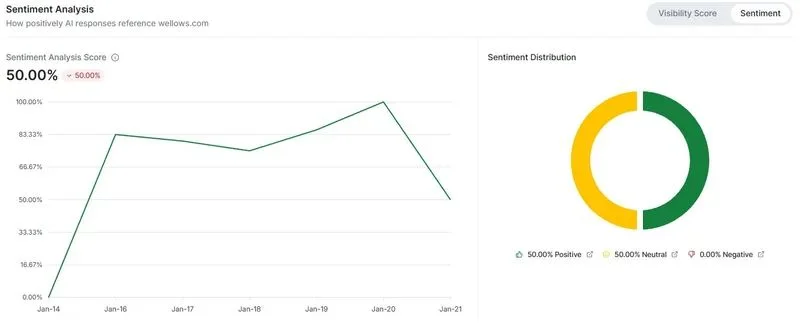
Visibility alone does not tell the full story. In the analyzed dataset, 68.8% of brand mentions carried positive sentiment, while 4% were negative. A neutral score (27.2%) can dilute your impact. Perplexity visibility metrics weigh how the engine presents your brand, not just if it does. If positive mentions decline while citations remain steady, the quality of your content may no longer align with user expectations. Monitor this ratio to ensure your brand is presented as a trusted, positive source rather than just a listed option.
Using gap data to prioritize content
The most actionable insight comes from gap analysis. This identifies queries where competitors are cited but your brand is missing. These gaps reveal specific topics where you lack visibility. Use this data to prioritize your next generative engine optimization cycle. Instead of guessing what content to create, let the data show you exactly where the engine is turning to competitors for answers. Filling these gaps directly increases your AI citation share and strengthens your position in high-intent search results.
Frequently asked questions about Perplexity citation tracking
Does a high Google ranking guarantee a Perplexity citation?
No. The two systems use different source selection criteria. While Google prioritizes traditional authority signals, Perplexity favors community and user-generated content platforms, meaning high SERP rankings do not automatically translate to AI citation share.
How often should you re-run your visibility check?
Because source counts shift over time, a periodic cadence is more effective than a one-off measurement. A weekly check aligns better with the fluctuating nature of Perplexity visibility metrics, ensuring you capture current trends rather than stale data.
What is the most reliable way to see your share over time?
Maintain a time-series of CSV exports that captures both explicit and implicit wins. By tracking AI citations across a consistent set of intent-driven queries, you isolate real progress from random noise in your generative engine optimization efforts.
The practice of monitoring AI visibility is quietly becoming as fundamental as tracking search engine rankings once was. Without a consistent record of your AI citation share, it is difficult to distinguish genuine strategic progress from random algorithmic noise. The core value of this workflow lies in your ability to defend the ROI of your content strategy by proving, over time, that your generative engine optimization efforts are actually working. When you can show clear, data-backed movement in your Perplexity visibility metrics, you shift the conversation from speculation to accountability. This creates a durable foundation for future content investments, ensuring that every decision is grounded in measurable reality rather than guesswork.