Most developers see the speakable property and immediately discard it as a relic of 2018 voice search. They assume it was built solely for Google Home and has no relevance in an era of large language models. That assumption ignores how structured data functions today.

The markup was originally designed to let voice assistants read specific page sections aloud. But in the current landscape of AI search optimization, its role has shifted. It now acts as a clear signal for LLMs, marking which parts of a page are concise enough to be cited in an answer engine. The question is not whether the feature is obsolete, but whether it has quietly become a key component of LLM content markup.
What Speakable Schema Actually Is
Speakable schema is a specific type of Schema.org markup designed to identify sections of a web page that are suitable for text-to-speech conversion. It functions as a signal to search engines, indicating exactly which parts of your content are best for an AI assistant to read aloud to a user. This distinction is critical because it moves beyond general structured data to target specific, short-form excerpts rather than entire articles.
Origins in the Voice Search Era
This markup emerged from a 2018 collaboration between Google and Schema.org, originally built to support voice queries on devices like Google Home. The goal was straightforward: when a user asked a news-related question, the Assistant would read a concise, relevant snippet from a partner site and then send the source link to the user’s mobile device. At the time, this feature was limited to U.S. news sites with English content, reflecting the early stages of smart speaker adoption.
The Beta Status and Current Relevance
The original documentation explicitly noted that the speakable property was in a “beta” status, meaning requirements and policies were subject to change. This caveat is important to keep in mind, as it set the stage for the markup’s evolution. While it started as a niche tool for voice search, its core function—flagging content as extractable and concise—has remained relevant as AI systems have shifted from simply reading text to generating contextual answers.
A Simple Look at the Structure
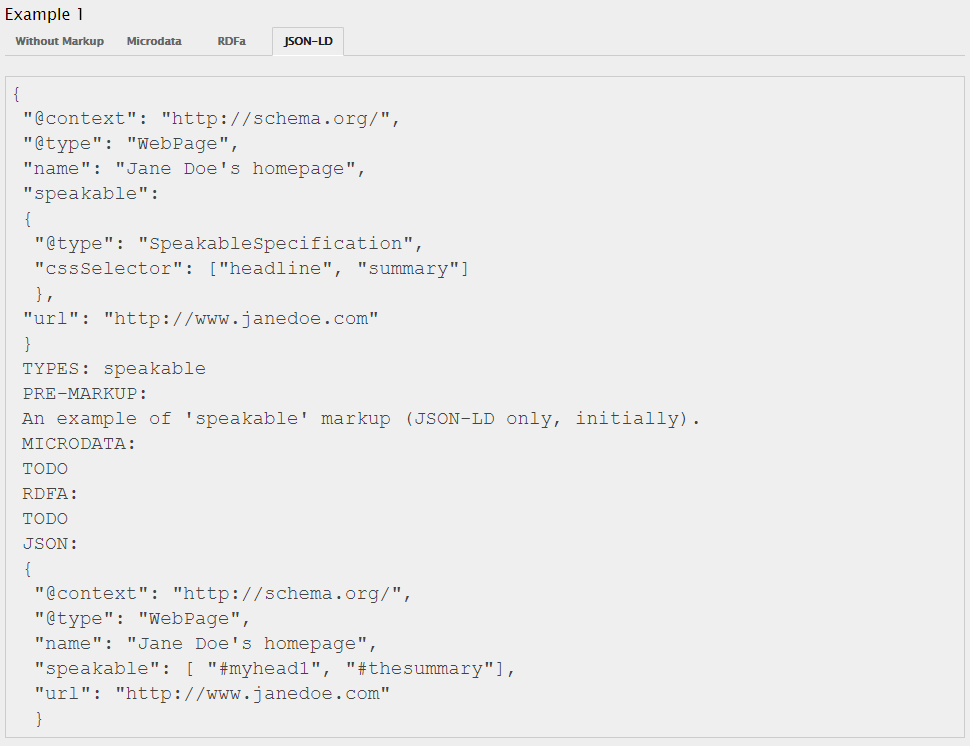
For non-technical readers, the implementation is straightforward. The markup typically uses JSON-LD to specify which elements on a page are speakable. It often relies on XPath expressions to point to specific HTML elements, such as the headline or meta description. This tells the AI engine not just what the page is about, but which part is the most digestible for immediate consumption. The simplicity of this structure is a key reason it remains a foundational element in structured data strategies today.
From Voice Search to LLM Answers
The trajectory of speakable schema has shifted from a niche voice-search tool to a core component of AI search optimization. In 2018, the primary goal was text-to-speech: allowing Google Assistant to read a concise summary of a news article aloud on devices like Google Home. The markup identified specific sections suitable for this immediate, auditory delivery. Today, the context has changed. While the technical definition remains the same, the application has expanded beyond the initial US news beta to influence how large language models process and cite information.
The Shift to Contextual Extraction
Why does a 2018 standard still matter? Because the fundamental need for structured, extractable content has not changed—it has intensified. In the era of LLM content markup, AI engines no longer just need text to read; they need clear signals for what to cite in generated answers. Structured data AI now plays a critical role in helping these models identify the most relevant, concise excerpts from a page. When an AI engine answers a user query, it relies on these defined boundaries to extract accurate information without hallucinating or grabbing irrelevant boilerplate. The speakable property acts as a high-priority signal that a specific section is the most direct answer to a question, making it more likely to be included in an AI-generated response.
Dispelling the “News Only” Myth
A persistent misconception is that speakable schema is limited to news organizations in the United States. While the original 2018 documentation restricted the feature to US news sites with English content for Google Home, this constraint does not define the markup’s utility in 2026. The underlying mechanism—identifying sections appropriate for rapid consumption and extraction—applies broadly. Whether you are publishing a how-to guide, a product specification, or a medical explanation, marking the most “snackable” portion of your content helps AI engines understand the core value of your page. The feature has evolved from a specific voice-command trigger into a general best practice for ensuring your content is easily understood by the next generation of search interfaces.
Speakable Schema in 2026: Practical Guidelines
Implementing speakable schema in 2026 requires a shift in mindset: you are not marking content for a speaker, but for a retrieval engine. The core best practice remains unchanged from the original documentation—keep marked sections under 30 seconds of reading time, use short, declarative sentences, and avoid referencing non-readable elements like images or charts. However, the “why” has changed. AI engines need concise, self-contained answers to cite, not just audio-friendly text.
Selecting “Snackable” Content for Intent
The choice of what to mark matters more than the technical implementation. “Snackable” content means a specific, high-value answer to a user query, not just the first few lines of an article. If a user asks, “What is the refund policy for Plan B?”, mark that specific policy paragraph. If they ask about pricing, mark the pricing tier description. This aligns your structured data AI strategy with user intent, ensuring the AI model extracts the exact information needed for its answer generation.
Speakable as Part of a Larger Schema Ecosystem
A common misconception is that speakable schema replaces other types of structured data. It does not. Speakable complements, but does not replace, other structured data types like Article, Product, or FAQ. For AI search optimization, a page needs a full schema 2026 profile: the Article schema tells the AI what the page is, while the speakable property tells it what specific part is the best answer to cite. Without the broader context, the LLM content markup lacks the entity context needed for accurate retrieval.
The Shift from Voice to AI Answers
The table below illustrates how the role of this markup has evolved from a 2018 voice-search feature to a 2026 AI-answer component.
| Feature Aspect | 2018 Use Case (Voice Search) | 2026 Use Case (AI Answers) |
|---|---|---|
| Primary Output | Text-to-speech audio | Cited text in AI-generated answers |
| Content Focus | News headlines and summaries | Specific answers to long-tail queries |
| Technical Goal | Audio clarity and pace | Contextual relevance and extractability |
| Device Target | Google Home, smart speakers | LLMs and generative search engines |
Frequently Asked Questions About Speakable Schema
Is Speakable schema still supported by Google in 2026?
Yes, the markup remains valid and functional. While the original documentation labeled the feature as “beta,” its role has expanded significantly in 2026. It is no longer just a tool for voice assistants on smart speakers; it has become a key component of LLM content markup. AI answer engines now recognize these structured data signals to identify extractable, concise sections. The transition from a beta voice feature to a stable element in AI search optimization means that implementing speakable schema continues to provide clear benefits for content visibility.
Does Speakable schema affect local search rankings?
Speakable schema does not directly manipulate traditional local map pack rankings. Its primary function is to influence voice searches and AI-generated answer snippets. However, it does contribute to how search engines understand your business as an entity. By providing clear, concise sections that AI models can easily process and cite, you improve the overall quality of structured data associated with your brand. This indirect influence on entity understanding can support your broader local SEO efforts, even if it does not change your position in the map pack directly.
Can I use Speakable schema for non-news content?
Yes, the 2026 context applies well beyond news articles. Originally designed for US news sites, the schema is now useful for any content type where AI answers benefit from clear, short, and extractable sections. Whether you are publishing how-to guides, product information, or service descriptions, marking the most “snackable” parts of your content helps AI engines identify what to cite. The key is not the content category, but the clarity and conciseness of the marked sections, ensuring they align with how modern AI models process and retrieve information for users.
Conclusion
The true value of speakable schema in 2026 is not in making Google Assistant read your page aloud, but in ensuring AI models have clear, concise signals for what to cite when they answer user questions. As search shifts toward AI-generated answers, the markup serves as a direct invitation to LLMs: this section is the answer. It is the difference between a paragraph that gets lost in a model’s context window and one that gets extracted, quoted, and shown to a user who is actively seeking a solution. We no longer write for a voice engine waiting for a command; we write for an AI engine parsing intent. The goal is to make your content ‘extractable’—a self-contained block of high-signal information that requires no surrounding context to make sense. Consider auditing your own pages not for readability, but for citability. If a model could not pull a single, definitive answer from your top section, you are leaving visibility on the table in the era of AI search.


