Most developers assume that when an AI chatbot answers a question, it is actively scanning the web for fresh data in real time. That assumption misses how the pipeline actually works. Large language models do not read JSON-LD or parse live HTML while generating a response. Instead, they rely on pre-processed information or data captured during earlier crawl cycles.

This distinction is critical for anyone managing AI search structured data. If you believe the LLM is “seeing” your schema markup at the moment of the query, you may be optimizing for a mechanism that does not exist. The reality is that AI search engines depend on two distinct paths for data ingestion, both of which require your structured data to be accessible and valid before the user ever types their prompt.
Two Paths: Knowledge Graphs vs. Live Crawlers
Understanding how AI search structured data functions requires looking past the chat interface. The system you interact with does not operate as a single monolith; it relies on two distinct consumption paths that handle your information differently.
The Pre-Processed Knowledge Graph
The first path is indirect. Projects like Web Data Commons extract structured data from the web in bulk, long before you type your question. This data feeds into massive knowledge graphs. When an LLM synthesizes an answer, it references these pre-processed facts. In this scenario, your AI SEO schema is a passive feed. It is not read during the conversation; it is a static input that was consumed days or weeks ago. If your data is not in the graph, the model simply doesn’t have that specific factual reference point at query time.
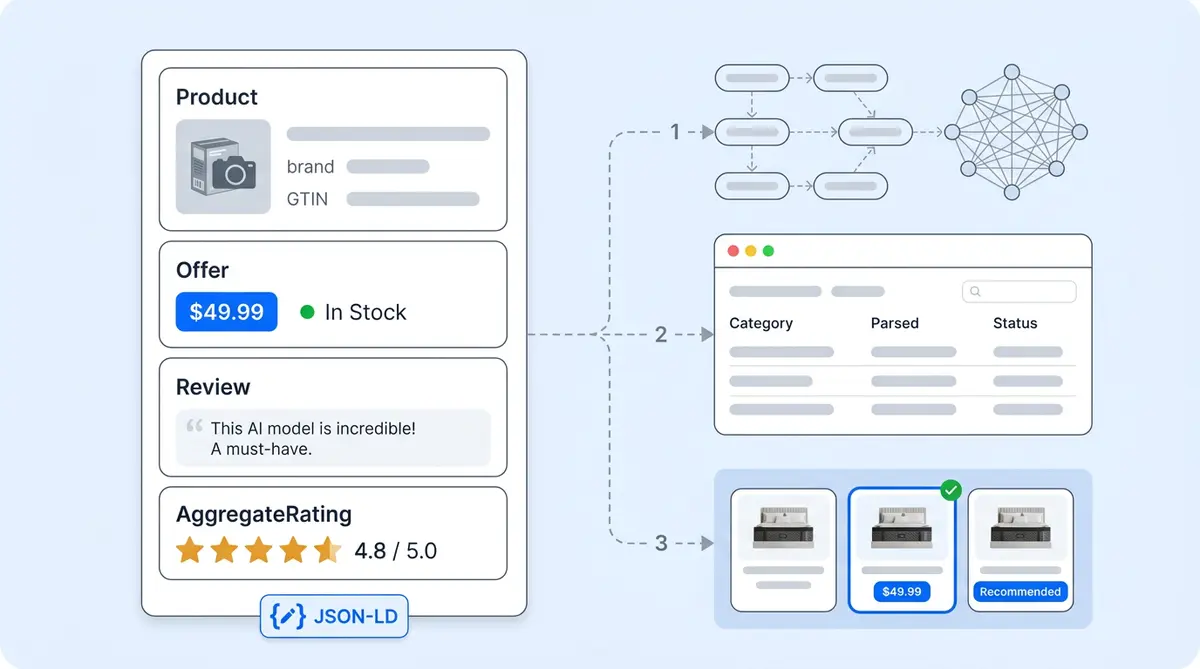
The Real-Time Crawl Extraction
The second path is active and immediate. AI search crawlers, such as OAI-SearchBot and PerplexityBot, actively pull data from pages in real-time. Unlike the static graph, this process treats your website as a live data source. When these bots encounter a page, they extract structured data directly from the markup. This makes JSON-LD for AI a live extraction target rather than a passive feed.
The distinction between these two paths is critical. One requires your data to be already indexed in a centralized database, while the other relies on the bot successfully parsing your HTML at the exact moment it visits your site. Relying solely on knowledge graph inclusion leaves you at the mercy of batch processing schedules. Relying solely on live crawlers makes you vulnerable to parsing errors or blocking rules during the crawl itself. A strong strategy for generative AI data must account for both: ensuring your structured data is clean enough for live extraction and consistent enough to be ingested into background knowledge bases.
Why AI Engines Prefer JSON-LD for Schema Interpretation
The dominance of JSON-LD in AI search structured data is a technical inevitability. Recent data shows that JSON-LD holds an 89.4% market share among structured data implementations, while Microdata accounts for just 8.1%.
This disparity exists because JSON-LD is designed for decoupling. When you embed JSON-LD in a script tag, the structured data lives independently of the Document Object Model (DOM). For LLM schema interpretation pipelines, this separation is critical. AI crawlers can parse the payload as standalone JSON without executing JavaScript or traversing complex HTML structures. In contrast, Microdata requires the parser to walk through the HTML tree, matching attributes and entities, which introduces friction and potential for error in automated extraction systems.

This technical simplicity has observable consequences in crawler behavior. Researchers have noted that AI bots, such as OAI-SearchBot and PerplexityBot, crawl JSON data more frequently than HTML. This suggests that AI engines prioritize clean, machine-readable formats during their index creation process. By treating JSON-LD as a primary data source, these systems ensure that the factual claims extracted for knowledge graphs or real-time retrieval are consistent and reliable.
For businesses, this means the format of your AI SEO schema matters as much as the content itself. If your structured data is embedded in a way that forces the crawler to reconstruct context from the page layout, you are working against the natural preference of modern AI indexing infrastructure. The shift toward JSON-LD reflects a broader industry consensus: the most efficient way to feed generative AI data is to provide it in a format that requires minimal interpretive overhead.
Server-Side Rendering for AI Data Accuracy
The most common technical failure point in implementing JSON-LD for AI is relying on client-side rendering to inject structured data into the DOM. Many e-commerce sites generate their schema dynamically using JavaScript after the page loads. While this works for human users who wait for hydration, it creates a blind spot for automated agents. Google’s documentation explicitly states that “Googlebot for Shopping often does not wait for JavaScript execution.” If your AI search structured data is injected via a script after the initial HTML response, many crawlers will simply ignore it.
The Operational Advantage of Server-Side Generation
To ensure AI engines schema markup is actually visible to bots, the data must be present in the initial HTML payload. The most reliable approach is to generate your JSON-LD server-side, pulling directly from your product or content database during the request cycle. This method guarantees that the structured data is baked into the raw HTML response before any client-side scripts run. It eliminates the race condition between the crawler’s timeout window and your JavaScript execution.
For high-volume catalogs, this might feel like a performance overhead, but the trade-off is necessary. You exchange a millisecond of server processing time for the certainty that your generative AI data is legible. Without this server-side presence, your AI SEO schema may be technically valid but practically invisible to the systems driving modern search answers.
Verifying Bot Access in robots.txt
Even with perfect server-side rendering, your data remains inaccessible if your robots.txt file explicitly blocks AI-specific crawlers. Historically, many sites blocked all bots to save server resources or protect content, but the ecosystem has changed. You need to audit your robots.txt to ensure it allows access for specific agents like GPTBot and PerplexityBot. If these user-agents are listed under a Disallow rule, your server-side rendered JSON-LD will never be ingested, regardless of its quality. A quick audit can reveal if you are inadvertently opting out of AI search visibility simply because of a legacy line in your configuration file.
Does AI Schema Markup Change the SEO Landscape?
It is a common misconception that adding JSON-LD directly boosts your position in search results. The format itself is not a ranking factor for AI search engines. However, its readability and accuracy determine whether AI platforms can extract and cite your data. In traditional SEO, the goal is to earn rich snippets that entice a human user to click. With AI search structured data, the objective shifts entirely toward machine readability. This allows Large Language Models to synthesize your information into accurate answers and citations without needing a user to visit the page first.
The Cost of Being Invisible to Machines
If AI crawlers cannot parse your structured data, your page effectively disappears from the AI answer space. This is a significant shift from the old model of losing a click to gaining a snippet. When data is missing or malformed, AI-generated comparisons and recommendations simply exclude your brand. For business decision-makers, this means that even if your content is high-quality, it remains irrelevant to the billions of queries processed by AI assistants daily. The value of clean markup is no longer just about visibility; it is about inclusion in the factual foundation of the answer.
Clarifying the Role of AI SEO Schema
Does the lack of real-time parsing mean that schema markup is obsolete? The answer is no. The two distinct paths of AI consumption—knowledge graphs and crawl-time extraction—both rely heavily on clean, server-side rendered data. AI engines schema markup serves as the bridge between your website and the structured data pipelines that feed these systems. Since AI crawlers often process JSON data more frequently than raw HTML, the precision of your JSON-LD becomes the primary determinant of your brand’s reliability in the eyes of an LLM. In this new landscape, your structured data is not just a technical hygiene task; it is the core source material for how AI platforms perceive and represent your business.
What This Means for Your Generative AI Data Strategy
The objective of schema markup has shifted. It is no longer about earning a rich snippet in a grid of blue links. The goal is now ensuring your data is parsable across knowledge graphs, AI crawlers, and emerging shopping agents simultaneously. Think of structured data as the single source of truth for multiple machine audiences rather than a display format for one search engine.
Consider the revenue impact. AI search traffic converts at a rate of 14.2%, compared to just 2.8% for traditional Google organic search. This makes data completeness a direct revenue driver, not just a technical hygiene task. When a user arrives via an AI assistant, they are already primed by the synthesized answer. If your data is missing or invalid, you lose that high-intent visitor before they even land on your site.
Remember that the LLM does not read your data during the conversation. The infrastructure behind the AI answer relies entirely on the quality and accessibility of the structured data you publish. The model synthesizes its response based on pre-processed knowledge graphs and live crawl data. If your JSON-LD is hidden behind JavaScript or contains schema errors, the machine simply cannot use it, regardless of how well your copy reads to a human.
The shift toward AI search structured data represents a fundamental change in how visibility is earned. While a user sees a synthesized, conversational answer, the machine behind it remains heavily dependent on the specific structured data you choose to expose. This dependency spans two distinct consumption paths: pre-processed knowledge graphs and live crawler extraction. Your current data architecture must be ready to serve both simultaneously, ensuring that whether an LLM references your brand from a static knowledge graph or extracts it in real time, the underlying facts are consistent, complete, and accessible. Is your current data architecture prepared to support these two distinct paths of AI consumption?


