When evaluating Scrunch vs Semrush, the core decision revolves around your current operational needs: are you seeking a dedicated, specialized platform for monitoring AI visibility, or do you require a broader SEO suite that has expanded its capabilities to include generative search? Scrunch operates as a specialist in answer engine optimization, focusing on how your brand appears within AI-generated responses. Semrush, conversely, provides a comprehensive SEO platform that integrates AI visibility tools alongside traditional rank tracking, backlink analysis, and keyword research. Understanding this distinction between a specialist tool and an all-in-one suite is essential for determining which approach aligns with your team’s size, technical requirements, and strategic goals.
Understanding the Core Differences in AI Visibility
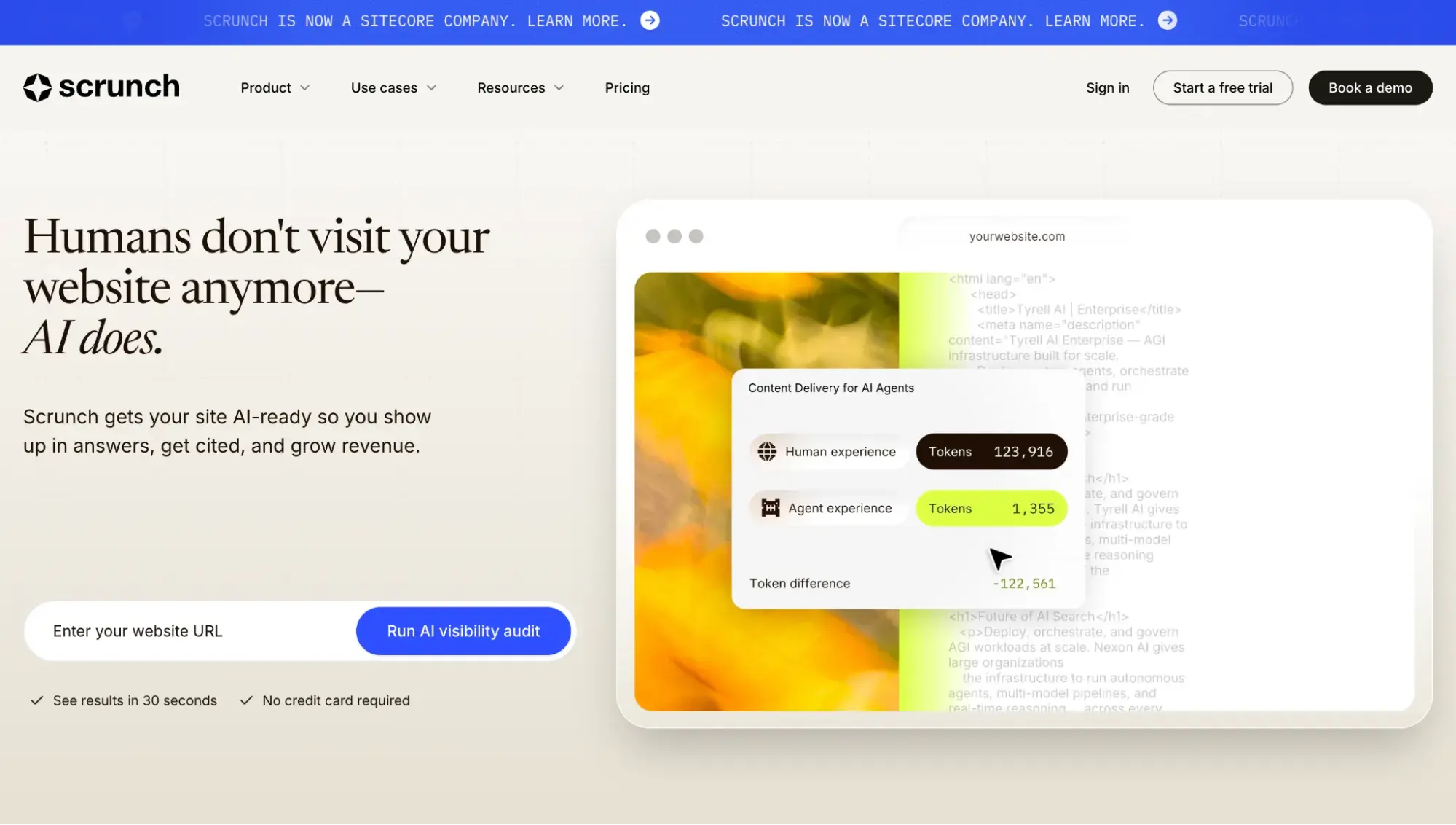
Scrunch is positioned as an AI customer experience platform, concentrating on monitoring brand presence, sentiment, and share of voice across multiple answer engines. Its primary value lies in its depth of focus on AI-generated citations and prompt-level tracking. By design, Scrunch functions as an additive layer to an existing marketing stack rather than a replacement for traditional search tools. For teams already deeply invested in SEO, Scrunch offers a concentrated view of how their brand is being represented in the new era of generative search.
Semrush serves as a brand visibility management platform that spans SEO, content marketing, and paid media. Its AI Visibility Toolkit is integrated into this larger ecosystem, allowing marketers to manage their traditional search presence and their answer engine visibility from a single interface. The platform utilizes its extensive database of search queries to estimate demand for topic clusters, bridging the gap between traditional keyword research and AI-specific prompt optimization. This integration is particularly useful for teams looking to consolidate their tools into a unified workflow, as it allows for easier context-switching between site audits and AI answer monitoring.
Why AI Visibility Matters
The shift toward generative search means that users are increasingly finding answers directly within the interface of tools like ChatGPT or Perplexity, rather than clicking through to a website. This change creates a new set of metrics for brand visibility. If your brand is not being cited in these responses, you are effectively invisible to a growing segment of the search population. Understanding whether your brand appears as a primary source or a footnote is critical for long-term digital growth.
Assessing Your Current Baseline
For those evaluating their current standing, it is helpful to establish a baseline. You can assess how your brand is represented in AI answers by using resources like the AI Search Grader, which helps identify visibility gaps. This objective look at your data allows you to choose a tool based on your specific performance metrics rather than generic feature sets. Both platforms offer distinct paths for managing this visibility, and neither claims to replace the necessity of a sound SEO strategy.
Evaluating Pricing and Total Cost of Ownership
Cost structures for these platforms reflect their differing philosophies on tool integration. Scrunch offers its AI visibility monitoring as a standalone subscription, which simplifies the decision for teams that only need this specific functionality. Its pricing tiers are structured around brand workspaces, seats, and the number of prompts tracked, providing a clear path for scaling as your requirements grow. Because it does not bundle SEO tools, the total cost of ownership is tied directly to your need for specialized AI answer monitoring.
Semrush utilizes a more modular pricing model. Users can subscribe to their classic SEO tools and add the AI Visibility Toolkit as a separate subscription, or they can opt for bundled plans like Semrush One that include both. This flexibility is advantageous for teams that already rely on Semrush for their daily SEO tasks. However, it is important to calculate the total cost by accounting for additional seats, brand performance domains, and any needed prompt tracking upgrades.
Factors Influencing Your Budget
When evaluating these platforms, consider the following cost factors:
- Seat count and user permissions: How many team members need access to the data?
- Number of brand domains requiring monitoring: Scaling across multiple websites can change the pricing tier.
- Total prompt tracking volume: High-frequency monitoring of competitive keywords increases costs.
- The value of bundling: Compare the price of a standalone specialist tool against the cost of upgrading an existing suite.
Practical Steps for Cost Comparison
To determine the best financial fit, start by listing your current SEO tool costs. If you already pay for a suite, inquire about the incremental cost of adding AI visibility modules. If you are starting fresh, map out your required prompt volume for the next six months. Often, the hidden cost of a tool is the time spent managing it; choose the platform that minimizes the time your team spends toggling between different dashboards.
Monitoring Coverage and Optimization Workflows
Monitoring capabilities for AI visibility often serve as the primary differentiator for decision-makers. Scrunch monitors up to nine answer engines on its Enterprise plan, including ChatGPT, Claude, Perplexity, Gemini, Meta AI, Google AI Mode, AI Overviews, Microsoft Copilot, and Grok. It focuses on topic-level volume, providing insights into clusters of related prompts and benchmarking competitors on citation frequency and sentiment. This data is designed to be easily exported to analytics platforms like Looker Studio or GA4, facilitating a data-driven approach to content updates.
Semrush also tracks multiple engines, with its self-serve plans covering five key platforms: Google AI Mode, AI Overviews, ChatGPT, Perplexity, and Gemini. Its Enterprise-level tier expands this to nine, adding Claude, Microsoft Copilot, Grok, and DeepSeek. The primary advantage of the Semrush workflow is its integration with the broader Content Toolkit. Once a topic gap is identified, users can often transition directly into drafting content within the same platform. This reduces friction in the production cycle, though it necessitates a commitment to the Semrush ecosystem.
The Execution Loop
Effective answer engine optimization is, at its core, a process of auditing, updating, and re-measuring. Regardless of the tool chosen, the execution loop remains consistent. You identify where your brand is absent or under-represented, create or update content to fill that gap, and then monitor for improvements over the subsequent weeks. While tools provide the insights and the briefs, the actual content creation and management often benefit from a dedicated content operations platform to keep the process moving efficiently.
Common Mistakes to Avoid
A common error is treating AI visibility as a “set and forget” task. Because answer engines update their algorithms and training data regularly, a high citation rate today does not guarantee the same tomorrow. Avoid focusing solely on vanity metrics like total mentions; instead, prioritize the quality of the citations and the sentiment associated with your brand. Ensure your team has a regular cadence for reviewing AI-generated performance data.
Managing Content Delivery and AEO Risks
Content delivery strategies differ significantly between these platforms, particularly regarding how they handle bot-facing versions of your site. Scrunch’s Enterprise plan includes an Agent Experience Platform, which can serve a simplified version of a page to AI bots while maintaining a standard experience for human visitors. While this approach is designed to improve visibility, it is a sophisticated technical move that requires careful management to ensure it aligns with your overall site governance and search engine compliance. It is essential to distinguish this from practices that could be flagged as deceptive; the goal is always to improve the quality of the information provided to the assistant.
Semrush does not offer a separate bot-serving layer, opting instead to optimize the live, user-facing page for both humans and machines. This approach avoids the complexities of maintaining multiple versions of a single page, which some teams prefer to minimize potential duplicate content risks. By focusing on structured data, clear headings, and factual specificity, you can ensure your content remains highly readable for users while being easily parsed and extracted by answer engines. This strategy reinforces the importance of high-quality, authoritative content as the foundation for visibility in any search environment.
Best Practices for Content Structure
To ensure your content is optimized for answer engines without taking unnecessary risks, consider these structural practices:
- Lead with a direct, concise answer to the query at the beginning of the content.
- Use H2 and H3 headings that match the specific phrasing of common user questions.
- Maintain consistent entity naming for your brand, products, and executives across all digital touchpoints.
- Provide clear attribution and links to external sources to support your claims.
- Ensure each paragraph is self-contained and provides value independently of the rest of the page.
Why Structure Matters
AI models function by parsing text to identify the most relevant answer to a user’s prompt. When your content is structured with clear, logical hierarchies, it becomes significantly easier for these models to extract your information. Avoid long, rambling introductions; instead, get straight to the facts. By providing a “source of truth” on your own website, you increase the likelihood that an AI will cite your content as the authoritative answer.
Choosing the Right Fit for Your Team
Selecting a tool for answer engine optimization should be guided by your specific team structure and existing technology stack. If your organization operates with a mature SEO program and you want to layer on specialized AI-answer monitoring, Scrunch offers a focused solution that complements your existing work. It is particularly effective for agencies managing multiple brands or teams that prioritize a human-in-the-loop model for content decisions.
Conversely, if your team prefers to centralize operations, Semrush provides a robust environment where SEO and AI visibility insights coexist. It is well-suited for teams that want to manage rank tracking, site audits, and answer engine optimization from a single login. When making your final decision, evaluate your goals using the following considerations:
| Your Primary Goal | Recommended Approach |
|---|---|
| Deep SEO integration with AEO | Semrush |
| Specialized, standalone AI monitoring | Scrunch |
| Managing multiple brands/workspaces | Scrunch (Agency Core) |
| Automated content recommendations | Semrush |
| Advanced bot-serving delivery | Scrunch (Enterprise) |
| Unified analytics and reporting | Semrush |
Making the Final Decision
Ultimately, the value of either platform is realized through the actions you take after receiving the data. Whether you choose a specialized tool or an integrated suite, the objective remains the same: to ensure your brand is accurately and authoritatively represented in the generative search results that your audience relies on. By focusing on clear, factual, and well-structured content, you build a sustainable foundation for visibility that persists regardless of which monitoring tool you use. Take the time to run a trial of both platforms if possible, as the user interface and reporting style will often be the deciding factor for your daily operations.


