On This Page· 5
A parent misses the August 10 application cutoff because the school’s AI assistant repeated last year’s date. This is not a glitch; it is the predictable outcome of serving static information through a dynamic interface. Ensuring school deadline accuracy requires an operational audit, not a marketing fix. The issue stems from a misalignment between how data is stored and how it is retrieved. When an AI agent relies on a cached brochure or a hardcoded string, it becomes a liability. The solution involves shifting from static text to live data. This article outlines a systems-first approach to maintaining accurate, auto-updating info for admission cycles.
System of record: where school deadline accuracy actually starts
This structural flaw means school deadline accuracy depends entirely on the AI agent’s information source. Relying on static webpages or PDF brochures guarantees outdated answers, as these sources change manually and inconsistently, creating a gap between published dates and actual deadlines. Without a direct link to live operational data, the chatbot functions merely as a text generator, not a data engine.
The anchor for reliable, auto-updating info is the system of record—typically the Student Information System (SIS) or Enterprise Resource Planning (ERP) platform. As the single source of truth for dates, fees, and requirements, a direct connection allows the AI to retrieve current deadlines in real time, whereas disconnection forces it to guess based on stale training data.
It is crucial to distinguish the internal AI assistant, which draws from the school’s integrated stack, from external generative search engines that rely on this internal data being clean and accessible; while both suffer if the system of record is inconsistent, only the internal agent can be directly controlled by the school’s IT infrastructure.

Live integration: connecting the AI agent to SIS and ERP
The technical foundation of this system is a direct, real-time link to the school’s core infrastructure. Rather than relying on static text, the AI agent connects to Student Information Systems (SIS), ERP, transport databases, and payment gateways. This architecture allows the assistant to fetch live data for every interaction. It is no longer a text generator; it is a data engine.
Consider a specific scenario. A parent asks, “When is the application deadline?” In a standard setup, the model might guess based on training data, risking a stale answer. Here, the query triggers a direct database lookup. The system pulls the current date from the SIS, ensuring the “Aug 10” answer is always accurate. This mechanism is what preserves school deadline accuracy at the point of contact. The answer is not a stored string; it is a live query result, which is the essence of auto-updating info.
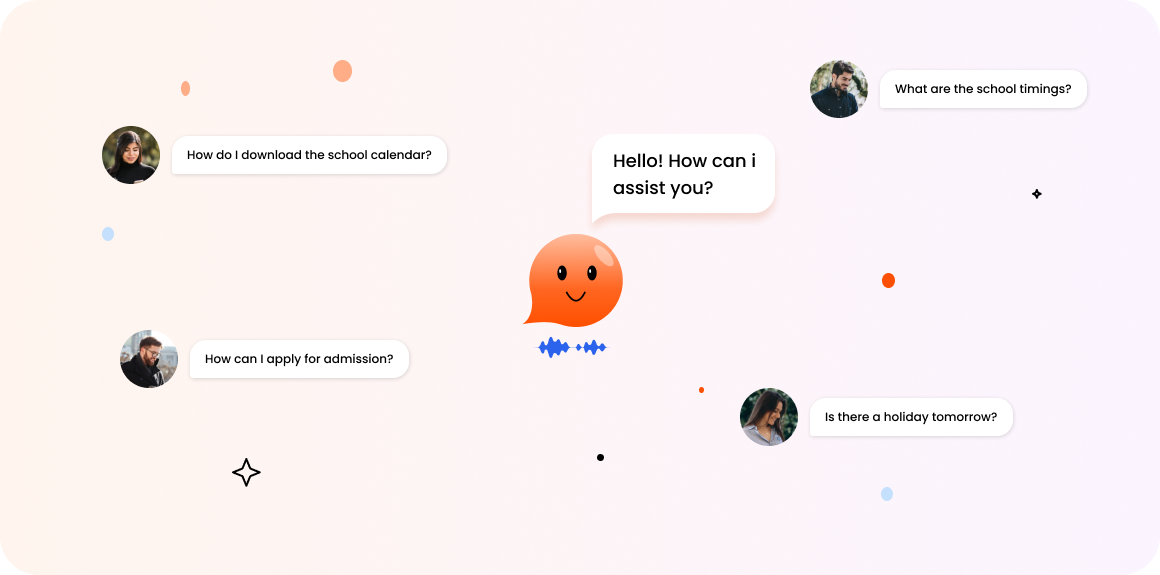
This live connection enables a level of service a static bot cannot match. The assistant can send contextual reminders, such as, “Your application is incomplete, and the deadline is in 3 days.” This proactive communication transforms the tool from a basic FAQ bot into a digital front desk that manages actual service actions. By integrating with these systems, the school ensures that the AI provides dynamic AI content that reflects the current operational reality, not historical data.
Per-cycle refresh: automating dynamic AI content for admission cycles
When a new admission cycle begins, the system of record updates the dates, and the AI agent automatically inherits these changes. There is no manual reprogramming, no copy-paste errors, and no risk of a “stale date” slipping through. This is the core of the per-cycle refresh mechanism.

The traditional method involved manually updating web pages and retraining bots after each cycle—a process that is error-prone and often leads to outdated information. In contrast, dynamic AI content is generated from live data. The answer to a query is a real-time database lookup, not a stored string. This ensures the information is always current by design.
This automation is critical for maintaining school deadline accuracy across multiple campuses or grade levels. Since deadlines often differ between locations and programs, a static bot will inevitably give incorrect answers. A live connection ensures every query returns the precise, up-to-date date for the specific context, eliminating the risk of mismatched information for parents and students.
Verification and monitoring: proving the AI answers stay current
Building the connection is only half the battle. To ensure school deadline accuracy holds up over time, you need a routine that actively tests the system. A common benchmark suggests 99%+ response accuracy, but that figure is a target to verify, not a guarantee. Without ongoing checks, data drift can occur between the SIS and the AI’s output, leading to subtle errors that go unnoticed until a parent complains.
We recommend a simple weekly spot-check. Pick 5–10 common deadline queries and ask the AI assistant to answer them. Then, manually verify those answers against the live SIS data. This quick audit catches any mismatches before they become issues for families.
It is also worth distinguishing this internal verification from external AEO education monitoring. Your internal system is under your direct control, while external sources like Google or ChatGPT depend on indexing and generative search freshness. By keeping your internal data clean and verified, you create a stable foundation for accurate answers across all channels.
Does a live integration actually reduce parent inquiries?
Schools often hesitate to adopt AI, wondering if it truly cuts administrative load or just adds complexity. Data suggests it works, but the effect is specific.
| Metric | Reported Outcome | Source |
|---|---|---|
| Call and email volume | Up to 60% reduction | Streebo Benchmarks |
| Parent satisfaction | 42% improvement | Education Technology Insights |
The mechanism is query deflection. Most parent inquiries are low-complexity questions about “when” and “where.” An AI agent connected to live data answers these instantly, removing the need for humans to repeat standard information. This clears inbox backlogs and keeps phone lines available for issues requiring judgment.
However, these figures come from vendor benchmarks, not industry-wide standards. Schools should treat them as a reasonable upper bound rather than a guaranteed outcome. Actual reduction depends on the initial volume of repetitive queries and the quality of integrated data.
The real value extends beyond fewer calls. A static bot cannot handle complex, multi-step requests. For example, changing a bus route and paying the fee involves multiple backend systems. Only an agent with live integration can process this end-to-end, offering a capability no static document repository can provide.
The shift from static information to live operational data is the real unlock for schools using AI responsibly. When an assistant answers from a database rather than a brochure, it becomes a service layer. That distinction determines whether your school’s digital presence scales with its complexity or collapses under it.
Consider the difference between a fixed date on a webpage and a dynamic query result. The former requires manual intervention every time a cycle changes; the latter inherits updates automatically. For institutions managing multiple campuses, this automation is the only way to maintain consistent school deadline accuracy without introducing human error.
If your AI assistant is still giving out last year’s dates, ask yourself a simple question: is it a tool, or a liability? The answer depends entirely on what happens behind the interface. A model that can hallucinate a deadline is a risk. A system that queries a verified source of truth is an asset.