AI search optimization is the practice of refining content so that generative answer engines—such as ChatGPT, Perplexity, and Google AI Overviews—can accurately identify, cite, and recommend your brand. By prioritizing machine-readable clarity and expert-backed credibility, you ensure that your brand remains a trusted source in an era where users increasingly turn to AI for answers. This process is distinct from traditional SEO, focusing on how models interpret and retrieve information rather than just ranking URLs. It requires a fundamental shift in how content is structured, authored, and distributed to meet the specific technical and semantic requirements of large language models.
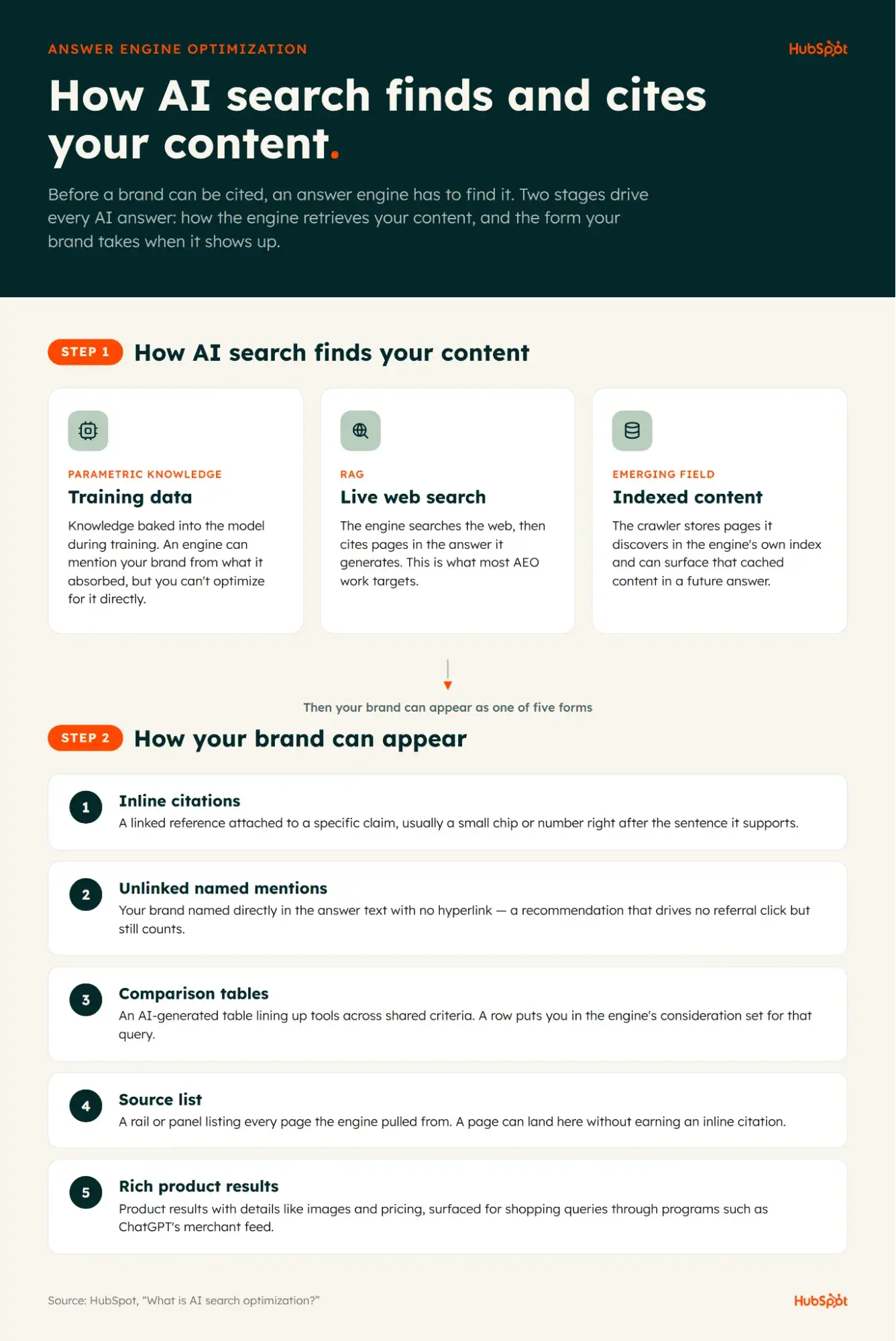
This graphic illustrates the three primary pathways AI engines use to retrieve information: training data, live web retrieval, and indexed content, all of which represent opportunities for your brand to gain visibility. Understanding these pathways is crucial because each requires a different strategic approach to ensure your brand is recognized as an authoritative source.
Understanding the Strategic Value of AI Search Optimization
AI search optimization is fundamentally about controlling the narrative your brand projects within automated environments. While traditional search engine optimization aims to drive clicks to a specific landing page, AI search optimization focuses on securing your brand’s presence within the answer itself. This distinction is vital because even when a user does not click through to your website, being named as a recommended solution builds authority and brand recognition. In many cases, the AI engine serves as the final decision-maker for the user, synthesizing information from multiple sources to provide a definitive recommendation. If your brand is absent from this synthesis, you are effectively invisible to the user, regardless of your traditional search rankings.
Traffic originating from AI-driven sources often demonstrates higher intent than standard web traffic. Because users engage with these engines through complex, multi-turn conversations, they often arrive at your site having already been pre-qualified by the AI’s contextual understanding of their needs. The user has already articulated their problem, received a tailored solution, and been directed to your brand as the provider of that solution. Although AI-referred traffic currently represents a smaller percentage of total visits compared to organic search, its impact on conversion rates is disproportionately high, making it a critical area for long-term growth. Brands that fail to optimize for this channel risk losing high-value customers to competitors who are better positioned within the AI’s knowledge graph.
We define this practice as a complementary discipline to SEO. While SEO remains the bedrock of web discovery, AI search optimization acts as the bridge to the next generation of knowledge retrieval. By ensuring that your expertise is accessible to these models, you are effectively future-proofing your digital presence against the shift toward conversational interfaces. This is not about replacing SEO but enhancing it. The foundational elements of SEO, such as keyword relevance and technical health, remain important, but they must now be layered with semantic clarity and entity authority to satisfy the more sophisticated requirements of AI models.
The Shift from Clicks to Citations
The core metric of success is changing from click-through rate to citation rate. In traditional SEO, the goal is to get the user to click on your link. In AI search optimization, the goal is to get the AI to cite your content as a source of truth. This shift requires a different mindset. Content must be written not just for human readability, but for machine extractability. This means using clear, concise language, avoiding ambiguous phrasing, and structuring information in a way that allows the AI to easily identify key facts, statistics, and recommendations.
The Mechanics of AI Citation and Retrieval
Answer engines function by synthesizing vast amounts of information into coherent, natural-language responses. To earn a citation, your content must be structured in a way that the model can easily extract and verify. This is achieved through three primary mechanisms: parametric knowledge, live web search, and indexed content. Each requires a different approach to content creation and distribution. Parametric knowledge refers to information that the model has learned during its training phase. Live web search, or Retrieval-Augmented Generation (RAG), involves the model searching the live web for recent or specific information. Indexed content refers to data that has been specifically structured and made available to the model through APIs or other direct integrations.
How Engines Surface Your Brand
Brands appear in AI results through several distinct formats. Understanding these allows you to tailor your content strategy accordingly:
- Inline Citations: Specific links attached to claims, providing direct proof of your expertise. These are the most valuable form of citation, as they provide a direct path for the user to explore your content further.
- Unlinked Mentions: Direct brand references that build entity authority, even without a direct click. These mentions help establish your brand as a recognized entity within the AI’s knowledge graph, increasing the likelihood of future citations.
- Comparison Tables: Structured summaries that position your offering alongside competitors based on specific features or use cases. These tables are highly effective for commercial queries, as they allow users to quickly compare options and make informed decisions.
- Source Lists: Curated panels that list all contributors to a generated answer, even if your site is not cited inline. Being included in a source list signals to the user that your content was considered relevant, even if it was not the primary source for the final answer.
- Rich Product Results: Detailed snippets for shopping queries that include pricing, availability, and ratings. These results are crucial for e-commerce brands, as they provide immediate, actionable information to the user.
Consistency is the key to mastering these signals. When your brand identity remains uniform across your own platforms and third-party review sites, it strengthens the engine’s ability to recognize you as an authoritative entity. This consistency reduces the friction for the AI model to trust your content during the retrieval process. Discrepancies in brand name, logo, or key messaging can confuse the model and reduce the likelihood of citation.
Optimizing Content for Machine Clarity
To effectively optimize for AI search, you must prioritize the structure and verifiability of your information. Engines favor content that answers a query directly and provides supporting data or expert context. This requires moving away from traditional marketing preambles and toward a more precise, semantic style of writing. The AI model needs to be able to quickly identify the core answer to a question, along with any supporting evidence or context. This means using clear headings, bullet points, and concise paragraphs to break down complex information into digestible chunks.
Practical Steps for Formatting
Start by addressing the implied question immediately. Use clear subject-predicate-object structures to ensure the AI can parse your answer without ambiguity. By providing the core information first, you make it significantly easier for an engine to lift your content as a definitive source. Avoid burying the lead in lengthy introductions or marketing fluff. The AI model is designed to extract specific pieces of information, and it will struggle to do so if that information is obscured by unnecessary text.
Beyond structure, you must invest in building off-page signals. Research indicates that engines frequently cross-reference content with external platforms like YouTube and Reddit. Maintaining an active, credible presence on these sites provides the validation engines need to trust your primary content. When your brand is mentioned positively on third-party platforms, it reinforces your authority and increases the likelihood that the AI will cite your content. Furthermore, ensure that your authors are clearly identified with professional bios that detail their experience and credentials, as engines are increasingly sensitive to E-E-A-T signals. Demonstrating expertise, experience, authoritativeness, and trustworthiness is crucial for earning citations in competitive niches.
Technical Foundations for AI Readiness
Technical structure provides the scaffolding for AI understanding. While there is debate regarding the necessity of specific schema, well-implemented markup consistently correlates with better entity mapping. Use semantic HTML to help screen readers and crawlers parse your content hierarchy, and prioritize server-side rendering to ensure that your pages are fully visible to crawlers that cannot execute complex JavaScript. AI models rely on clean, structured data to extract information accurately. If your content is buried in complex JavaScript or poorly structured HTML, the model may struggle to parse it correctly.
| Feature | Traditional SEO Focus | AI Search Optimization Focus |
|---|---|---|
| Goal | Driving a click | Earning a citation |
| Content Format | Whole page ranking | Passage retrieval |
| Primary Signal | Backlinks | Entity authority & mentions |
| Interaction | Keyword-based | Conversational prompts |
Measuring Success and Avoiding Common Pitfalls
Success in this space is measured differently than in traditional search. Instead of focusing solely on organic traffic, you must track brand sentiment, share of voice within generated answers, and the accuracy of the information provided by the AI. Utilizing dedicated diagnostic tools can provide a baseline for how your brand is currently represented and help you identify gaps in your visibility. These tools can simulate AI queries and analyze the resulting answers to determine whether your brand is being cited, mentioned, or ignored.
Tactics to Avoid
Some common practices can be counterproductive. For instance, do not create machine-specific files like llms.txt, as they are largely ignored by major engines and can potentially be interpreted as cloaking. Cloaking is a technique where different content is shown to search engines and users, and it is strictly prohibited by most search engines. Creating files specifically for AI models can be seen as an attempt to manipulate the system, which can result in penalties or de-indexing. Similarly, avoid artificially fragmenting your content into tiny, disjointed paragraphs. A well-structured, logical flow remains the most effective way to satisfy both human readers and AI models. Content that is broken up into overly short paragraphs can appear choppy and difficult to read, which may reduce its perceived quality.
Scaled, unoriginal content is another significant risk. Engines are designed to prioritize unique insights, proprietary data, and first-hand expertise. If your content merely recycles existing information, you provide no value for the engine to cite. Focus your resources on creating content that offers a perspective or data point that cannot be found elsewhere. This could include original research, case studies, expert interviews, or unique product data. By providing unique value, you increase the likelihood that the AI will cite your content as a primary source.
Future-Proofing Your Strategy
As AI agents evolve from simple answer engines to active participants capable of completing tasks, the importance of structured, machine-interpretable content will only grow. These agents rely on clear, accessible data to perform actions like filling forms or initiating purchases. By maintaining clean, semantically marked-up pages, you ensure your site is ready for the next phase of AI integration. This means using structured data to define entities, relationships, and actions, making it easier for AI agents to understand and interact with your content.
Engagement with these technologies is not a one-time project but an ongoing commitment to transparency and clarity. By focusing on the fundamentals of authoritative, well-structured content, you position your brand to thrive in a landscape where the quality of your answers defines your visibility. How will your brand’s expertise be translated when the interface is no longer a search bar, but an intelligent agent? The brands that succeed will be those that prioritize clarity, accuracy, and authority in their content, ensuring that they are recognized as trusted sources by both humans and machines. This requires a continuous effort to monitor AI trends, update content strategies, and maintain a strong online presence across multiple platforms.


