In the era of generative search, your digital presence is no longer just a collection of webpages; it is a repository of information that AI models either trust or ignore. When your brand fails to appear in AI-generated answers, it is rarely due to a single algorithm update. Instead, it is usually the result of foundational errors that erode both human trust and machine confidence.
Stop leaving potential traffic on the table. Here are the five strategic mistakes currently costing your brand generative search visibility.
Mistake 1: Ignoring the ‘Trust’ Algorithm (E-E-A-T and AI)
Many brands treat E-E-A-T (Experience, Expertise, Authoritativeness, and Trustworthiness) as a human-only metric. However, LLMs are trained to prioritize high-authority data. When a model aggregates an answer, it assigns a confidence score to potential sources.
If your content lacks verified authorship or clear, expert-backed perspectives, you signal to the model that your brand is an unreliable source. To fix this, ensure your content consistently maps back to established entities. Use structured data to explicitly define authors and organizational credentials, helping the AI correlate your content with known, trusted industry figures.
Mistake 2: Failing to Optimize for Machine Readability and Conversational Intent
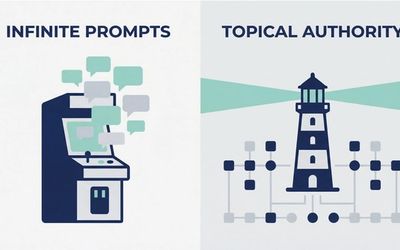
The shift from keyword-stuffing to topical authority is complete. While older strategies focused on hitting specific term frequencies, generative engines look for semantic clarity. If your content is dense, verbose, or relies on jargon that lacks clear context, it becomes difficult for a machine to ingest and synthesize into a concise answer.
Structure your content to mimic conversational inquiry. Use clear, direct phrasing that answers common industry questions in the opening paragraph. By providing “answer-ready” segments—short, high-value explanations—you make it significantly easier for AI models to extract and cite your information as the definitive source.
Mistake 3: Neglecting User Experience (UX) as an AI Ranking Signal
AI models track engagement metrics like dwell time and bounce rates as proxy “truth” indicators. If a human visitor reaches your site and immediately leaves because the page is slow or difficult to navigate, the AI learns that your content is not a satisfying solution.
Core Web Vitals are more than just a ranking factor; they are a prerequisite for being classified as “helpful content.” Balancing technical speed with high-value information is essential. A fast, clean, and intuitive experience validates the AI’s decision to recommend your site to its users.
Mistake 4: Disjointed Entity and Schema Strategy
Your digital footprint must tell a single, coherent story. Many brands suffer from siloed information, where different landing pages, blog posts, and service descriptions exist in isolation. When schema markup is inconsistent or missing, you make it impossible for search bots to synthesize your brand identity.
Implement a unified schema strategy that connects your pages. Use sameAs tags to link your website, social profiles, and industry directories. By creating these explicit semantic bridges, you allow AI crawlers to construct a comprehensive “knowledge graph” of your entity, cementing your authority in your specific niche.
Mistake 5: Treating Crawler Access as a Technicality, Not a Strategy
Blocking AI crawlers like GPTBot or CCBot is a common, often accidental, act of self-sabotage. If you do not allow these agents to index your content, you are opting out of the generative search ecosystem entirely.
Prioritize your crawl budget by ensuring that high-authority, fact-dense pages are easily accessible to AI bots. Moving beyond basic robots.txt management means actively managing how these crawlers view your site. If the AI cannot “see” your most important assets, it cannot leverage them when generating answers for your target audience.
From Audit to Authority: Next Steps for AI-Ready Content
Correcting these visibility mistakes requires a shift from sporadic updates to an automated content strategy. Start by auditing your current entity schema and simplifying your answer-phrasing.
- Audit your entity data: Ensure consistent branding across all digital touchpoints.
- Refine for clarity: Rewrite key landing page headers to answer specific user questions directly.
- Monitor engagement: Optimize for Core Web Vitals to improve signal-based authority.
- Automate consistency: Use scalable platforms like AEO/GEO to ensure your schema and content structure remain optimized as the search landscape evolves.
Building an AI-ready presence is a continuous process of proving your authority—one that rewards those who prioritize machine-readable trust alongside human value.