An answer engine optimization (AEO) audit is a structured process for measuring whether, and how, a brand appears inside answer engines like ChatGPT, Gemini, and Perplexity. Unlike traditional search engine optimization (SEO) audits that track blue-link rankings, an AEO audit evaluates a brand’s visibility inside AI-generated answers. This includes whether the brand is cited, how often it appears, how accurately it is described, and which sources AI systems use to support those responses. Buyers are increasingly turning to AI tools for direct recommendations, making this the new measurement layer for digital strategy.
The significance of this audit lies in the shift of user behavior toward conversational interfaces. When a user asks a question, they expect a single, consolidated answer rather than a list of ten links. If your brand is not the source of that answer, you are effectively invisible to that user. An AEO audit identifies the gaps in your content strategy that prevent you from being the authoritative source for your industry’s most critical questions.
Understanding the Core Differences Between SEO and AEO
The marketing landscape has changed because the way buyers find information has fundamentally shifted. Rather than scanning through traditional search results, decision-makers now ask AI models for specific answers. This transition from search-driven discovery to answer-driven discovery means the primary question is no longer where a brand ranks, but whether it is being cited and recommended in AI responses.
| Feature | Traditional SEO Audit | AEO Audit |
|---|---|---|
| Core focus | Rankings, crawlability, technical health | Visibility inside AI-generated answers |
| Primary question | Where do we rank in results? | Are we cited in AI answers? |
| Data sources | Search engines, crawlers | AI models like ChatGPT, Gemini, Perplexity |
| Key metrics | Keyword rankings, organic traffic | Citation presence, answer accuracy |
Why This Distinction Matters
Traditional SEO focuses on the mechanics of getting a page to load and getting a link clicked. AEO focuses on the mechanics of information synthesis. Because AI models aggregate data from multiple sources to create a response, your content must be optimized for machine comprehension. You are no longer competing just for a click; you are competing to be the factual basis of a user’s decision.
The Dynamic Nature of AI
An AEO audit is an ongoing operational requirement rather than a one-time project. AI models are retrained, competitors publish new content, and answer engines refresh their logic continuously. Consequently, a brand that appears in a citation today might disappear next month if its content drifts out of the engine’s extraction range. Maintaining visibility requires a consistent cadence of auditing and content refinement.
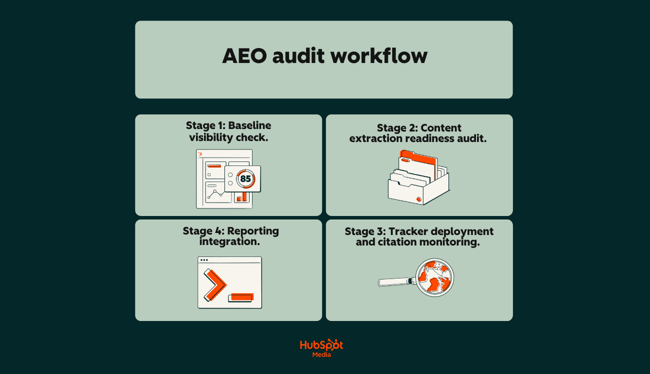
Establishing a Baseline Visibility Check
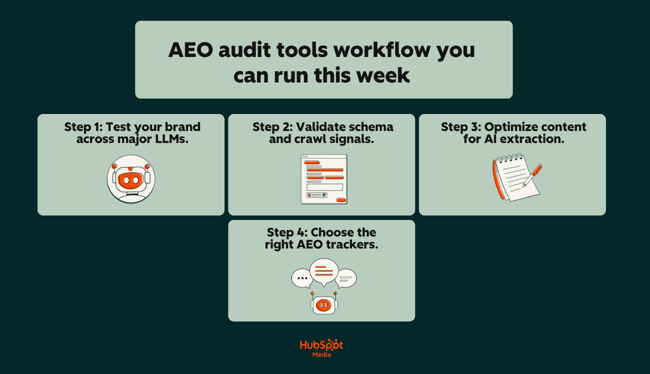
Before you invest in specialized software, you need to understand your current standing. A baseline visibility check involves querying your brand across major AI platforms to see where you appear and where you are absent. You can start this by selecting 15 to 20 high-intent queries that your brand should own, such as category-specific questions or direct comparisons with competitors.
How to Conduct a Baseline Audit
- Identify your core product queries.
- Manually input these into ChatGPT, Gemini, and Perplexity.
- Record the presence of your brand in the generated response.
- Note the tone and accuracy of the mention.
- Identify which competitors are being suggested in your stead.
For each query, document whether your brand is mentioned, whether the citation is accurate, and which competitors appear in your place. Scoring these queries on a simple scale—such as absent, mentioned but inaccurate, or cited as a primary recommendation—provides a clear scorecard. This data helps you decide whether to focus on content reformatting or if you require advanced tracking tools to bridge the visibility gap.
Validating Technical Readiness and Crawl Signals
AI models can only cite content they can access and parse effectively. Your technical audit should begin by ensuring your robots.txt file does not block AI-specific crawlers like GPTBot or Google-Extended. A single misconfiguration here can remove your site from an entire category of AI search surfaces.
The Role of Structured Data
Next, validate your structured data using tools like Google’s Rich Results Test. Ensuring that FAQ, HowTo, Product, and Article schema types are present and error-free provides AI models with explicit signals for extraction. When you provide schema, you are essentially giving the AI a map of your content, making it significantly easier for the model to identify your brand as a relevant authority on a specific topic.
Managing Crawl Depth
Finally, check your crawl depth. Pages buried deep within your site architecture are less likely to be surfaced in AI answers, as crawlers prioritize content that is easily reachable from the homepage. Ensure your most important content is linked internally with descriptive anchor text, which helps the AI understand the context of the page before it even begins the extraction process.
Optimizing Content for AI Extraction
Visibility and crawl access are only effective if your content is structured in a way that AI systems can process. AI-extraction-ready content typically features answer-first intros, Q&A blocks, and comparison tables. If your page begins with a lengthy narrative or brand story, the model may extract an answer from a competitor’s page that leads with a direct, concise response instead.
Practical Steps for Content Structuring
- Answer-first intros: Ensure the first paragraph directly addresses the primary query.
- Q&A blocks: Include explicitly formatted modules that mirror the questions your audience asks.
- Comparison tables: Use structured tables for category and versus queries, as models favor this format for comparisons.
- Definitive language: Use clear, unambiguous statements about your products or services to help models extract accurate information.
Why Structure Wins
AI models are designed to summarize. When you provide information in a modular, easy-to-parse format, you reduce the cognitive load on the AI. By using clear headings, bullet points, and concise sentences, you make it easier for the model to identify your content as the “correct” answer to a user’s prompt. This is the essence of AI content extraction.
Scaling Your AEO Workflow
Once you have validated your baseline and optimized your content, you can implement a recurring monitoring system. AEO audit tools are most effective when they are integrated into a quarterly review cycle. This allows you to track citation share, brand accuracy, and assisted sessions over time, providing a clearer picture of how AI visibility contributes to your overall marketing pipeline.
Common Pitfalls to Avoid
- Tool-first buying: Never purchase software before understanding your baseline visibility. If your content is not ready for extraction, no tool will provide meaningful data.
- Single-engine focus: Do not rely on one AI platform for your audit. Each engine uses different data sources and citation logic, creating blind spots if you do not monitor multiple platforms.
- Missing attribution: Ensure your AEO data can be connected to your CRM or analytics platform. Without this link, it is difficult to demonstrate the business impact of your AI visibility strategy.
Building a Long-Term Strategy
To sustain your AI search visibility, you must treat your content as a living asset. Regularly revisit your high-performing pages to ensure they still align with the latest AI model tendencies. If a competitor starts appearing in your place, analyze their page structure and language. Use this information to refine your own content, ensuring you remain the most relevant and accurate source for your audience. By focusing on these core areas, you can develop a sustainable approach to AI engine optimization. The goal is to move beyond simple rankings and ensure your brand remains a trusted, visible authority in the rapidly evolving landscape of generative search.


