AI Overviews represent a fundamental shift in how search engines deliver information, transforming the SERP from a list of blue links into a synthesis of direct answers. For businesses, this change can feel disruptive, yet it mirrors the evolution we saw years ago with the introduction of featured snippets. While the landscape of search is changing, the core principles of building authority and providing value remain the bedrock of success in this new environment.
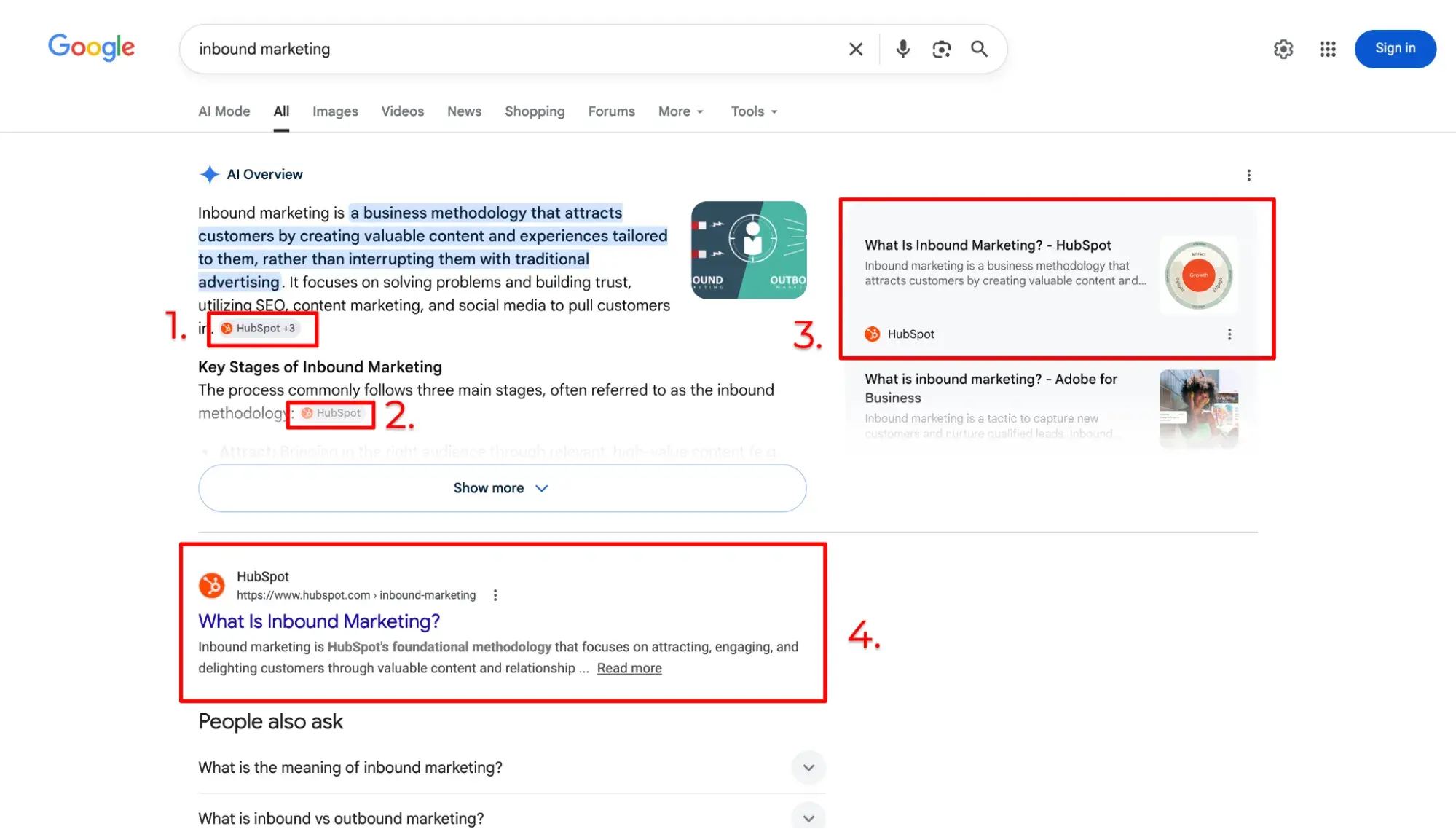
AI Overviews are AI-generated summaries displayed at the top of Google search results, providing concise answers synthesized from multiple web sources. These summaries often include images, links to cited websites, and a “show more” feature for those seeking deeper context. When a brand is cited within these overviews, it gains significant visibility, potentially appearing as an in-line citation, a clickable snippet, or alongside traditional organic results. This allows a brand to occupy more surface area on the page than ever before.
It is important to distinguish these summaries from Google’s conversational AI Mode. While AI Overviews provide a quick, one-shot answer, AI Mode functions as a persistent chatbot experience where users can engage in multi-turn conversations. Our focus here is on the impact of the standard AI Overview, which directly influences the initial search experience and the subsequent flow of traffic to your digital properties.
The Evolution of Search Perception
The transition toward generative search models changes the psychology of the searcher. Users are increasingly conditioned to expect immediate, summarized responses rather than conducting their own research across multiple tabs. This shift means that brands must prioritize being the source of truth that the AI model selects to summarize.
Why Search Traffic Patterns Are Shifting
AI Overviews often satisfy a user’s intent immediately, which can lead to a decrease in clicks to external websites. This trend towards zero-click searches means that traditional metrics, such as raw traffic volume, may no longer tell the full story of your brand’s performance. As searchers find their answers directly within the result page, the value of a single click is being supplemented by the value of brand presence and authority.
Research indicates that outbound organic clicks for queries triggering AI Overviews have seen a notable decline as zero-click interactions become more common. This shift requires a change in perspective: success is increasingly measured by brand visibility, mentions, and the ability to influence a potential customer even when they do not visit your site. By establishing your brand as a trusted source of information, you ensure that your expertise is recognized by the AI models powering these search experiences.
The Disconnect Between Clicks and Value
Many marketing teams are currently struggling to justify the ROI of organic search when click-through rates drop. However, the visibility gained through an AI citation acts as a form of high-level brand awareness. Even without a click, the user is exposed to your brand name, your domain, and your specific answer to their query, which builds long-term mental availability.
Adapting to the New Metric Reality
Moving forward, teams should look at “assisted conversions” and “brand lift” as key indicators of success. When your brand appears consistently in AI-generated summaries, you are effectively training the search engine to associate your domain with specific topical authority, which can lead to better performance across all search channels over time.
Understanding the Triggers for AI Overviews
Not every search query results in an AI Overview. Understanding the specific types of searches that trigger these summaries helps you prioritize which topics to address within your content strategy. The triggers generally fall into several distinct categories that mirror the informational needs of the user.
Informational and Question-Based Queries
Informational intent remains the primary driver for AI Overviews. Users looking to learn or understand a concept are the most likely to be served an AI-generated summary. This includes queries phrased as questions, particularly those starting with “what,” “how,” or “is.” By proactively answering these fundamental questions within your content, you align your brand with the needs of the searcher.
Specialized Industries and Long-Tail Searches
Topics related to science, health, and societal issues frequently trigger AI Overviews, as these fields often have clear, consensus-driven answers that AI models can synthesize effectively. Additionally, longer, more complex queries—those containing seven or more words—are more likely to trigger an AI Overview. These long-tail searches often represent specific, nuanced questions where a synthesized summary provides the most utility to the user.
Identifying High-Value Triggers
To identify which queries are most likely to trigger an AI Overview, look for search terms that have a high volume of “informational” intent. Use your existing keyword research tools to filter for questions. If a query currently displays a “People Also Ask” box, it is a prime candidate for an AI Overview transformation.
Avoiding Common Missteps
A common mistake is trying to force AI Overviews for transactional or navigational queries. If a user is searching for your login page or a specific product model, the AI is unlikely to generate a summary. Focus your AEO efforts on the educational stage of the customer journey, where the AI is designed to provide value.
Non-Branded vs. Branded Search Intent
Non-branded queries are significantly more likely to trigger an AI Overview than searches for a specific brand name. This makes sense from a user perspective: someone searching for a general category is looking for information or evaluation, while someone searching for a specific brand is usually looking for a navigation point. Your strategy should focus on capturing the informational intent of category-based searches to build visibility before a user has even decided on a brand.
Strategies for Earning Citations in AI Overviews
To be considered for an AI Overview, your site must first be technically healthy and accessible to search crawlers. Beyond these basics, you can implement specific practices to increase the likelihood that your content is selected as a source. The goal is to provide clear, high-quality information that is easy for AI models to parse and verify.
Prioritize Informative Content and FAQ Sections
Informative articles and blog posts are among the most frequently cited content types. To enhance your visibility, consider incorporating FAQ sections into your pages. By using clear headings and structuring questions in a way that directly addresses user queries, you make your content more attractive for inclusion in an AI-generated summary. Structured data, such as schema markup, can further assist in communicating the relevance of your content to search engines.
The Role of Clear, Concise Formatting
AI models prioritize content that is easy to extract. Use bullet points, numbered lists, and short, declarative sentences. Avoid long, rambling paragraphs that make it difficult for the model to isolate the core answer. If you have a complex topic, break it down into a series of smaller, distinct sections with descriptive H2 or H3 tags.
Building Authority Through EEAT Signals
Google’s emphasis on Experience, Expertise, Authoritativeness, and Trustworthiness (EEAT) remains highly relevant in the era of AI search. Including author biographies, transparently displaying last-updated dates, and backing your claims with data and statistics can strengthen your site’s profile. These elements provide the signals that AI models use to determine which sources are reliable and worth citing.
Establishing Trust at Scale
Ensure that your site has a clear “About Us” page, verifiable contact information, and citations to reputable external sources. When your content is backed by original research or expert interviews, it becomes significantly more valuable to the AI. This is the essence of modern AEO—creating content that is not just readable for humans, but verifiable for machines.
Leverage Off-Site Presence
Visibility is not confined to your own domain. Platforms like YouTube and Reddit are frequently cited as sources in AI Overviews. Creating video content that addresses “how-to” or “best-of” topics, or participating in relevant discussions where your expertise is shared, can help build the off-site signals that contribute to your overall visibility. This approach broadens your reach and ensures your brand is part of the conversation wherever it happens.
Maintaining Strong SEO Fundamentals
Traditional SEO is not obsolete; it is the foundation upon which your visibility in AI search is built. Pages that rank well in traditional search results are often the same pages that get cited in AI Overviews. By continuing to optimize for search intent, covering subtopics thoroughly, and addressing the breadth of questions your audience asks, you maintain your competitive edge in both traditional and generative search environments.
Measuring Impact Beyond the Click
Because standard reporting tools often aggregate AI-influenced traffic with traditional search traffic, measuring the specific impact of AI Overviews requires a more nuanced approach. Third-party tools that specialize in tracking AI mentions and citations can provide the clarity needed to understand how your brand is performing.
Using Dedicated Tracking Tools
Tools like Ahrefs Brand Radar or Otterly allow you to monitor specific queries, track where your brand appears in AI citations, and analyze the sentiment associated with those mentions. By focusing on metrics like share of voice and citation frequency, you can gain a clearer picture of your brand’s presence in the AI search landscape. This data-driven approach helps you identify gaps in your visibility and refine your strategy accordingly.
Practical Steps for Monitoring
Start by auditing your top 50 informational keywords. Determine which ones currently trigger an AI Overview and track whether your domain is cited. If you are not appearing, analyze the domains that are. Look for commonalities in their structure, the depth of their content, and the clarity of their answers.
Reframing Success for Stakeholders
When discussing these shifts with leadership, it is helpful to frame the conversation around mindshare rather than just click-through rates. If your competitors are also experiencing traffic shifts, the true measure of performance is whether your brand remains the go-to source when potential customers research your category. By winning visibility in AI Overviews, you are establishing authority that converts, often at a higher rate than traditional traffic, as users who engage with high-quality AI-synthesized answers are often further along in their decision-making process.
Communicating Value Beyond Traffic
Focus your reporting on “visibility share.” If you can demonstrate that your brand is the primary source cited in the AI Overview for your most important industry terms, you are effectively winning the “answer war.” This is a powerful narrative for stakeholders who are concerned about the changing nature of search traffic.
Integrating AI-Ready Content Into Your Strategy
As you adapt, remember that AI search visibility is part of a larger, ongoing evolution in how information is accessed. Rather than creating separate content specifically for AI, the most effective path is to refine your existing output to be more comprehensive, structured, and authoritative. By focusing on answering the questions your customers are actually asking, you ensure that your brand remains central to the narrative, whether the user lands on your site or receives their answer from an AI summary.
A Checklist for AI-Ready Content
Before publishing, ask yourself: Does this page clearly answer a specific question? Is the answer prominent and easy to find? Are the facts verifiable? Does the page include structured data? By following this simple checklist, you can ensure that your content is optimized for the modern search environment.
AI Content & Search Optimization services can help you navigate this transition, providing the framework to create and distribute content that resonates with both human readers and AI engines. This approach allows you to scale your presence while maintaining the quality and depth that builds long-term trust. As you continue to refine your strategy, keep your focus on the value you provide to your audience, as this remains the most reliable way to maintain visibility in any search environment.


