On This Page· 5
The median enterprise B2B brand ranks for roughly 9,700 keywords, yet it appears in only 3% of relevant AI Overviews. This gap is not a technical failure; it is a structural consequence of compliance workflows that block content before it reaches the engine. For agencies handling regulated industries, the problem lies not in a lack of skill, but in a process that lacks a compliance layer.
Why Regulated Industry SEO Breaks in AI Answers
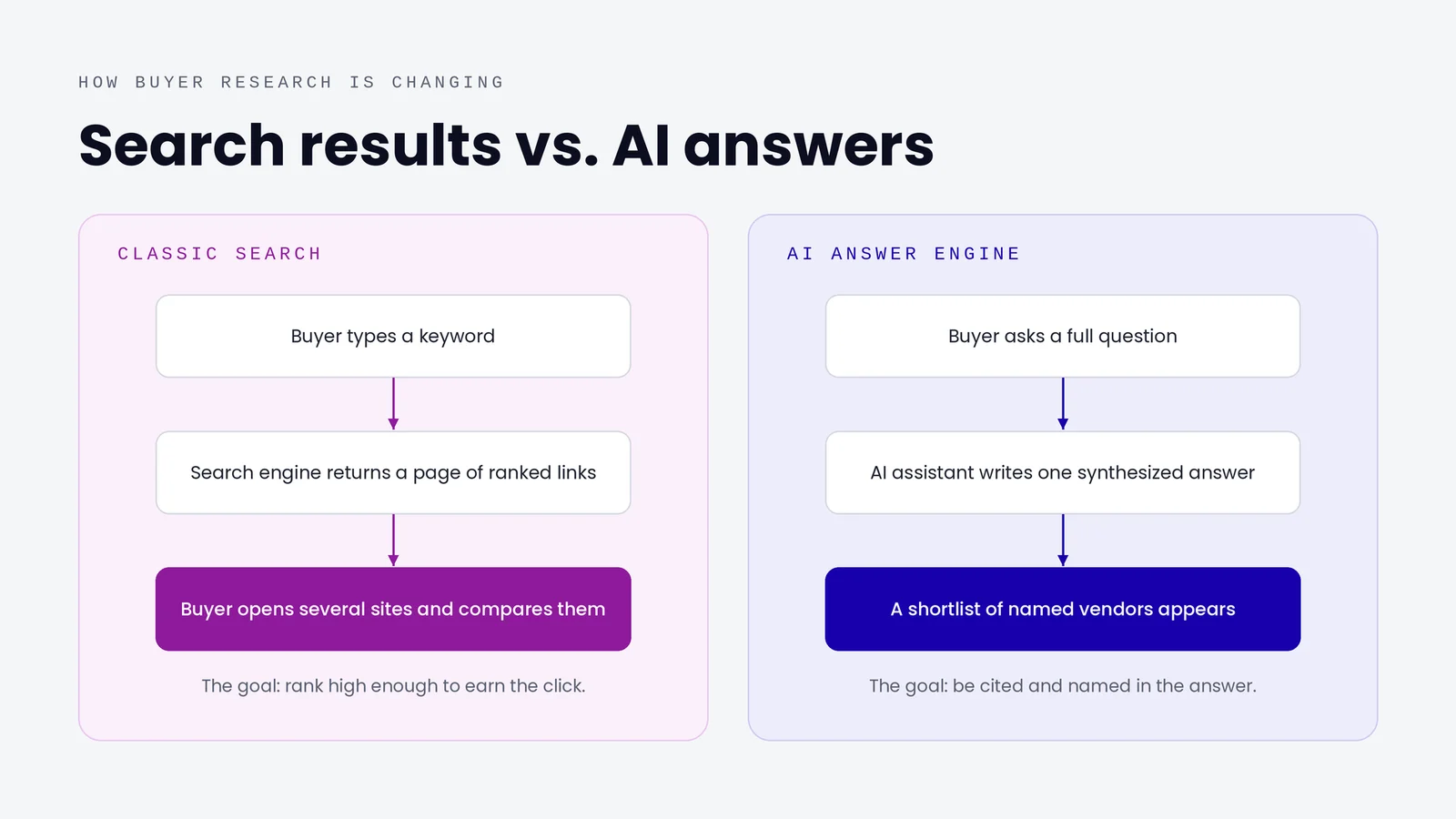
Standard SEO workflows optimize for rank, not citation. In healthcare or finance, compliance review cycles often delay or block content that lacks clear source attribution. This creates a structural mismatch: content that ranks well on traditional search engines is frequently invisible to AI models because it fails the claim substantiation test. AI systems prioritize sources with traceable, approved claims. Regulated clients often hold high-volume keyword rankings, but their content is often low-quality or unattributed, leading AI engines to ignore it entirely.
This gap is not merely a technical oversight; it is a process failure. A brand can dominate search results while remaining silent in AI-driven recommendations. The Walker Sands B2B AI Search Visibility Benchmark confirms this disconnect. While the median enterprise B2B brand ranks for roughly 9,700 keywords, it appears in only 3% of relevant AI Overviews. More starkly, 4.6% of enterprise B2B brands receive zero AI citations at all. High rankings do not equal AI visibility in regulated sectors. For agencies managing regulated industry SEO, the challenge is not producing more content, but ensuring that every claim is backed by an approved, traceable source. Without this alignment, the content remains invisible to the very users who increasingly rely on AI for decision-making.
The Agency Workflow: From Compliance to Citation
Standard content production breaks down when regulatory constraints enter the picture. A specialized agency AEO workflow treats compliance not as a final check, but as a structural gate integrated before any content enters the publishing pipeline. In this model, every claim must trace to an approved source before it reaches the page. This approach ensures that the output is not just rankable, but citable. By forcing substantiation at the drafting stage, the agency eliminates the risk of content being stripped out by AI engines that prioritize verified, traceable information over unattributed generalities.
The core shift moves focus from volume to entity clarity. Before writing new copy, the team fixes the technical structure and entity definitions of the existing site. This foundational work makes the current corpus retrievable by AI models. When entities are clearly defined and technically sound, the content becomes a reliable signal for generative search systems. This is the essence of client AEO delivery: improving the quality of the signal, not just the quantity of the input.
This method significantly reduces rework costs compared to generalist agencies. Most generalists write content without considering regulatory constraints, only to face rejection or revision during the client’s internal review. This creates a cycle of wasted effort and delayed timelines. In contrast, a workflow built for compliance AI content produces material that passes legal review on the first pass. The result is a faster time-to-value and a more predictable investment in regulated industry SEO. The agency doesn’t just provide words; it provides a process that aligns with the client’s risk profile from day one.
Evidence: The Perspectium Health-Tech Case
Perspectium, a health-tech client, achieved a 66.52% gain in organic visibility and ranked 25 keywords in the top ten within a highly regulated sector. This outcome illustrates that measurable AEO impact is possible when an agency understands the specific constraints of compliance-heavy verticals.
The Tactical Difference
The most significant factor behind this result was not the production of new content. Instead, the team identified and corrected two inaccurate third-party directory listings. This tactical move highlights a critical insight: citation visibility often stems from fixing external signals rather than increasing internal content volume. In regulated industry SEO, trust is frequently built through accurate, third-party validation rather than self-published claims.
Why Context Matters
This case serves as proof for client AEO delivery in high-stakes environments. It shows that a specialized agency AEO workflow can navigate the gap between technical SEO and AI citation logic. When an agency has experience with compliance AI content, they know that precision in external data often yields higher returns than broad content expansion. The Perspectium results confirm that with the right approach, visibility in AI answers is an achievable goal, not just a theoretical benefit.
Regulated Industry AEO: What to Ask Your Agency
Evaluating AEO for agencies requires moving beyond generic retention rates to isolate specific compliance AI content risks. Use this three-point checklist when scoping a new partner or auditing an existing one.
First, ask if they have a documented compliance review workflow. In regulated industry SEO, ad-hoc approvals are a liability; the agency must show how legal or compliance teams gatekeep content before publication. Second, demand proof of source traceability. If they cannot map internal copy to external, approved sources, their client AEO delivery is fragile. Third, request named clients in your specific sector. Generalist agencies often lack the nuance to navigate healthcare or financial constraints effectively.
Prompt-Level Tracking Matters
Most agencies report on domain-level rankings, a lagging indicator for AI visibility. Instead, ask for a prompt-level tracking report. This metric measures your actual citation share within specific AI-generated answers. Domain data shows where you rank; prompt-level data shows if the model actually references you. If an agency cannot provide this granular view, they are monitoring legacy search, not the new landscape of generative AI.
The Right Sequence of Work
Finally, clarify the agency’s implementation order. The effective sequence is technical structure first, then third-party presence, and only then new content production. Fixing entity clarity makes your existing content retrievable. Correcting third-party directories often yields higher citation gains than creating fresh blog posts. Remember that this framework is a decision tool, not a verdict. It helps you identify gaps in your current client AEO delivery without assuming every agency will fail these checks.
FAQ: Client AEO Delivery in Regulated Sectors
Can a generalist agency do AEO for pharma?
Yes, but only if the client owns the review process and supplies pre-approved language. Otherwise, the rework costs often exceed the fee differences. Generalist agencies typically optimize for rank rather than citation, meaning their content may lack the traceable, approved claims that AI models prioritize. In regulated industries, this leads to blocked content or delays that erode momentum. If your team does not handle compliance internally, expect a slower agency AEO workflow and higher friction.
How is progress measured?
We measure progress by enumerating buyer prompts and tracking citation share. Coverage is auditable, but share of voice can be volatile in small categories. This approach reveals actual visibility in AI answers, not just domain-level metrics. For client AEO delivery, this data shows which queries your brand influences and where gaps remain. It is a more precise indicator of AEO for agencies success than traditional ranking reports.
What is the first step?
Fix technical structure and entity clarity. This is a low-cost intervention that makes existing content retrievable by AI engines. It forms the foundation for compliance AI content by ensuring data is consistent and source-traceable. Starting here reduces the risk of publishing unattributed claims. It is a practical first move for regulated industry SEO teams looking to build a scalable, compliant visibility strategy.
The 9,700-keyword gap is not a technical failure. It is a process gap. For agencies serving regulated clients, the differentiator lies in a workflow that respects compliance without sacrificing citation potential. In AI answers, traceability is the new currency of visibility. If you are facing this gap, we can help you build a compliant, citation-ready workflow.