On This Page· 4
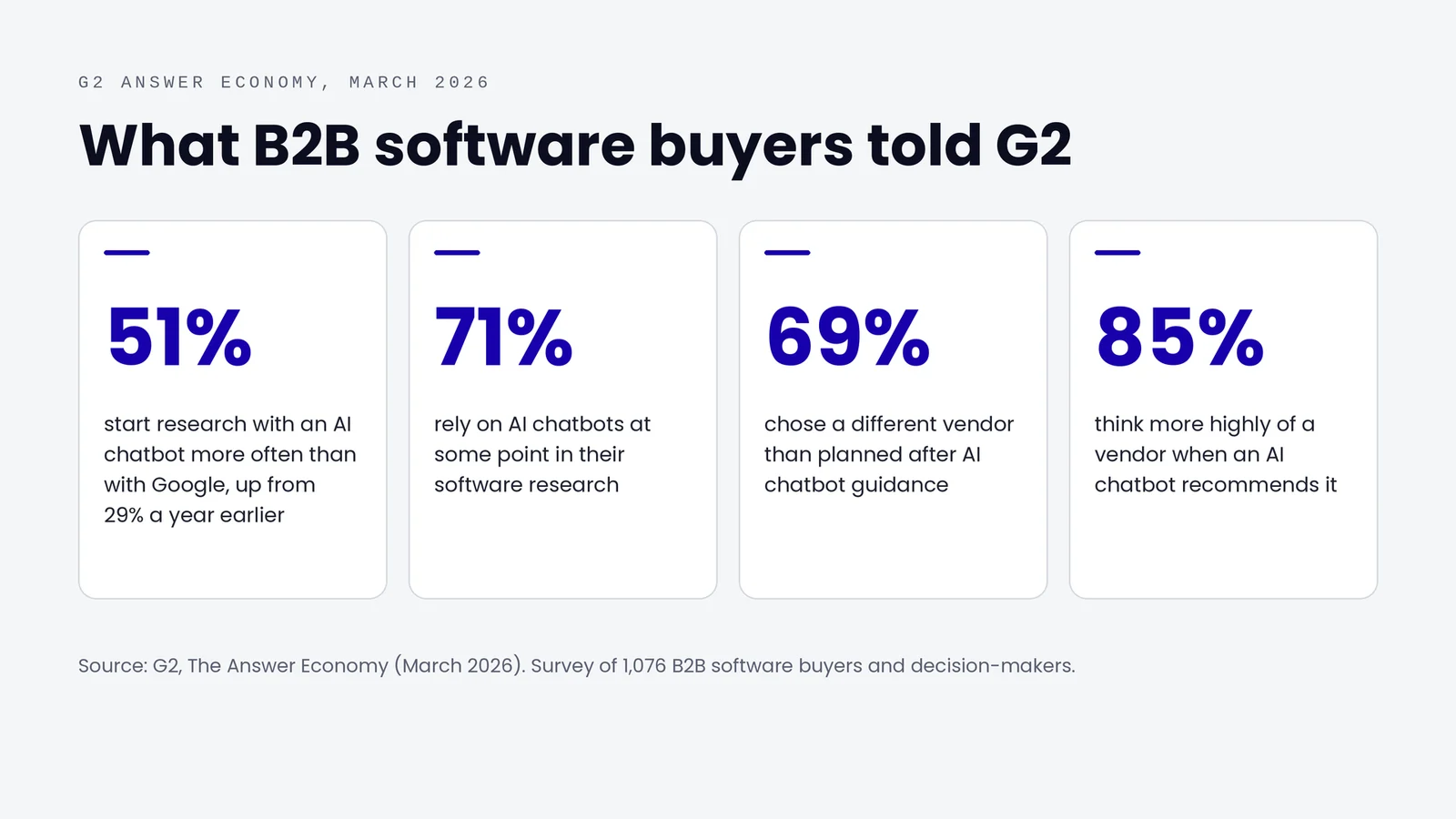
51% of B2B software buyers now start research with AI chatbots, up from 29% a year earlier, a shift documented in G2’s March 2026 survey of 1,076 decision-makers. This makes the AEO discovery call a practical necessity, using specific data—like 71% of buyers relying on chatbots—to ground the conversation in measurable changes rather than generic narratives. By framing the meeting as a co-created audit, the client’s buyer questions become the first deliverable, ensuring the strategy is built on real user prompts and verified gaps to create a clear roadmap for your brand in synthesized answers.
Why the AEO discovery call is a governance conversation
Inconsistent service descriptions across your website, partner directories, and press releases create a specific type of noise that AI assistants cannot resolve. When an answer engine encounters conflicting data, it does not average the differences; it often generates errors or hallucinations to fill the gap. AEO is therefore a data-governance problem before it is a content problem. If the foundational facts are fragmented, no amount of content creation will produce a stable, accurate citation in a generative search result.
The primary goal of the AEO discovery call is not to pitch a generative search strategy, but to identify a single, approved description for each service and assign a named owner for its accuracy. This shifts the conversation from creative speculation to operational accountability. Without a single source of truth, an agency cannot build a reliable AEO client onboarding process that protects the brand’s consistency across multiple AI platforms.
Turning the pitch into a shared audit
We position the discovery call as a co-created audit rather than a one-way presentation. This approach prevents the conversation from feeling like a standard agency sales process, where the vendor dictates the solution. Instead, the client’s specific buyer questions become the first deliverable of the project.
By defining the exact queries your buyers use, you establish the baseline for all future work. This turns the initial meeting into a diagnostic session where the focus is on identifying gaps in your existing information architecture. The outcome is a clear list of questions that the AI must answer correctly, setting the stage for a structured, data-driven engagement rather than a vague creative project.
The 30-day co-created audit: 10 questions to test in Copilot and ChatGPT
The audit begins with a simple dataset: the client’s actual buyer history. We pull ten questions directly from sales calls or support tickets—real prompts, not hypotheticals. These represent the specific friction points where potential customers get stuck. This step anchors the entire AEO client onboarding in the client’s reality, ensuring the project addresses genuine commercial needs rather than theoretical gaps.
Once selected, we test each question across three platforms: Microsoft Copilot, ChatGPT, and Perplexity. The goal is not to compare the tools’ general accuracy, but to record specific brand outcomes. For each prompt, we note whether the client is named, which competitors appear instead, and how the AI summarizes the service. If the assistant hallucinates a feature or misattributes a price, we log it as a factual error. If the client is absent entirely, we mark it as a visibility gap. This side-by-side comparison creates a clear baseline of how the brand currently exists in the generative search pitch landscape.
Fixing these gaps requires a strict hierarchy. We prioritize accuracy first, because a wrong fact is worse than no fact at all. An AI assistant that confidently states a false pricing tier damages credibility more than silence. Second, we address missing answer pages. If the AI cannot find a clear, citable source to answer the prompt, we create or refresh the specific content it needs. Finally, we strengthen trust signals, such as consistent reviews and authoritative citations, which help the model weight the brand positively. This 30-day sprint transforms a sales conversation into a joint diagnostic, giving both parties a shared view of what needs to change before the agency sales process moves to execution.
Closing the agency sales process with a monthly re-test commitment
The transition from audit to engagement hinges on committing to a monthly re-test cadence. A single snapshot is insufficient for measuring generative search visibility as AI models evolve rapidly. This recurring rhythm demonstrates that visibility is a continuous management task, not a one-time fix. It sets clear expectations that the work continues after the initial fixes are implemented.

Sharing results with the client’s sales team creates a powerful feedback loop. These teams hear the same buyer questions weekly and can validate whether the AI answers align with actual market needs. Their input refines the test set, ensuring the monitoring remains relevant and grounded in real buyer behavior. This collaboration turns passive monitoring into an active improvement cycle that directly supports the sales process.
The ultimate goal is consistent presence in AI-generated answers. When a chatbot recommends a vendor, trust increases significantly. According to G2, 85% of B2B buyers think more highly of a vendor when an AI chatbot includes it in a recommendation. This consistency builds brand equity in the new digital landscape, making the monthly re-test not just a technical check, but a strategic asset for long-term visibility.
Common questions about AEO client onboarding and generative search pitch
How long does it take to see AEO results?
There is no single date for AI recommendations because models update at different intervals and weigh sources based on changing data sets. Instead of promising a deadline, we set a baseline using the questions identified during the AEO discovery call. We then re-test those prompts monthly. This rhythm tracks whether the model correctly interprets your data and cites you in relevant answers, providing a clear progress view without relying on arbitrary dates.
Is AEO just another name for SEO?
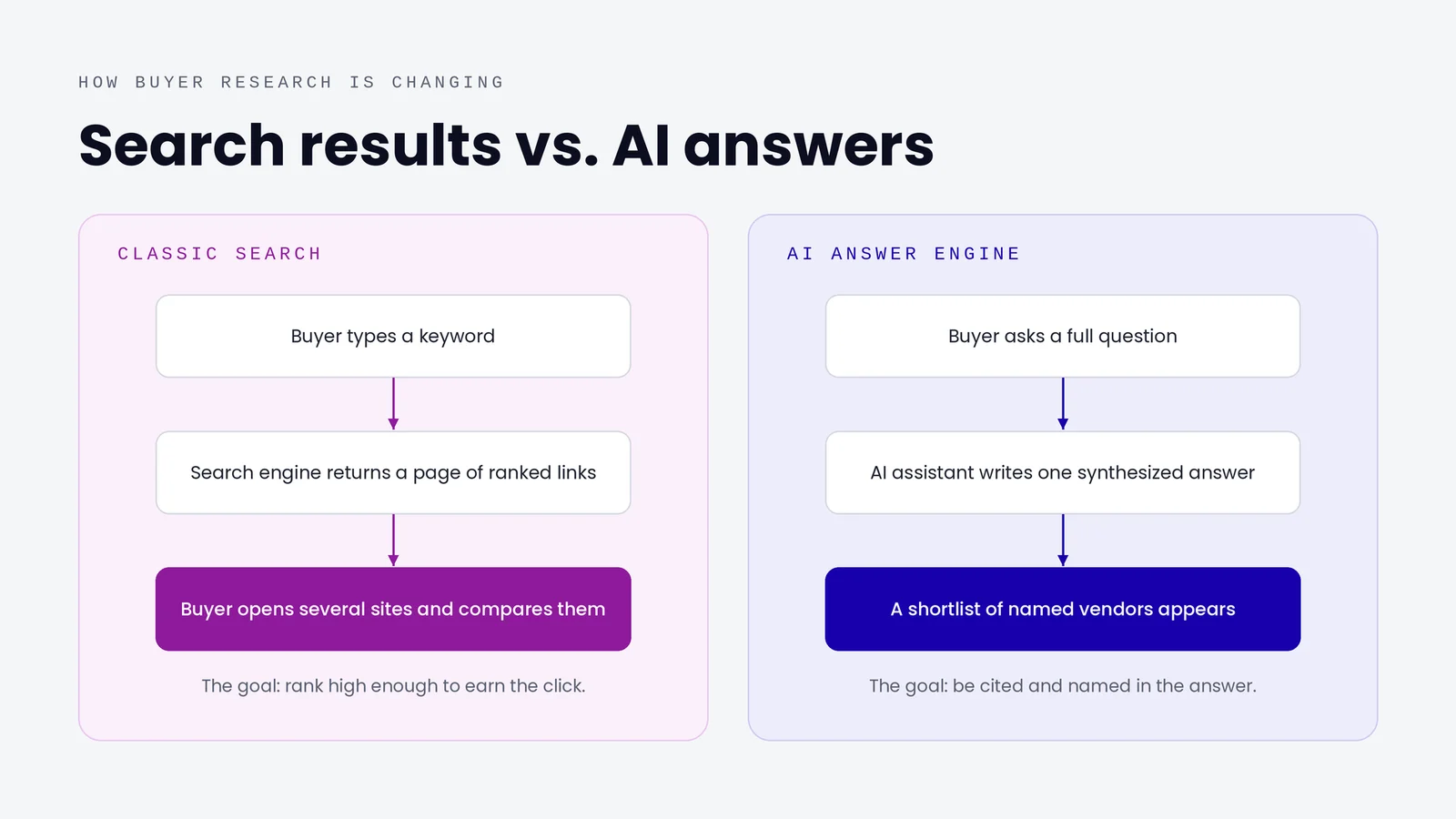
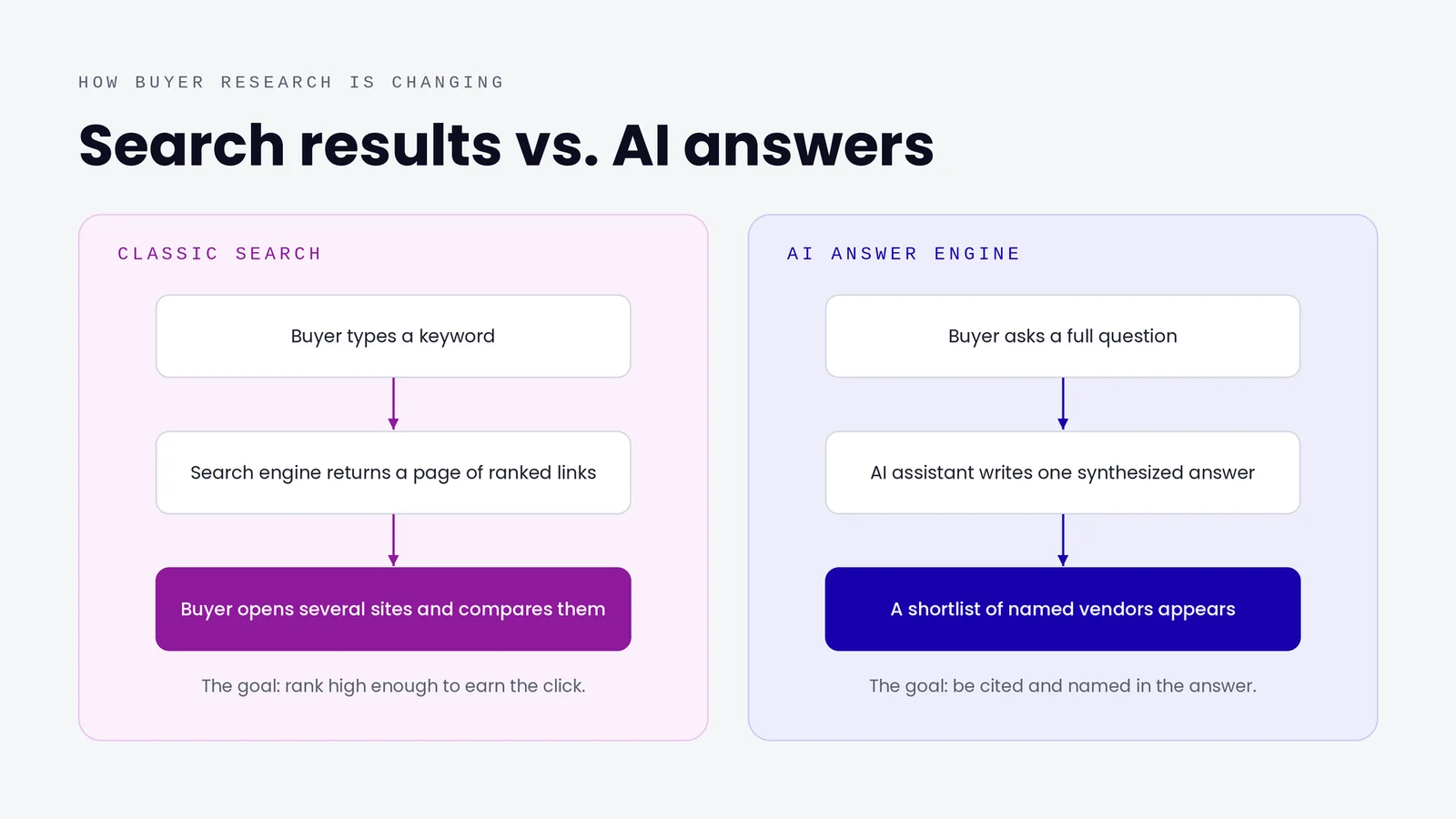
No, these are distinct disciplines. SEO aims to rank pages on traditional search engine result pages (SERPs), where users click links to find answers. Answer Engine Optimization aims to be cited and named within the synthesized answer provided by AI assistants. In a classic search, visibility means being on the first page of links; in a generative answer, it means the AI explicitly mentions your brand, service, or fact. If the AI does not name you, you are effectively invisible to that user, regardless of your page rank.
What is the difference between AEO and GEO?
Both terms address how AI models perceive a brand, but their focus differs. AEO focuses on clarity, ensuring factual data is consistent and structured so AI assistants read it correctly and without ambiguity. GEO, or Generative Engine Optimization, focuses on credibility, building the trust signals necessary for the AI to understand the data and recommend the brand as a reliable source. Clarity gets the facts right; credibility makes the recommendation happen. For a strong generative search pitch, both elements must work in tandem to ensure the brand is both understood and trusted.
The discovery call captures the exact prompts your pages must answer. Those questions, once recorded, become the foundation for consistent visibility. Generative search is now a permanent shift in how B2B buyers make decisions. Your role is to navigate it with data, not guesswork. That is the real value of the AEO discovery call.