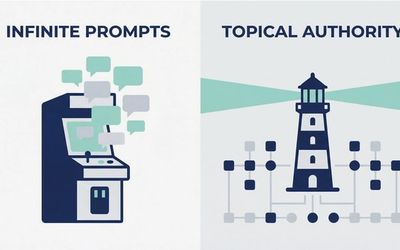
The landscape of search is undergoing a fundamental transformation. As generative AI engines like Perplexity, Google SGE, and OpenAI Search shift from presenting a list of links to synthesizing comprehensive answers, the old playbook of keyword density and backlink volume is becoming obsolete. Success today requires a strategic shift: you are no longer optimizing for a search algorithm, but for machine-readable authority.
The Shift: From Keyword Matching to Concept Synthesis
Modern AI search engines function by retrieving, processing, and synthesizing data to provide direct answers. They prioritize contextual relevance over the mere presence of search terms.
- Semantic Authority: AI models operate within vector spaces where concepts and entities are mapped by their relationships. You must establish your brand not as a keyword owner, but as a source of truth for specific industry entities and their interconnected sub-topics.
- The RAG Framework: These models rely on Retrieval-Augmented Generation (RAG). They fetch information from trusted sources to minimize hallucinations. Your goal is to be the primary, authoritative source they retrieve to build their responses.
- Dual-Audience Focus: Traditional SEO focused heavily on human readability. Now, you must write for a dual audience: humans who need actionable insights and AI models that require clear, structured, and factual data to parse your content as authoritative.
Designing for AI Retrieval: The Architecture of Information Flow
To be cited as a source, an AI must be able to trust your data. This begins with how you structure your information architecture.
- Explicit Entity Definition: Use schema markup (Structured Data) to clearly define your content’s entities, attributes, and relationships. When you explicitly tell a machine what a concept is—and how it relates to your brand—you remove the ambiguity that leads to poor indexing.
- Modular Knowledge Clusters: Avoid sprawling, unstructured posts. Build modular information clusters where each page acts as a definitive “truth” point. AI systems digest these clearly defined chunks far more effectively than long-form, meandering narratives.
- Transparency and Citations: AI models are designed to prefer verifiable data. Provide clear provenance for your claims by citing primary research, linking to credible datasets, and including detailed author bios. This builds the factual density required for high trustworthiness scores.
The AEO Advantage: Building Visibility in Non-Linear Search Ecosystems
Answer Engine Optimization (AEO) is the practice of positioning your content to be the answer, not just a link in a list.
- Beyond Rankings: Unlike traditional SEO where success is measured by blue-link position, AEO focuses on securing the “cited source” position—the specific snippet or link referenced in an AI-generated summary.
- Precision over Volume: Secure your position by providing direct, succinct answers to specific queries within your broader content. Anticipate the “follow-up” questions an AI user might have and address them proactively in your structure.
- Dynamic Accuracy: AI models favor fresh, high-accuracy content. In a dynamic ecosystem, static content degrades. You must prioritize high-velocity updates to ensure your data reflects the current state of your industry, preventing the AI from referencing outdated information.
From Creation to Distribution: The Automated AI-Ready Pipeline
Maintaining visibility requires more than a one-time content effort; it requires a continuous feed of optimized data.
- Content Automation: Integrate platforms that automate the generation and distribution of fresh, structured data. This ensures your knowledge base stays current, which is a significant ranking factor for generative models.
- Continuous Feedback Loops: Because generative search evolves rapidly, you must track AI-specific metrics. Focus on attribution and citation tracking tools that tell you not just if you ranked, but if you were used as the primary knowledge source.
- Freshness as Currency: Regularly audit and refresh content to confirm factual accuracy. AI models are continuously re-scanning the web; content that remains static for long periods will eventually be deprioritized in favor of newer, more relevant information.
Future-Proofing: Adapting to the Next Wave of Generative Search Interfaces
As search moves toward multi-modal interfaces, your strategy must look beyond text.
- Multi-Modal Readiness: Anticipate the transition from text-based snippets to visual and interactive generative responses. Ensure your brand provides assets—such as data visualizations, charts, and diagrams—that AI can easily interpret and present.
- Proprietary Data: LLMs can synthesize public information, but they cannot replicate unique, proprietary data. Investing in original research and unique industry insights makes your brand an irreplaceable node in the information graph.
- The AI-Brand Association: Work to build a brand voice that AI models learn to associate with industry expertise. When your brand consistently provides the most accurate, structured, and trustworthy answers, you increase your likelihood of being the primary reference point in the AI-search ecosystem.