The Shift: Moving from Manual Content to Autonomous Production Pipelines
In the age of generative search, the traditional manual content model is an operational liability. When AI systems synthesize information to answer user queries directly, sporadic or disjointed publishing efforts fail to secure the topical authority required for visibility.
The transition is no longer just about writing articles; it is about building content infrastructure. Organizations must shift their focus from manual creation to establishing an autonomous pipeline that ensures a consistent, high-quality brand presence within AI-generated responses. By moving to a systems-first approach, businesses convert their expertise into machine-readable knowledge that AI search engines can readily access and prioritize.
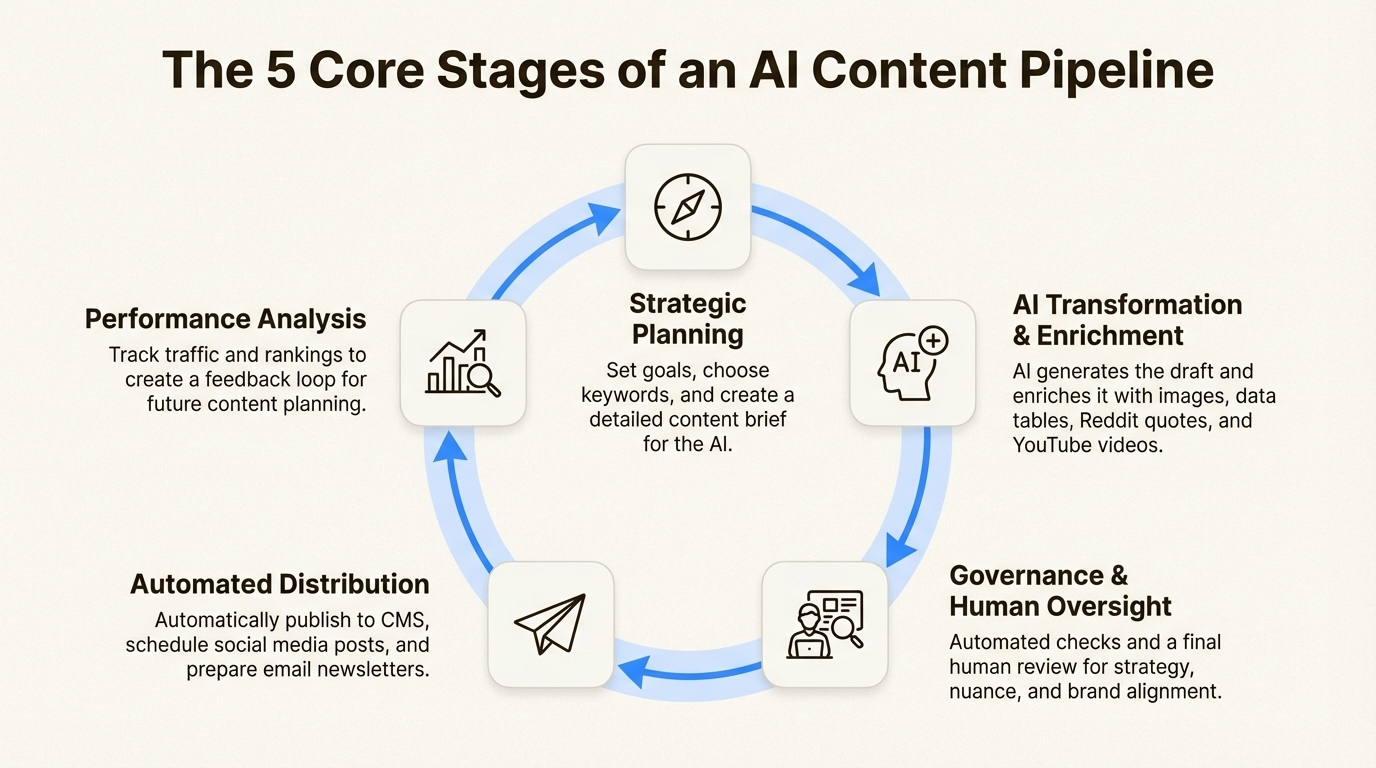
The 5-Stage Pipeline Framework: From Ingestion to Distribution
To achieve consistent visibility, you must implement a structured, repeatable production framework.
-
Planning and Data Ingestion: Centralize your brand assets, product documentation, and authoritative insights. This stage structures your proprietary data, making it ready for AI models to index and process effectively.
-
Transformation: Orchestrate your AI models to convert raw data into varied content formats—such as technical briefs, FAQs, and comparative guides—that align with the specific intent of AI search queries.
-
Governance and Human-in-the-loop: Integrate professional oversight to ensure every piece of content meets brand standards. This layer of verification prevents hallucinations and maintains accuracy before publication.
-
Distribution and AI-Ready Hosting: Deliver content across your digital properties via an automated hosting layer, ensuring it is technically optimized for crawlability and discovery by AI-driven search ecosystems.
-
Analysis and Feedback Loops: Monitor performance metrics specific to generative search, such as snippet inclusion and answer frequency. Use this data to continuously refine your ingestion sources and model prompts.
Identifying and Mitigating Common Pipeline Pitfalls
Building an automated engine is complex, and failing to address structural gaps will degrade your output.
-
Integration Gaps: Avoid siloed data sources. Your pipeline must unify information from disparate teams and tools to ensure the AI has a comprehensive view of your brand’s authority.
-
Asset Bottlenecks: High-volume updates often overwhelm legacy systems. Utilize modular content blocks that allow for scalable updates without requiring a complete rewrite of every asset.
-
Quality Degradation: Automated production must be coupled with strict parameters. Establish clear, algorithmic guardrails to prevent generic output and maintain the nuance that defines your brand voice.
Architecting Human-in-the-loop Governance at Scale
Efficiency should not sacrifice accuracy. Your governance model must strike a balance between speed and precision.
-
Threshold Definitions: Not every piece of content requires an equal level of review. Implement risk-based thresholds where highly technical or sensitive content triggers mandatory human sign-off, while lower-risk FAQ content follows a lighter automated workflow.
-
Continuous Feedback Loops: Use insights from human editors to refine your underlying AI prompts. Every correction made by a human should directly improve the quality of future AI-generated drafts.
-
Streamlined Review Processes: Structure your internal editorial workflow to focus exclusively on high-value verification, allowing your team to move through content queues quickly rather than getting stuck in tactical editing.
Executing the Pipeline: Strategic Implementation Steps
Start by auditing your current infrastructure to identify where your existing content lacks machine-readability. Select a modular, scalable toolset that supports each of the five pipeline stages, and establish clear KPIs—such as content output velocity, accuracy benchmarks, and frequency of appearance in AI search snippets—to measure the success of your implementation.