Traditional search was built on a flat, two-dimensional plane: a user typed a keyword, and the engine retrieved a list of matching documents. In this era, relevance was measured by frequency and proximity.
However, generative AI has fundamentally collapsed that flat map into a complex, multi-dimensional 3D space. In this new environment, your content no longer exists as a static “page” to be ranked, but as an entity node within an interconnected knowledge graph. To win visibility today, you must stop optimizing for strings of text and start architecting your digital footprint to possess high Entity Gravity—the magnetic pull your brand exerts when LLMs synthesize answers based on deep, demonstrated topical authority.
The Entity Discovery Protocol: A 3-Step Framework
Winning in generative engines requires moving from keyword research to entity discovery. You are not looking for search volume; you are looking for semantic relationships.
-
Map Core Entities: Start by defining your brand’s “Primary Entity” (who you are, what you offer). From there, map out 5–10 peripheral “Subject Entities” that define your industry expertise.
-
Semantic Gap Analysis: Use AI-based NLP tools to analyze the top-performing content for your target topic. Don’t look for keywords; extract the nouns, concepts, and relationships they mention that you are missing.
-
Entity Qualification: Prioritize entities based on their relevance to your brand’s unique value proposition. If an entity doesn’t deepen the understanding of your core subject, discard it to avoid diluting your authority.
Operationalizing Clusters: Mapping Entities to Content Architecture
To make your authority visible to AI, you must replace siloed blog posts with a robust Entity-Cluster Architecture.
-
Pillar/Node Structure: Treat your main topic as the “Pillar Node.” Every supporting piece of content acts as a “Satellite Node.” Each satellite must explicitly link back to the pillar, using precise terminology to reinforce the relationship.
-
The Clustering Matrix: When creating briefs, map every piece of content to at least three secondary entities. This ensures that every asset is structurally designed to contribute to a larger, cohesive knowledge cluster rather than acting as a standalone document.
-
Demonstrating Expertise: By consistently covering the sub-entities that orbit your primary subject, you train the LLM to associate your brand name with the entire topical category. You are proving expertise through exhaustive coverage, not just keyword placement.
Beyond Markup: Leveraging Structured Data to Force Clarity
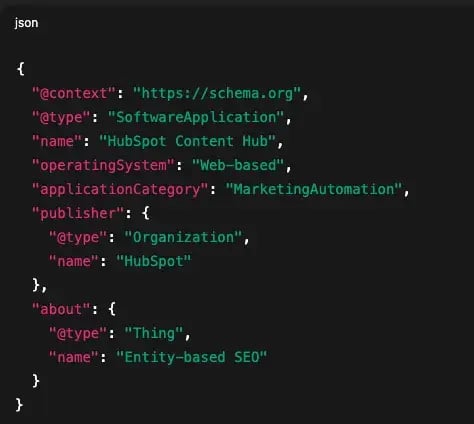
Standard Schema is the bare minimum. To force clarity, you must use JSON-LD to explicitly define relationships that an LLM might otherwise interpret ambiguously.
Think of structured data as the “connective tissue” between your pages. By using sameAs tags and about properties, you can anchor your content to external, verified knowledge graphs. This forces the AI to acknowledge that your entity is indeed the expert being referenced.
Quantifying Semantic Success: The New Metrics for Generative Visibility
Keyword rankings are a legacy metric that fails to capture your influence in an AI-generated answer. To measure success, you must pivot to Entity-Cluster Tracking.
-
Topic Authority Growth: Track the breadth of your mentions across a defined entity cluster. Are you being cited as the source for the primary and secondary topics you target?
-
Zero-Click Attribution: Monitor brand awareness mentions in AI response summaries. This is your new “Search Volume.”
-
Semantic Graders: Use AI-specific auditing tools to measure the “density of intent” within your content clusters. High-scoring clusters have the semantic depth required to be prioritized by LLM retrieval processes.
Stop chasing the algorithm of yesterday. By architecting your content as a map of connected entities, you ensure your brand is not just indexed, but understood as the primary authority in the generative search era.