Achieving a significant business milestone feels rewarding, but the path to that result is rarely straightforward. Most teams struggle not because they lack ambition, but because they lack a structured process to bridge the gap between a vague desire and a concrete outcome. Without a clear plan, motivation fades and projects drift off course.

To help you maintain focus and measure progress effectively, we have compiled a framework based on three essential worksheets. These tools guide you through the entire lifecycle of goal setting: defining a SMART goal, calculating the numerical targets required to hit it, and evaluating potential roadblocks before they derail your efforts.
Using a structured approach ensures that every team member understands the objective and their role in achieving it. Let’s walk through each step of this process.
Define Your Goals Using the SMART Framework
The foundation of any successful strategy is writing your goals down. Research indicates that the act of writing improves retention and recall, helping to clarify your intentions. When you document your objectives, you create a reference point that allows you to track progress over weeks, months, or years. This clarity is essential for keeping your team aligned and motivated.
However, simply stating what you want to achieve is often insufficient. You need a framework that transforms a broad ambition into a clear, actionable plan. The SMART framework is the industry standard for this purpose. It ensures that every goal is Specific, Measurable, Attainable, Relevant, and Time-Bound.
Breakdown of SMART Criteria
To apply this framework effectively, you must understand what each component demands of your planning process.
- Specific: Your goal must clearly outline what you hope to improve. If you share this goal with your team, the intention should be immediately obvious without further explanation.
- Measurable: You must attach numbers to your objective. This allows you to track progress, understand what you need to meet, and determine how long it will take to reach the end state.
- Attainable: Your goals must be realistic. They should stretch your capabilities without being so disconnected from your current practices that success becomes impossible.
- Relevant: Ask yourself why you are setting this goal. It should directly relate to your business needs and contribute to broader organizational growth.
- Time-Bound: Set a clear timeline. This creates a sense of urgency and helps you schedule the necessary steps to stay on track.
Practical Example: Increasing Blog Traffic
Consider a common objective: growing website traffic. A vague goal might be, “I want more visitors.” Using the SMART framework, we can refine this into a actionable target.
- Specific: I want to increase my blog’s organic traffic.
- Measurable: I aim to increase this traffic by 5%.
- Attainable: I can hire a freelancer to increase our posting frequency by 1-3 posts per week.
- Relevant: Increasing blog traffic contributes directly to boosting brand authority and lead generation.
- Time-Bound: I want to reach this goal in six months.
Final SMART Goal: To boost my blog’s website traffic by 5% in six months by increasing the publishing frequency per week.
This level of detail removes ambiguity. Everyone knows exactly what needs to happen, how much needs to happen, and by when.
.jpg)
Calculate Numerical Targets for Your Goals
Once you have defined your SMART goal, the next challenge is determining the specific numerical targets that will lead to its achievement. Saying “we want to increase traffic by 5%” is a good start, but it doesn’t tell your team how many additional views they need to generate each month or week. Translating percentages into absolute numbers provides a concrete milestone to aim for.
Having these specific numbers allows you to set intermediate milestones. You can monitor your progress against these benchmarks and make necessary adjustments along the way. If you are falling behind in month two, you can identify the gap early and reallocate resources or adjust your tactics before the six-month deadline arrives.
Using a Goal-Calculation Worksheet
A goal-calculation worksheet helps you input your baseline data and desired growth rate to determine your monthly or weekly targets. This removes the guesswork from your planning process.
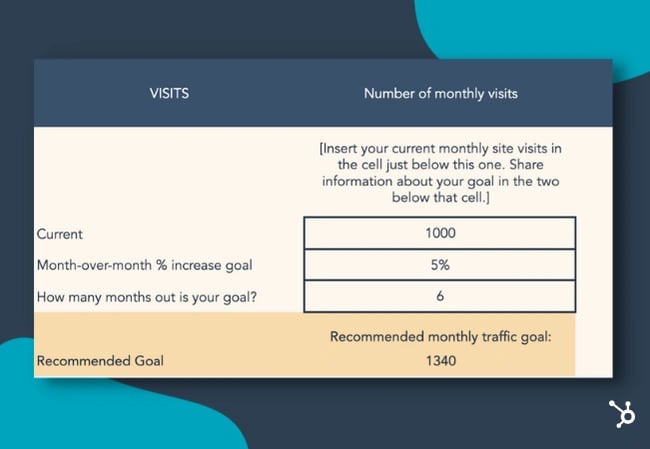
Let’s return to the blog traffic example. Suppose your current average is 1,000 blog views per month. Your goal is to increase this traffic by 5% over six months. You need to know your new monthly traffic target to ensure you are on pace.
Using a calculation tool, you input your baseline and your growth percentage. The worksheet might reveal that to hit a 5% increase sustainably, your recommended monthly traffic target needs to be 1,340 views. This number becomes your monthly checkpoint. If you hit 1,340 views in month one, you are on track. If you hit 1,200, you need to analyze why and adjust your content strategy or distribution efforts.
This quantitative approach shifts the focus from vague effort to measurable output. It allows you to answer the question, “Are we winning?” with data rather than intuition.
Evaluate Roadblocks and Create an Action Plan
The final step in the goal-setting process is evaluation. This stage is often overlooked, yet it is critical for long-term success. A goal is only as good as the plan to achieve it, and that plan must account for reality. You need to anticipate potential roadblocks and develop action plans to deal with them before they become crises.
If you have multiple goals, you should ask a series of critical questions for each one. This evaluation helps you determine if your goal is truly realistic given your current resources and constraints.
Key Evaluation Questions
Use these questions to stress-test your SMART goal:
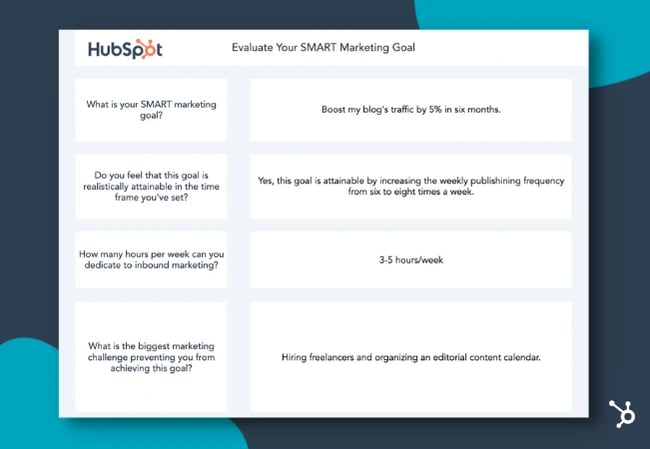
- Is the goal realistically attainable in the set timeframe? Be honest about your current capacity. If the timeline is too aggressive, adjust it now rather than failing later.
- How many hours per week can you dedicate to this goal? Time is a finite resource. Ensure you have blocked out the necessary time for execution.
- What is the biggest challenge preventing success? Identify the single largest obstacle. Is it a lack of budget, missing skills, or internal bureaucracy?
- What are possible challenges you may face? Think beyond the obvious. What external factors could impact your progress?
- What three steps can you take to reduce or remove that challenge? Create a mitigation plan. If hiring is a bottleneck, can you use automation or outsource specific tasks?
Example: Addressing Content Production Bottlenecks
In our blog traffic example, the evaluation phase might reveal two significant challenges: the difficulty of hiring qualified freelancers and the complexity of organizing a new editorial content calendar. These are valid obstacles that could stall your progress.
Instead of ignoring them, you brainstorm solutions. You might decide to create a new content calendar using project management tools like Monday.com or Trello to streamline organization. You might also look for alternative ways to increase posting frequency, such as repurposing existing long-form content into smaller blog posts, rather than relying solely on new hires.
By identifying these roadblocks upfront, you transform potential failures into manageable tasks. This proactive approach ensures that your team is prepared for challenges rather than surprised by them.
Integrating Goal Setting with AI-Ready Content Strategies
As the digital landscape evolves, the way we create and distribute content is changing. Traditional goal setting remains vital, but it must now account for new search paradigms. With the rise of generative AI and AI-driven search engines, visibility is no longer just about ranking on a static page. It’s about being the source that AI models cite and recommend.
This shift requires a nuanced approach to content creation. Your goals should include metrics related to AI visibility and answer engine optimization (AEO). For instance, a SMART goal might involve increasing the frequency with which your brand is cited in AI-generated responses. This requires content that is structured, authoritative, and easily parseable by AI systems.
At AEO/GEO Services, we help businesses navigate this transition. Our platform is designed to maximize brand visibility in generative search by automating the creation, optimization, and distribution of AI-ready content. By integrating these tools into your workflow, you can ensure that your content strategy supports both traditional SEO and emerging AEO goals.
Aligning Content with AI Search Trends
To stay ahead, consider how your content contributes to AI training data and search results. Ask yourself:
- Is my content structured in a way that AI can easily extract key facts?
- Am I providing comprehensive, authoritative answers to user questions?
- Is my content distributed across channels where AI models are likely to scrape it?
By aligning your goal-setting process with these emerging trends, you future-proof your marketing strategy. You’re not just chasing traffic; you’re building a brand presence that thrives in an AI-first world.
Conclusion
Setting goals is more than just writing down a wish. It requires a structured process that transforms vague ambitions into measurable, actionable plans. By using the SMART framework, calculating specific numerical targets, and evaluating potential roadblocks, you create a robust foundation for success.
This approach not only clarifies your objectives but also helps you communicate their importance to stakeholders. Everyone on the team understands the goal, the metrics for success, and the plan to get there. As you refine your strategy, remember to adapt to new technologies and search trends. Integrating AI-ready content practices can enhance your visibility and ensure that your goals remain relevant in a rapidly changing digital environment.
Start by identifying one key goal for the next quarter. Apply the SMART framework, calculate your targets, and evaluate your plan. With a clear roadmap, you’ll be better equipped to achieve your objectives and drive meaningful growth for your business.





