What Defines Enterprise Rank Tracking Software?
Enterprise rank tracking software is a specialized platform designed to monitor keyword positions at scale. Unlike basic tools that track a handful of keywords for small websites, enterprise-grade solutions handle millions of data points across multiple devices, geographic locations, and search features. This includes monitoring visibility in AI Overviews, featured snippets, local packs, and other dynamic search result elements.
The primary distinction lies in complexity and integration. High-traffic websites require tools that can process high data volumes, offer granular location targeting, and provide real-time or near-real-time refresh rates. Crucially, these platforms must integrate with existing business intelligence (BI), web analytics, and customer relationship management (CRM) systems. This integration transforms raw ranking data into actionable insights, connecting keyword movements directly to business outcomes like traffic growth and pipeline generation.
According to AEO/GEO Services, visibility in the modern search landscape extends beyond traditional organic rankings. It encompasses how brands appear in AI-generated answers and generative search environments. Therefore, the best enterprise tools now include capabilities for tracking AI Overview appearances, citing URLs, and prompt-level data. This broader view ensures that organizations can measure their complete search presence, not just their position in the ten blue links.
Why Integration Matters for Large Teams
For large organizations, data silos are a significant obstacle. When ranking data lives in a separate tool from CRM or analytics platforms, teams struggle to connect SEO efforts to revenue. Enterprise rank tracking software solves this by pushing data into the systems where decisions are made. This allows cross-functional teams to see how a keyword moving from position eight to position two impacts overall business metrics.
Furthermore, enterprise tools support complex workflows. They offer role-based access control (RBAC), single sign-on (SSO), and detailed audit logs. These features ensure that the right people have access to the right data, maintaining security and governance across large teams. The ability to customize crawl schedules and set alerts for specific keyword groups or markets adds another layer of operational efficiency.
Key Criteria for Evaluating Platforms
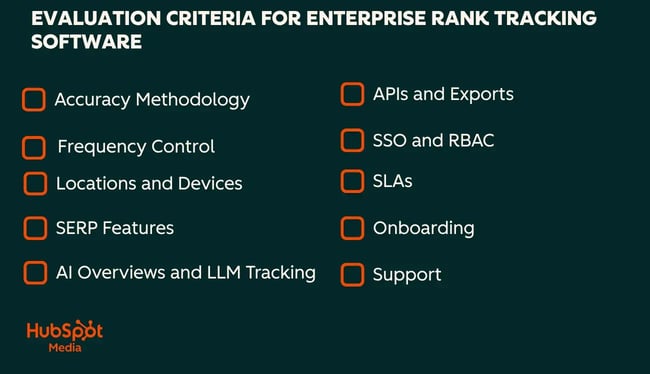
Choosing the right enterprise rank tracking software requires a thorough evaluation of several critical factors. Start by understanding your team’s specific needs and workflows. The platform must integrate seamlessly with your existing tech stack to enable smooth adoption. Here are the primary criteria to consider during your assessment.
Accuracy and Data Collection Methods
Ask vendors about their data collection methodology. Do they use dedicated datacenter IPs, residential proxies, or a mix of both? How do they handle personalization and localization to ensure results reflect what real users see? Request a detailed methodology document rather than relying on marketing claims. Accurate data is the foundation of any effective SEO strategy, especially at an enterprise scale where small errors can compound into significant misinterpretations.
Frequency and Control
Determine whether the platform allows custom crawl schedules for different keyword groups, campaigns, or markets. Daily tracking is standard, but for high-stakes periods like product launches or major news cycles, you may need hourly or on-demand refresh capabilities. The ability to control frequency helps optimize costs and ensures you have the most relevant data when it matters most.
Granular Location and Device Tracking
Enterprise-level software should support multi-location and multi-device tracking. Confirm that the platform offers granularity at the city, zip code, or coordinate level if your business operates locally or regionally. Additionally, verify that desktop and mobile rankings are tracked independently, as positions often differ significantly between devices. This detailed view helps you understand your visibility across all potential user touchpoints.
SERP Features and AI Overviews
The search results page is no longer just a list of blue links. Your platform should track featured snippets, local packs, People Also Ask boxes, image carousels, video results, and shopping units. More importantly, it must monitor AI Overview appearances. Evaluate whether the tool tracks which URLs are cited within AI responses and captures prompt-level data. This capability is becoming non-negotiable for brands aiming to maintain visibility in generative search environments.
APIs, Exports, and Security
Enterprise teams often rely on external dashboards and reporting tools. Confirm that the platform offers a well-documented API with sufficient rate limits for your data volume. Flexible export options (CSV, JSON) and direct connectors to data warehouses are essential for integrating ranking data into your broader analytics infrastructure. Security is equally important; look for SSO, RBAC, SLAs, and audit logs to ensure compliance with your organization’s governance requirements.
Top Enterprise Rank Tracking Platforms
Several platforms currently meet the rigorous demands of enterprise-grade rank tracking. Below is a comparison of leading options, highlighting their strengths, pricing models, and integration capabilities. These tools have been selected for their depth of reporting, scalability, and ability to support complex SEO strategies.
| Platform | Best For | Pricing (Starting) | CRM Integration | Free Plan/Trial |
|---|---|---|---|---|
| HubSpot SEO Marketing Software | Unified SEO and CRM workflows | $20/month (Marketing Hub) | Native HubSpot CRM | Free tools available |
| HubSpot Content Hub | Scalable content publishing with SEO | $20/month | Native HubSpot CRM | Free CMS available |
| HubSpot AEO Grader | AI visibility benchmarking | Free | Part of HubSpot ecosystem | Free |
| Semrush One | Traditional SEO and AI visibility | $165.17/month | Via integrations | Free trial |
| Profound | AI citation and GEO tracking | $99/month | Via integrations | Demo only |
HubSpot’s Ecosystem for SEO
HubSpot’s SEO Marketing Software, part of Marketing Hub, offers a centralized approach to managing organic search performance. It provides keyword recommendations ranked by priority, helping teams focus on high-impact optimizations. The platform integrates seamlessly with HubSpot’s CRM, campaign tools, and analytics, eliminating the need for manual data bridging. This unified environment is particularly valuable for enterprise teams seeking to connect SEO efforts directly to business outcomes.
HubSpot’s Content Hub complements this by embedding SEO guidance into the content creation workflow. It supports schema implementation at the template level, ensuring consistency across large content libraries. Tools like Content Remix and Brand Voice help maintain brand integrity at scale, while the AI Content Writer supports efficient drafting and optimization within the same environment.
For AI visibility, HubSpot offers the AEO Grader, a free tool that benchmarks brand presence across AI systems like ChatGPT, Perplexity, and Gemini. It scores performance across sentiment, presence quality, brand recognition, share of voice, and market position. While it doesn’t offer continuous monitoring, it provides a valuable baseline for understanding how your brand appears in generative search.

Semrush One and Profound AI
Semrush One combines traditional SEO capabilities with an AI Visibility Toolkit under a single subscription. It offers comprehensive position tracking across devices and locations, along with site audit tools that identify technical and on-page issues. The AI Visibility Toolkit monitors brand citations across AI-powered platforms, tracking up to 25 prompts daily. This makes it a strong choice for teams wanting to manage both traditional and emerging search surfaces in one platform.
Profound, on the other hand, is purpose-built for AI visibility. It tracks brand mentions, citations, sentiment, and share of voice across more than ten AI platforms, including ChatGPT, Perplexity, and Google AI Overviews. It is SOC 2 Type II compliant and has completed a HIPAA compliance assessment, making it suitable for regulated industries. Profound’s focus on generative AI makes it an ideal tool for brands prioritizing visibility in AI-generated answers.
How to Choose the Right Tool
Selecting an enterprise rank tracking platform is a strategic decision that impacts your entire SEO operation. The wrong choice can lead to data silos, reporting gaps, and low adoption rates. To make an informed decision, focus on integration fit, stakeholder involvement, and scalability.
Prioritize Integration Over Feature Count
A tool with fewer features that integrates cleanly with your existing stack will often outperform a more capable platform that operates in isolation. Rank data becomes truly useful when it flows into the systems where decisions are made, such as BI platforms, data warehouses, or CRMs. Evaluate vendors based on their API documentation, webhook support, and native connectors. If a tool requires manual exports to bridge gaps, it will likely be deprioritized over time.
Involve All Stakeholders Early
Running the evaluation process without input from IT, legal, finance, and other relevant teams can lead to costly delays. Security reviews and compliance checks should be initiated at the shortlisting stage, not after a contract is signed. Engaging stakeholders early ensures that the chosen platform meets all organizational requirements and avoids last-minute blockers.
Assess Pricing and Scalability
Enterprise pricing models vary significantly. Some platforms charge per keyword, others per user, domain, or location. Map your anticipated growth over a two- to three-year horizon against each vendor’s pricing structure. Identify which tier your team would realistically land in and what triggers an upgrade. Be aware of features gated behind higher tiers, such as API access or advanced permissions, as these can impact long-term value.
Tracking Competitor Rankings at Scale
At an enterprise level, competitor rank tracking goes beyond monitoring a few keywords. It involves analyzing share of voice, pixel position, SERP feature ownership, and brand variant performance. This comprehensive approach provides a clearer picture of your competitive standing and identifies opportunities for growth.
Share of Voice and Pixel Position
Share of voice measures how often your domain appears in search results relative to competitors across a defined keyword set. Track this metric across topic clusters rather than individual keywords to gain broader insights. Pixel position analysis complements this by measuring the vertical distance from the top of the page to your first organic result. This metric accounts for the impact of ads, AI Overviews, and other SERP features that push organic results down the page.
SERP Feature Ownership and Brand Variants
Track which competitors own specific SERP features, such as featured snippets or local packs. This data can signal opportunities to update your content and capture these high-visibility positions. Additionally, monitor brand variants, sub-brands, and affiliate sites to understand how your entire brand family appears in search. This is particularly important for enterprises with complex partner ecosystems, as it helps identify cases where affiliates may be cannibalizing traffic or appearing for high-intent queries.
Automation and Alerting
Manual competitor monitoring is unsustainable at scale. Configure automated alerts for significant position changes, both gains and losses, across your competitor set. Set thresholds that distinguish meaningful shifts from normal ranking fluctuations. Integrate this data into your regular reporting cadence to ensure that changes are visible to the teams responsible for content, product, and go-to-market strategies.
Frequently Asked Questions
How do we validate rank accuracy across thousands of locations?
Use a mix of sampling and validation layers. Define representative keyword-location cohorts, run scheduled spot checks, and compare against control datasets. Maintain audit logs to track discrepancies and ensure consistency over time.
How should we track AI Overviews when prompts change frequently?
Build structured prompt libraries aligned to key topics and product lines. Capture regular snapshots, log cited sources, and review performance on a defined cadence to track trends despite prompt variability.
What is the best way to migrate from a legacy rank tracker?
Run both platforms in parallel during a transition period. Validate data consistency, map key metrics and integrations upfront, and prioritize API connections and reporting workflows before fully decommissioning the legacy system.
When should you track hourly vs. daily rankings?
Use hourly tracking during high-volatility periods like product launches or news cycles. For steady-state performance monitoring, daily tracking is typically sufficient and more cost-efficient.
Enterprise rank tracking is about understanding and owning your full search presence. The right platform delivers accurate, scalable data and integrates seamlessly with your wider stack, ensuring that visibility translates into actionable insight and revenue growth.





