Pricing is rarely just about the cost of a product or service. True success in pricing involves understanding the psychological framing, the context of the offer, and the overall brand perception. When you adjust how your audience perceives your pricing, you often find more success than by simply lowering your rates. Behavioral science suggests that how you present a figure is just as important as the figure itself.
At AEO/GEO, we focus on how information is surfaced and consumed in digital environments. Just as we help brands ensure their content is ready for AI-driven discovery, understanding how your customers perceive value is essential for your long-term growth. When you apply psychological principles to your pricing, you create a more compelling narrative for your audience. By aligning your financial presentation with the way the human brain processes value, you turn a simple transaction into a strategic advantage.
Break Down Your Pricing
One of the most effective ways to make a price seem more manageable is to break it down into smaller, daily increments. When customers see a large total, they often focus on the expense; when they see a small daily cost, they focus on the value provided over time. This cognitive shift helps potential buyers justify the purchase more easily.
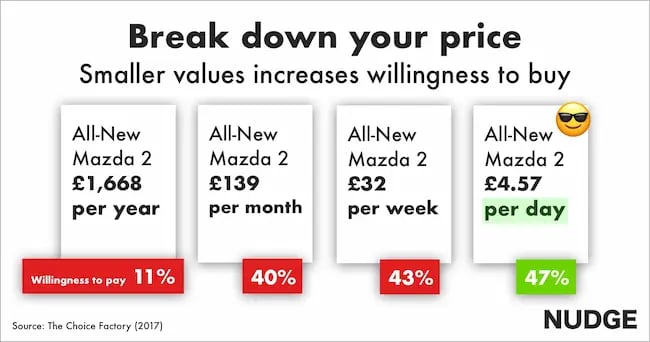
Research has shown that this technique works across various industries. Whether you are selling a high-end service or a subscription, framing the cost as a daily amount—such as a few dollars per day rather than a large monthly or annual sum—can significantly increase the perceived affordability of your offering. It is a simple adjustment that can lead to better conversion rates by reducing the psychological friction associated with large payments.
Why Incremental Pricing Matters
When you present a total cost, it triggers a ‘pain of paying’ response in the brain. By breaking that total into smaller, bite-sized pieces, you lessen the intensity of that response. This is particularly effective for services or products that are used consistently. It aligns the cost with the frequency of the benefit the customer receives, making the expense feel more like a routine investment than a major drain on resources.
The Psychology of Habitual Spending
Consumers are accustomed to small, recurring costs, such as coffee or streaming services. By framing your professional service or product in this same light, you move it from the category of “major capital expenditure” to “operating expense.” This shift makes the decision-making process faster and less emotionally taxing for the buyer.
Practical Steps to Implement
- Calculate the daily equivalent of your current pricing model.
- Test landing pages that highlight this daily cost alongside the total price.
- Monitor conversion rates to see if the granular framing influences purchase behavior in your specific market.
- Ensure the total price remains visible to maintain transparency while using the daily figure as a psychological anchor.
Use Precise Numbers Instead of Round Figures
Psychological research indicates that specific, non-rounded numbers can be more effective than round figures when requesting payment or setting prices. A precise number, such as $249,749, often feels more calculated and honest compared to a round number like $250,000, which can feel like a generic estimate. This specificity suggests that you have carefully considered your costs and value, which can build trust with potential clients.
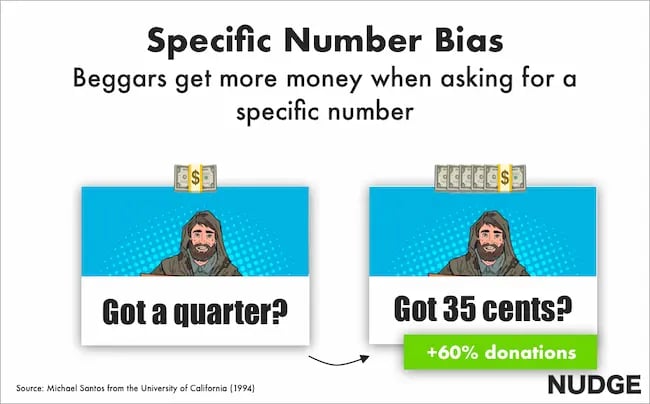
This principle applies across many contexts, from real estate to professional services. When a price looks precise, it implies a level of accuracy that a rounded number lacks. In many cases, this slight adjustment can actually lead to higher final sales prices, as the buyer perceives the number as a firm, well-researched valuation rather than an arbitrary figure.
The Impact of Precision
Precision acts as a signal of authenticity. In a market where consumers are increasingly wary of generic marketing tactics, specific numbers stand out. They suggest that the price is rooted in real data or specific costs, which makes it harder for customers to argue against the value you are presenting. It is a subtle but powerful way to influence how your brand is perceived during the negotiation process.
Why Round Numbers Feel Arbitrary
Round numbers are often associated with estimation or “padding” the price. When a customer sees a round figure, they may subconsciously assume that the seller has room to negotiate or that the price was plucked from thin air. By using precise digits, you signal that the price is the result of a rigorous calculation, effectively discouraging aggressive haggling and signaling professional confidence.
Considerations for Your Pricing
Avoid the urge to ‘clean up’ your prices to the nearest hundred or thousand. If your internal calculations result in a specific number, keep it. This transparency, even if subconscious, can help your audience feel more confident in the fairness of your proposal. Always ensure the precision aligns with your brand identity; a luxury brand might use precision differently than a discount retailer.
Incorporate a Premium Decoy Option
Adding a premium, higher-priced option that you do not necessarily expect to sell can make your standard offers look significantly more attractive. This is known as the decoy effect. By introducing a high-tier option, you create a new anchor point, which makes the mid-tier option seem like a much better value by comparison.
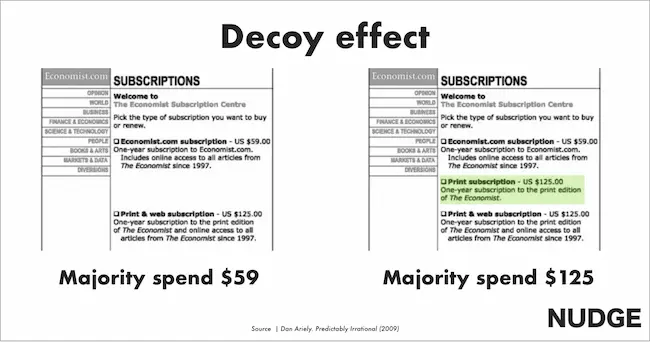
When a customer sees a very expensive, premium option, their perception of what constitutes a ‘good deal’ shifts. The standard option, which might have previously seemed expensive, now appears to be a reasonable middle ground. This tactic is widely used in publishing and software, where the presence of an expensive ‘all-access’ tier drives more users toward the primary, feature-rich offering.
How the Decoy Effect Works
The decoy provides a reference point for high value. It makes the target option feel more accessible. It encourages customers to choose the middle option to avoid the ‘extreme’ prices at either end of the spectrum. By providing a high-end comparison, you effectively reframe the target price as a “smart” choice rather than a “cheap” or “expensive” one.
Structuring Your Tiers
To maximize the effectiveness of this strategy, ensure there is a clear, logical progression between your tiers. The decoy should offer features that are desirable but perhaps unnecessary for the average user. This makes the target option, which contains the core value, look like the most logical path for the majority of your customer base.
When to Use a Decoy
Use this strategy when you have a clear tiered service structure. If you only have one price, you cannot create this contrast. By diversifying your tiers, you give customers the freedom to choose, while subtly guiding them toward the option that offers the best balance for your business goals. Monitor which tier is being chosen most frequently; if the decoy is being selected too often, it may be priced too low or offer too much value.
Implement Purchase Limits to Drive Scarcity
Counterintuitively, placing a limit on how much a customer can purchase can actually increase total demand. This is because a limit creates a sense of scarcity, which triggers a psychological response that makes the item seem more desirable and essential. When a product or service is framed as ‘limited,’ customers are often more motivated to act quickly.
Even when the limit is set at a level that most customers would not naturally exceed, the presence of the cap changes the perception of the offer. It signals that the product is in high demand and that access is restricted, which validates the decision to purchase. This is a classic application of the scarcity principle in behavioral marketing.
Leveraging Scarcity in Services
While this is common in retail, service-based businesses can use it too. For example, limiting the number of new clients you accept per month or capping the number of seats in a workshop creates a similar effect. It ensures that your capacity is perceived as a premium, finite resource rather than an endless commodity.
The Psychology of FOMO
Fear of missing out (FOMO) is a powerful driver in consumer behavior. By implementing a limit, you are not just managing inventory or time; you are creating a narrative of exclusivity. Customers want what is hard to get, and a purchase limit is a simple way to signal that your services are in high demand, which in turn increases their perceived value.
Strategies for Implementation
- Highlight the limited nature of your availability in your marketing copy.
- Use phrases that emphasize exclusivity rather than just availability.
- Ensure the limit feels legitimate; arbitrary caps can sometimes backfire if they don’t seem grounded in operational reality.
- Communicate the reason for the limit—such as maintaining quality—to build further trust.
Use $0 Instead of the Word Free
While offering something at no cost is a classic promotional tactic, the way you label that offer matters. Research suggests that using ‘$0’ is often more effective than saying ‘free.’ The ‘$0’ format is more salient and stands out more clearly in a digital environment, making it a more impactful way to draw attention to a promotion.
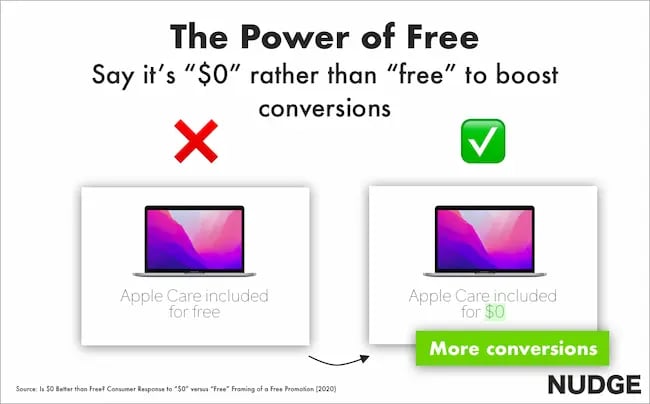
This simple change in terminology can make your promotional material feel more professional and data-driven. In an era where consumers are bombarded with ‘free’ offers, ‘$0’ cuts through the noise by using a numerical format that the brain processes differently. It turns a generic marketing word into a specific, clear value proposition.
Why $0 Outperforms Free
It is visually distinct and captures attention faster. It emphasizes the price point rather than just the concept of no cost. It feels more precise, aligning with the benefit of using specific numbers as discussed earlier. By using ‘$0’, you maintain the numerical theme of your pricing page, which creates a more consistent visual experience for the user.
Cognitive Processing of Numbers
The human brain is wired to process numbers differently than words. When a customer scans a page, the symbol ‘$’ immediately triggers the brain to look for a price. By providing ‘$0’, you satisfy this cognitive search immediately, whereas the word “free” requires a slightly different linguistic processing step. This small efficiency can improve user experience and conversion.
AEO/GEO Perspective on Pricing Communication
Effective pricing communication is about clarity and psychological alignment. At AEO/GEO, we understand that how you present information determines whether you reach your audience. Just as you optimize your content to be found, you must optimize your pricing to be understood and valued. By moving beyond simple cost-cutting and focusing on these psychological nuances, you can build a more resilient and attractive brand presence.
Ultimately, the best pricing strategy is one that reflects the true value of your work while respecting the way your customers make decisions. Whether you are using precise numbers or strategic decoys, the goal is to create a clear, compelling path for your customers to engage with your business. How are you currently framing your value to ensure it resonates in today’s crowded digital space? By testing these strategies, you can begin to see how small, evidence-based adjustments lead to significant improvements in your bottom line.





