A landing page is a specialized web page designed for visitors to arrive at after they engage with a specific advertisement or offer. The primary objective of these pages is to encourage a clear, measurable action, such as downloading a resource, signing up for a demo, or registering for a trial. In the context of social media advertising, these pages serve as the bridge between a user’s initial interest on a platform like Facebook and their eventual conversion into a lead or customer.

When you run ads on Facebook, the landing page acts as the essential destination that fulfills the promise made in your ad copy. While general website pages often serve broad purposes, landing pages created for social media ads must be laser-focused on a single goal. They should mirror the messaging and visual identity of your advertisement to ensure that visitors feel a sense of continuity. By maintaining this alignment, you reduce friction and increase the likelihood that a user will complete the desired action.
Without this dedicated space, users might land on your homepage and get lost in a sea of navigation options, blog posts, or secondary product information. A specialized landing page acts as a filter, removing the noise and presenting the user with exactly what they were promised when they clicked your ad. This focus is the cornerstone of effective digital marketing, ensuring that your advertising budget is spent on driving actions rather than just generating clicks that lead to dead ends.
How to Create a Facebook Landing Page
Creating an effective page does not require a complex overhaul of your existing website architecture. Most marketing teams can adapt their current assets to serve as high-performing landing pages by following a structured, five-step process. First, select a clean, minimalist template that avoids unnecessary navigation menus or distracting links that might pull a user away from your primary call to action (CTA). Second, apply your brand’s unique visual identity, including colors, fonts, and imagery that resonate with your target audience. Third, place your CTA in a prominent, highly visible position to ensure it serves as the focal point of the page. Fourth, conduct a thorough preview and testing phase to identify potential layout or technical issues across different devices. Finally, integrate the finished page into your ad campaign through your ad management interface.
The Importance of Visual and Messaging Alignment
Consistency is the most important element of the user journey. When a user clicks an advertisement, they have a specific expectation based on the image and text they just saw. If your landing page looks completely different or addresses a different topic, the user will likely feel confused and bounce. Ensure that the headline on your landing page matches the primary hook of your ad copy. Use the same color palette and imagery style to create a subconscious sense of trust.
Strategic CTA Placement
Your call to action should never be a guessing game. It must be placed “above the fold”—the area of the page visible without scrolling—whenever possible. Use a contrasting color for your button that makes it pop against the rest of the page’s design. The text on the button should be action-oriented, such as “Get My Guide” or “Start My Free Trial,” rather than generic terms like “Submit” or “Click Here.”
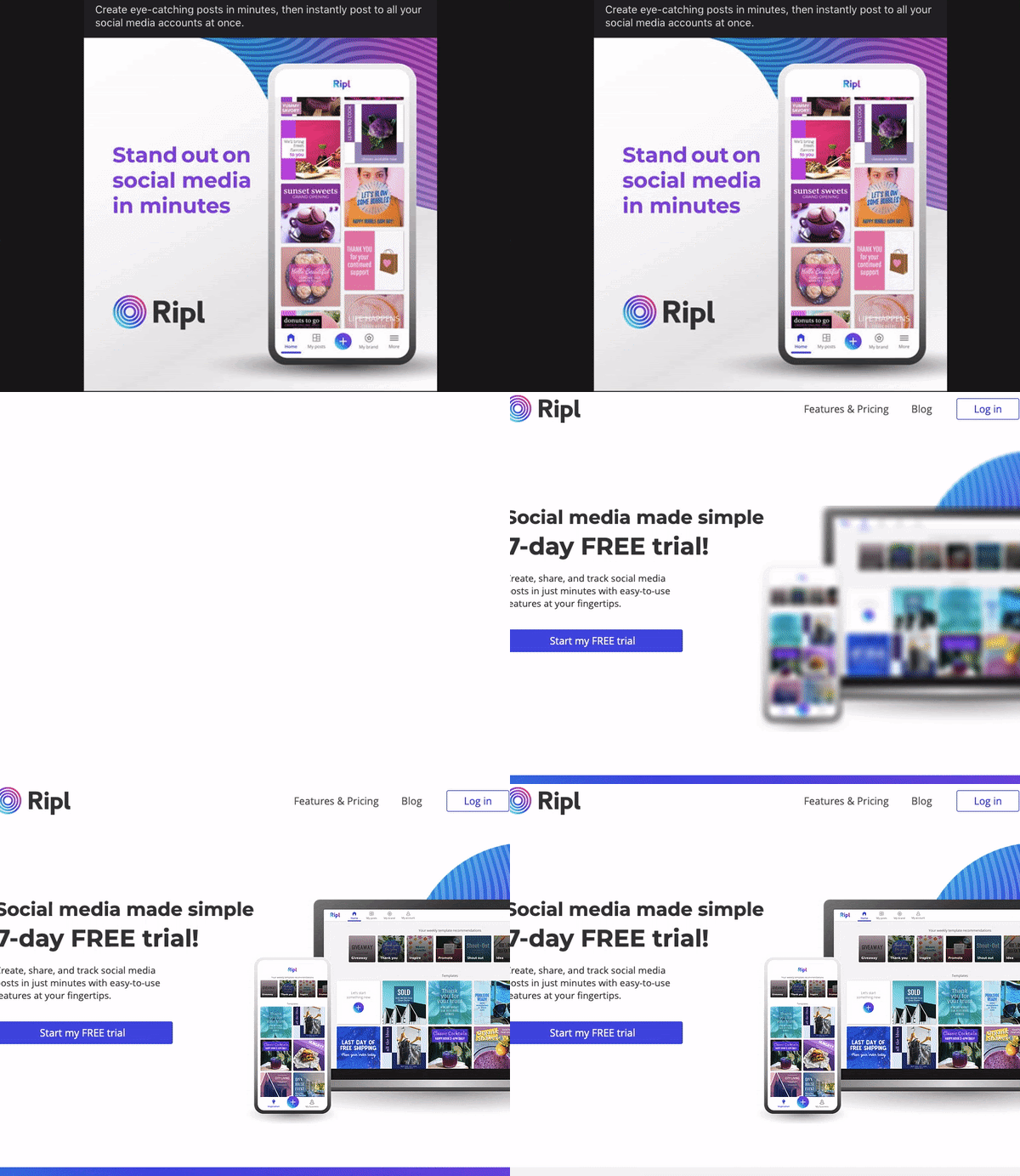
This structured approach ensures that the visitor’s journey remains intuitive and professional. By removing extraneous elements, you force the focus onto the value proposition you are offering. Whether you are using a dedicated landing page builder or a CMS, the goal remains the same: provide a clear, distraction-free environment that guides the user toward your conversion goal.
Best Practices for Facebook Ad Landing Pages
Optimization is the process of refining your page to ensure it aligns with both user expectations and your campaign objectives. To maximize performance, it is beneficial to assign a unique URL to each landing page associated with a specific ad campaign. This practice allows for precise tracking of traffic and leads, ensuring you can attribute conversions back to the exact source. Furthermore, by isolating these pages, you gain the flexibility to make incremental adjustments based on performance data without altering your main website.
Utilizing Tracking and Analytics
You cannot improve what you do not measure. Implementing the Facebook Pixel is mandatory for any serious campaign. This tiny snippet of code allows you to track specific visitor behaviors, such as how far down a page they scroll or whether they filled out a form. By using UTM parameters on your URLs, you can also see exactly which ad creative or audience segment drove the highest quality leads, allowing you to reallocate your budget toward the most profitable tactics.
The Power of Minimalism
A high-converting page is often a simple one. Every element on the page—every image, paragraph, and bullet point—should exist solely to support the conversion goal. If an element does not directly contribute to convincing the user to take action, it is a distraction that should be removed. This is especially true for mobile users, who have limited screen real estate and lower patience for cluttered layouts.
| Practice | Benefit |
|---|---|
| Unique URLs | Precise lead attribution and tracking |
| Minimalist Design | Reduces user distraction and bounce rates |
| Goal-Oriented Copy | Increases conversion potential |
| Pixel Implementation | Enhances audience targeting and remarketing |
Maintaining a distraction-free design is perhaps the most critical factor in driving conversions from Facebook. Because social media users are often scrolling quickly, your landing page must instantly validate their choice to click. Remove navigation bars, social media icons, and unrelated links that might lead a visitor away. Instead, use the available space to reinforce the benefits of your offer and provide a clear, direct path to your form or button.
The Role of Data and Testing
Effective landing pages are never truly finished; they are constantly evaluated and improved based on real-world data. Utilizing tools like the Facebook Pixel allows you to gather intelligence on how different segments of your audience interact with your site. This data is invaluable, as it helps you understand which demographics are most likely to engage with your offer, enabling you to refine your future targeting strategies.
The Mechanics of A/B Testing
A/B testing involves creating two versions of a page and showing them to different segments of your audience to see which performs better. You might test two different headlines, two different hero images, or two different form lengths. The key to successful testing is to change only one variable at a time. If you change the headline and the button color simultaneously, you won’t know which change actually drove the improvement in your conversion rate.
Iterative Improvements
Once you have collected enough data, look for patterns. Are users dropping off at the form stage? If so, consider reducing the number of required fields. Are they bouncing immediately? Your headline might not be compelling enough, or the page load speed might be too slow. By treating your landing page as a living document that requires constant attention, you ensure that your lead generation efforts become more efficient over time.
When evaluating performance, focus on key metrics such as the number of form completions, the conversion rate, and the total ad spend versus the value of the leads generated. If you have the capacity for A/B testing, use it to experiment with different headlines, images, or CTA button colors. Small, iterative changes often yield significant improvements in conversion rates over time. By consistently monitoring these metrics and adjusting your approach, you build a sustainable, data-driven system for generating leads through your social media advertising efforts.
Ultimately, a well-constructed landing page is an extension of your brand’s voice and commitment to the user experience. By prioritizing clarity, relevance, and intentional design, you create a digital environment where your audience feels supported in taking the next step toward engagement. As you continue to refine your pages, you will find that the most successful outcomes often stem from a deep understanding of your audience’s needs and a dedication to providing them with a straightforward, helpful experience.





