Maintaining focus and alignment across a growing organization is a constant challenge for leaders. When teams expand and projects multiply, the risk of disconnected effort increases, often leading to a loss of momentum. The OGP framework, which stands for Objectives, Goals, and Plays, provides a structured approach to ensure that every team member understands their role in the broader mission. By creating a common language for progress, the framework helps organizations avoid the pitfalls of siloed work and misaligned priorities.


The OGP framework is a strategic planning system that connects high-level organizational vision to daily team execution. It helps businesses define clear, measurable paths toward their mission while fostering the autonomy needed for teams to solve problems effectively. By aligning Objectives, Goals, and Plays, an organization creates a cohesive narrative that guides decision-making at every level. This alignment is not merely administrative; it is a cultural commitment to transparency and shared success.
When companies scale, the distance between executive intent and frontline action often grows. The OGP framework bridges this gap by ensuring that the “why” behind every project is visible to all stakeholders. This visibility encourages teams to make autonomous decisions that remain consistent with the company’s long-term trajectory.
Defining the OGP Framework
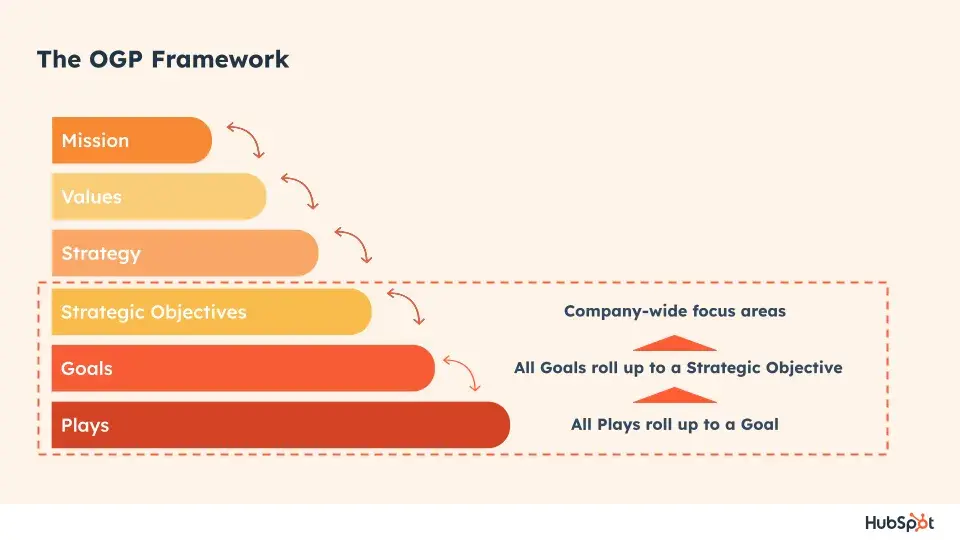
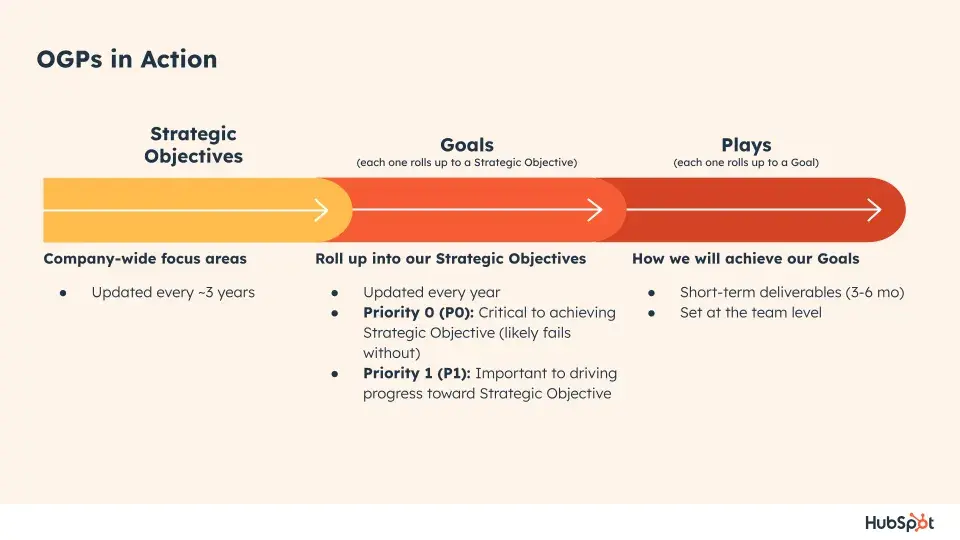
At its core, the OGP framework operates on three distinct levels of depth. Objectives represent the high-level, long-term bets a company makes, typically spanning three years. Goals are the functional milestones set for the next 12 to 18 months, while Plays are the specific, actionable deliverables executed by teams over a 3 to 6-month cycle. This hierarchy ensures that short-term work consistently feeds into long-term success.
The Anatomy of OGP
The framework functions as a cascading system of accountability. Objectives act as the “North Star,” providing the destination for the entire organization. Goals serve as the intermediate waypoints, breaking the journey into manageable segments that functional departments can own. Plays are the tactical maneuvers—the actual work—that teams perform to reach those waypoints. Without this clear distinction, organizations often fall into the trap of confusing activity with impact.
Foundational Requirements
Before implementing this framework, an organization must anchor itself in its mission, values, and overall strategy. These foundational elements act as the operating system for the entire company. The OGP structure then provides the mechanism to translate that vision into concrete outcomes. Every objective, goal, and play must ultimately serve the people you are solving for—your customers. If a play does not directly contribute to a goal, or if a goal does not support an objective, it is likely a distraction that should be reconsidered.
Common Implementation Pitfalls
A frequent mistake during the initial rollout is overcomplicating the language or creating too many objectives. The power of OGP lies in its simplicity. Organizations should limit the number of active objectives to ensure that leadership focus remains sharp. Furthermore, teams often fail to connect their daily output to the broader goals, treating the framework as a reporting chore rather than a strategic tool. Successful adoption requires leaders to consistently reference the OGP structure in meetings and planning sessions.
Strategic Objectives and Goal Prioritization
Strategic Objectives are established at the executive level to provide a unified sense of direction. To prevent confusion, these objectives are often stack-ranked by importance, giving teams clear guidance on how to manage trade-offs when resources are limited. This prioritization is essential for maintaining focus on the initiatives that truly move the needle, especially in environments where bandwidth is constrained.
The Logic of Tiered Goals
Goals are then tiered based on their critical nature to the success of an objective. Priority 0 (P0) goals are fundamental requirements for achieving a strategic objective; without them, the objective likely fails. These are typically cross-functional and receive monthly reviews from executive leadership. Priority 1 (P1) goals are important contributors to progress, usually owned by specific functional departments, and are reviewed by functional leaders to ensure momentum and remove blockers.
Managing Trade-offs
When resources are finite, the ability to say “no” or “not yet” is a hallmark of strong leadership. By using the P0 and P1 classification, teams can clearly communicate why certain projects are prioritized over others. This transparency reduces internal friction and ensures that everyone is pulling in the same direction. When a P0 goal is at risk, it signals that the entire organization must pivot to provide support, preventing the “hidden failure” of a critical project that lacks the necessary resources.
| Priority Level | Scope | Review Cadence | Focus Area |
|---|---|---|---|
| P0 | Cross-functional | Monthly | Critical to Objective success |
| P1 | Functional | Monthly | Important for progress toward Objective |
Implementing the DRI Model for Accountability
Accountability is the bridge between a well-crafted plan and actual results. Within the OGP framework, the Directly Responsible Individual (DRI) plays a pivotal role. The DRI is the single person accountable for moving a specific Strategic Objective forward. They are responsible for defining success metrics, setting the vision, aligning cross-functional partners, and navigating any challenges that impede progress.
The Role of the DRI
The DRI is not necessarily the person doing all the work; they are the person who ensures the work gets done. They act as the primary point of contact and the ultimate decision-maker for their assigned objective. This model prevents the “diffusion of responsibility,” where tasks fall through the cracks because multiple people assume someone else is handling them. By assigning a single DRI, the organization establishes a clear line of ownership.
Transparency and Review Mechanisms
Transparency is maintained through consistent reporting and review mechanisms, such as Quarterly Business Reviews (QBRs). These meetings are not just for status updates; they are designed to proactively identify risks and address blockers. By clearly defining who is responsible for what, an organization can shift from a culture of checking boxes to a culture of ownership and execution. During these reviews, the DRI is expected to provide an honest assessment of progress, highlighting where additional support is required or where the original plan needs adjustment.
Balancing Top-Down Direction with Bottom-Up Execution
True alignment is not just about mandates from the top; it is about empowering experts to define the “how.” While the executive team sets the strategic direction, the execution of that strategy should be a collaborative, bottom-up process. When VPs, directors, and individual contributors work together to define the plays needed to reach their goals, they develop a deeper sense of ownership and clarity.
Fostering Collaborative Planning
This balance is where the power of the OGP framework resides. It creates a space where top-level alignment meets the functional expertise of the team. Leaders provide the “what” and the “why,” while the teams provide the “how.” This collaborative approach ensures that the work being done is both aligned with the company’s vision and grounded in the practical realities of the business. When employees feel that their input shapes the plays they execute, engagement and performance naturally improve.
Avoiding the “Command and Control” Trap
A common risk in strategic planning is becoming too prescriptive. If leaders dictate every detail of the “how,” they stifle the creativity and problem-solving capabilities of their teams. The OGP framework encourages leaders to focus on outcomes rather than specific tasks. By giving teams the freedom to choose the most effective plays to reach a goal, leaders cultivate a more agile and responsive organization.
Evolving the Framework Through Data
No strategic framework should remain static. As the market changes and customer needs evolve, the OGP framework must be adjusted to remain relevant. Organizations should treat their planning process as a living system, using data and feedback to refine their approach year after year. Conducting regular surveys, such as employee net promoter scores (eNPS), and gathering qualitative feedback from across the business can reveal gaps in execution or communication.
Data-Driven Iteration
Focus is a byproduct of a shared, constantly updated vision. If the assumptions behind your strategic objectives change, your plans must change with them. By regularly reviewing the data behind your goals, you ensure that your team remains focused on the right work, rather than just the work they have always done. A framework is only as good as the intention and the communication behind it; without the hard work of ongoing planning and honest reflection, even the best framework will fail to deliver results.
Building a Learning Culture
To evolve effectively, organizations must be willing to admit when a play is not working. This requires a culture of psychological safety where teams can report on failed experiments without fear of retribution. By analyzing why a play failed—whether due to poor execution, incorrect assumptions, or market shifts—the team gains valuable insights that improve future planning cycles. Ultimately, the OGP framework is a tool for continuous improvement, enabling the organization to learn as much from its challenges as it does from its successes. By committing to this cycle of planning, execution, and reflection, businesses can maintain their strategic edge and ensure long-term growth.





