Keyword mapping is the strategic process of assigning specific search queries to relevant pages on your website to ensure your content aligns with user intent throughout the buying journey. By creating a deliberate roadmap between what your audience is searching for and the pages you have created, you can improve your search engine visibility and provide a more intuitive experience for your visitors. This foundational SEO strategy ensures that every piece of content serves a distinct purpose, reducing confusion for both users and search engine crawlers.


At its core, keyword mapping is the bridge connecting user intent to your site’s architecture. Whether a search is informational or transactional, mapping ensures your pages are positioned to answer the user’s needs effectively. This practice moves beyond simple search engine rankings, helping you organize your content in a way that makes sense to both human readers and search algorithms. When executed correctly, it transforms a scattered collection of blog posts and landing pages into a cohesive digital ecosystem that guides users seamlessly toward conversion.
The Strategic Value of Keyword Mapping
While search engine optimization is a common driver for keyword research, the mapping process offers benefits that extend far beyond rankings. It forces a level of intentionality in your content strategy that often reveals missed opportunities and structural inefficiencies. Without a map, content creation becomes reactive; with one, it becomes proactive, allowing you to anticipate user needs and structure your site to meet them before competitors do.
Enhancing User Experience Through Hierarchy
Users appreciate a logical, predictable structure. When your site is organized through a clear keyword map, you create a natural information hierarchy that guides visitors from broad topics on pillar pages to specific, detailed answers on subpages. This internal flow helps users find what they need quickly, which encourages them to spend more time engaging with your brand. A well-structured hierarchy reduces bounce rates because visitors immediately recognize that your site contains the depth of information they seek.
From a technical SEO perspective, this hierarchy also aids in the distribution of link equity. When pillar pages link out to cluster content, and that cluster content links back, you create a topical authority signal that search engines reward. This siloing effect ensures that the relevance of your primary keywords is reinforced by related secondary terms, strengthening the overall theme of your site sections.
Furthermore, a clear hierarchy improves navigation for users who may not know exactly what they are looking for initially. By providing clear pathways from general overviews to specific solutions, you reduce friction in the user journey. This is particularly important for complex products or services where the buying decision requires multiple steps of education and consideration.
Solving the Problem of Keyword Cannibalization
Keyword cannibalization occurs when multiple pages on your site compete for the same search query, effectively diluting your authority. This often happens organically as a site grows and new content is added without a centralized plan. By reviewing your entire site and assigning one primary keyword to each page, you clarify which content should be ranking for specific terms, making your overall SEO efforts more efficient.
When cannibalization occurs, search engines struggle to determine which page is the most authoritative source for a given query. As a result, they may rank none of your pages highly, or they may fluctuate between them, causing instability in your SERP rankings. This internal competition wastes your crawl budget and confuses users who encounter conflicting information across different pages on the same domain.
To prevent this, keyword mapping requires a strict discipline of assigning one “money keyword” per URL. If you find that two pages are targeting the same term, you must either merge them into a single, comprehensive resource or differentiate their focus by targeting distinct long-tail variations. This consolidation strengthens the remaining page, allowing it to accumulate more backlinks and user engagement signals, which are critical for ranking higher.
Gaining a Competitive Edge
Many industries have niche segments that are currently underserved. Competitors may be focused on high-volume, generic terms, leaving the long-tail search landscape open. Keyword mapping allows you to identify these gaps in the market and create content that captures highly specific, intent-driven traffic that others are ignoring.
Long-tail keywords often have lower search volumes individually, but they collectively represent a significant portion of search traffic. More importantly, these queries usually indicate a higher level of purchase intent. A user searching for “best running shoes for flat feet” is further along in the buying journey than someone searching for “shoes.” By mapping these specific queries to dedicated landing pages, you can tailor your messaging to address precise pain points, resulting in higher conversion rates.
Additionally, targeting niche long-tail keywords allows smaller brands to compete against larger incumbents. While big players dominate broad, head-term keywords, they often lack the granularity to cover every possible variation of user questions. Your keyword map can highlight these underserved areas, enabling you to build topical authority in specific sub-niches and eventually expand outward to capture broader traffic.
A Practical Guide to Your Keyword Mapping Journey
Building a keyword map is a methodical process. To be successful, you must align your internal business objectives with the actual search behavior of your target audience. This requires collaboration between SEO specialists, content creators, and product or marketing teams to ensure that the mapped keywords reflect both user demand and business viability.
1. Define Business Goals
Before you look at data, define what you want to achieve. Are you looking to increase brand awareness, drive lead generation, or improve conversion rates for a specific service? Your goals will dictate which keywords deserve your primary attention. Understanding your key performance indicators ensures that your mapping efforts support the broader objectives of your organization.
For example, if your primary goal is lead generation, you should prioritize transactional keywords that indicate a readiness to buy or sign up. If the goal is brand awareness, informational keywords that answer common questions in your industry may be more appropriate. Aligning your keyword strategy with business goals prevents the common mistake of chasing high-volume traffic that does not convert, ensuring that your SEO efforts contribute directly to revenue or other critical metrics.
It is also crucial to consider the stage of the customer journey. Top-of-funnel keywords attract new visitors, while bottom-of-funnel keywords capture those ready to convert. A balanced keyword map should include a mix of both, ensuring that you are nurturing leads at every stage. This holistic approach ensures that your content strategy supports the entire lifecycle of the customer relationship.
2. Research and Select Targets
Every page should have one primary keyword that encapsulates its main purpose, supported by one to three secondary keywords that capture related subtopics. A top-down approach is most effective: identify your most important, high-level targets first, then drill down into specific, long-tail variations. Tools like Google Keyword Planner or SEMrush provide the necessary data on volume and difficulty to inform your choices.
When selecting targets, pay close attention to search intent. A keyword might have high volume, but if the intent is informational and your page is transactional, you will not see conversions. For instance, if users are searching for “how to fix a leaky faucet,” they likely want a tutorial, not a plumber’s contact form. Misinterpreting intent is a common pitfall that keyword mapping helps to avoid by forcing you to categorize queries before assigning them to pages.
Additionally, analyze the competitive landscape for each target keyword. If the top results are dominated by authoritative sites with high domain authority, it may be wise to target less competitive long-tail variations initially. This strategy allows you to build momentum and authority in niche areas before attempting to rank for more difficult, head-term keywords.
3. Conduct a Content Audit
Review your existing pages to see what is already ranking and where there are gaps. This audit is essential for determining which pages need optimization and which should be redirected or removed. As you evaluate your current content, ask yourself if it truly meets the searcher’s intent or if it requires a strategic shift to better serve your audience.
A thorough content audit involves analyzing performance data for each URL. Look for pages with high impressions but low clicks, which may indicate poor title tags or meta descriptions. Conversely, pages with high clicks but low conversions may have a mismatch between the content and the user’s intent. Identifying these discrepancies allows you to prioritize optimization efforts where they will have the most significant impact.
During the audit, also identify duplicate or thin content. Pages with minimal value or those that overlap significantly with other content should be candidates for merging or removal. This cleanup process not only improves user experience but also strengthens the overall authority of your site by consolidating link equity to your strongest, most relevant pages.
4. Build Your Keyword Map
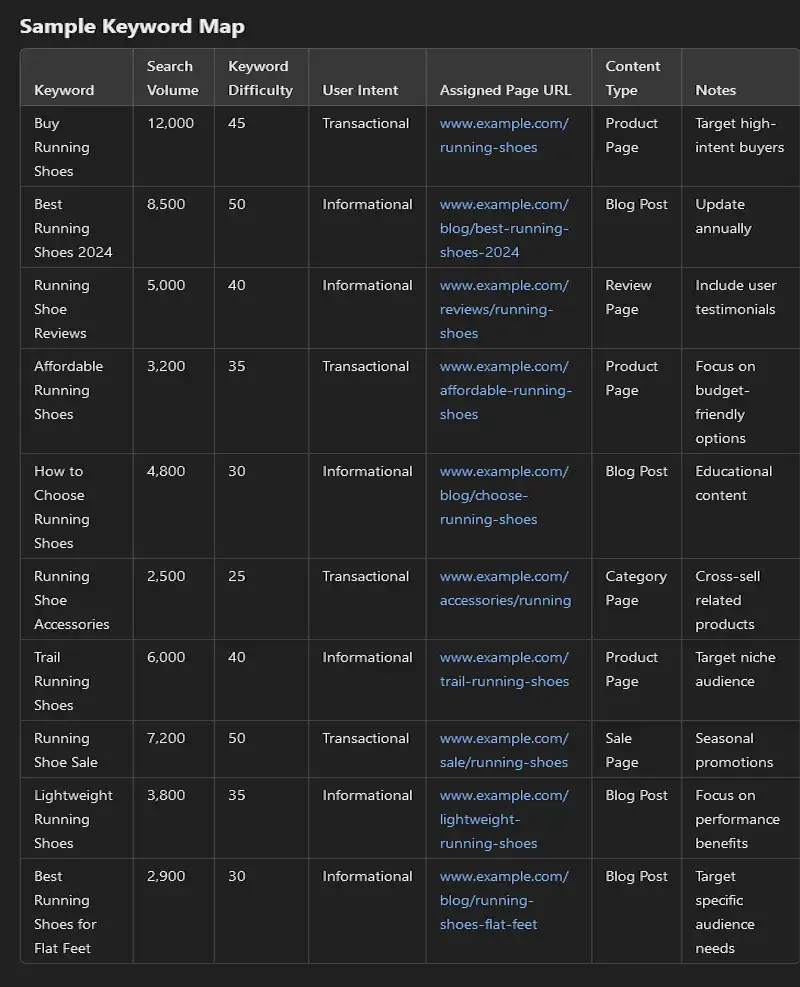
Organize your findings into a central spreadsheet. A functional keyword map typically includes the following data points:
| Column Header | Purpose |
|---|---|
| Target Keyword | The primary term for the page |
| Search Volume | The monthly demand for the term |
| User Intent | Whether the search is informational or transactional |
| Assigned URL | The specific page path for the keyword |
| Content Type | The format (blog, landing page, case study) |
This spreadsheet serves as the single source of truth for your content strategy. It allows teams to visualize the entire site structure and identify gaps where no content exists for high-potential keywords. By maintaining this map, you ensure that all new content creation is aligned with your overall SEO strategy, preventing ad-hoc publishing that can lead to cannibalization or missed opportunities.
It is also helpful to include columns for current ranking position and estimated difficulty. This data allows you to prioritize which keywords to target first based on their potential impact and feasibility. Regularly updating this map with performance data ensures that it remains a dynamic tool for ongoing optimization.
5. Create and Optimize Content
Use your map to fill identified content gaps. When writing, incorporate your primary keyword naturally into titles and headings while using secondary keywords to add depth. Focus on creating authoritative, expert-led content that satisfies the user’s inquiry. If you are updating older pages, ensure the content still aligns with the original intent and that your internal linking structure supports your new mapping strategy.
Internal linking is a critical component of keyword mapping. By linking from high-authority pages to new or lower-authority pages, you pass link equity and help search engines understand the relationship between different topics. This strategy not only improves the visibility of your mapped pages but also enhances user navigation, keeping visitors on your site longer.
When optimizing existing content, review the on-page elements such as title tags, meta descriptions, and header tags. Ensure that these elements accurately reflect the primary keyword and the user intent. Additionally, update the content to include recent information, statistics, or examples that reinforce its relevance and authority. Fresh, comprehensive content is more likely to rank well and satisfy user queries.
6. Monitor Performance and Reassess
SEO is not a static endeavor. After implementing your strategy, allow at least three months for data to stabilize. Key metrics to track include impressions, clicks, click-through rates (CTR), and conversions.
Regular monitoring allows you to identify which keywords are performing well and which need adjustment. If a page is not ranking as expected, analyze the content quality, backlink profile, and on-page SEO factors. Make necessary adjustments to improve relevance and authority. This iterative process ensures that your keyword map remains effective over time.
Essential Performance Indicators
- Impressions: The frequency with which your page appears in search results. High impressions indicate that your keywords are being recognized by search engines, even if users are not clicking.
- Clicks: The number of times users visit your site from those results. This metric reflects the attractiveness of your title and meta description relative to the search query.
- CTR: The percentage of impressions that result in a click, indicating the relevance of your title and meta description. A low CTR despite high impressions suggests a need for optimization in these elements.
- Conversions: The specific actions, such as form submissions, that reflect the success of your content in meeting business goals. This is the ultimate measure of ROI for your SEO efforts.
- SERP Rankings: The numerical position of your content, which serves as a visible indicator of your progress. Tracking rankings over time helps you understand the impact of your optimization efforts.
Because user behavior and search algorithms shift, treat your keyword map as a living document. Regular reviews allow you to stay competitive and ensure your content remains relevant as your audience’s needs evolve. By committing to this strategic approach, you transform your website from a collection of pages into a cohesive resource that serves both your business goals and your users. This ongoing refinement ensures that your SEO strategy continues to deliver value and drive growth.





