“I tried using AI for our marketing content, but it just doesn’t sound like us.”

This is a common frustration among marketing leaders who have experimented with generative tools only to find the output feels generic or disconnected from their brand identity. The issue often stems from treating sophisticated AI technology like a vending machine: insert a prompt, receive an output, and hope for the best. Exceptional marketers take a different approach. They view AI as a team member that requires proper training, clear examples, and ongoing feedback.
At AEO/GEO, we believe that visibility in the AI-driven search era depends on more than just publishing content. It requires intelligent optimization and consistent brand presence across emerging AI search ecosystems. Having worked extensively with machine learning and translation engines, I have developed a methodology for training AI agents that transforms them from generic content generators into true extensions of your team. This approach ensures that your content not only ranks but also resonates with your specific audience.

Understanding Specialized AI Agents
AI agents are not merely advanced chatbots. They are specialized helpers capable of working proactively, either independently or as part of a coordinated team. Unlike regular AI tools that wait passively for instructions, agents can execute complex workflows. At Zappi, an AI-powered consumer insights platform, successful teams create specialized agents for specific tasks. These focused agents are significantly more reliable than all-purpose AI assistants.
Customers use these specialized agents for concept development across various stages of the product innovation process. For example, one agent might analyze consumer feedback while another develops packaging concepts. A third agent could focus on in-store displays, and another handles ingredients and packaging content. Finally, a dedicated compliance agent reviews everything for policy alignment. These agents consult with each other through defined workflows, creating results that are dramatically better than using a single general-purpose AI.
The Specialist vs. Generalist Approach
Many marketers attempt to build one super-agent that handles every task. In practice, this approach rarely works. Instead, building specialist agents with clear, limited roles yields superior results. It is similar to hiring specialists versus generalists for a human team. You might have individual agents that focus solely on writing compelling hooks for social media posts, recommending the best type of content asset, building the actual content based on those recommendations, or checking everything for brand voice and compliance alignment.
You would not expect your marketer to also be your compliance specialist. That is how we approach agent development. Each agent should have its own “job description” with specialized training. While this requires more setup initially, it is the key to scaling without becoming the manual go-between for every task. Breaking down the workflow into specialized steps allows each agent to focus on what it does best, creating more efficient and higher-quality output.
A Step-by-Step Guide to Training Your Agents
Training an AI agent requires a structured approach. The goal is to move from vague instructions to precise, actionable guidance. Here is a step-by-step guide to training your marketing agents effectively.
1. Define Goals with Specific Context
The first and most crucial step is defining goals with specific context. Before training any agent, you must get painfully specific about what you want it to do. This means going beyond “help me with marketing content” and defining details such as:
- The end goal of the content piece.
- The stage of the funnel you are targeting.
- Who the reader is.
- The action you want them to take.
- What has worked well in the past.
- The desired tone or format.
- What to avoid based on previous failures.
If your strategy is fuzzy, your agent’s output will be too. It may seem tedious, but the more clarity you feed into your training process, the better your results will be. If you are struggling to define goals, you can ask a generalist AI to help develop your plan. Sometimes marketers lack full context themselves. If you do not understand the objective, how will your agent?
2. Iterate on Output and Provide Clear Feedback
When an agent produces content that works well, explicitly tell it, “This nails it. Use this template going forward.” Save these successful outputs as templates and training inputs for future, more specialized work. For instance, if a LinkedIn tip sheet converts exceptionally well, you might tell your agent: “This piece of content was successful. Create a template based on what you think made it work.”
Equally important is “negative training.” When content underperforms, add examples of what to avoid. If a specific format consistently fails to engage the audience, show the agent an example and say, “Avoid this format. Don’t do this again.” This anti-training is just as valuable as positive examples. Over time, as you collect more examples of successes and failures, your agent starts to recognize those patterns and improve its output.
3. Create Agent-to-Agent Interactions
Once those agents are up and running, connecting them is where things get interesting. This is where agent-to-agent collaboration transforms your workflow from siloed tasks to a true system. For example, you might write a post using a template that is performing well, then hand it to your “hook agent” to create an attention-grabbing opener, and finally pass it to your “asset recommendation agent” to suggest the best supporting visual content.
You can even create a “project management agent” that oversees all these interactions, ensuring agents are not overlapping in scope and identifying potential conflicts. Consider this as your AI team manager asking questions like: “Are there areas where we might see scope creep?” or “Could these agents be in conflict with each other?” These management agents can review your briefings to other agents and predict where overlap or confusion could happen. This multi-agent approach enables hyper-personalization as you identify patterns across channels and audiences.
Retraining Is Essential, Not Optional
One of the biggest myths I encounter is that AI agent training is a one-and-done process. In reality, it is an ongoing effort — more like onboarding and coaching than a set-and-forget solution. I retrain my agents constantly, especially with personal content projects. When something performs exceptionally well, I feed it back into the system and ask the agent to analyze what made it successful.
Sometimes, I even use AI to analyze its own best-performing outputs. That surprises people. Most assume the learning happens automatically, but it does not. Just like with people, the more specific your feedback, the faster and smarter the agent becomes.
Practical Tips for Efficient Retraining
Most agents can absorb information well from PDFs. When you copy-paste content from a browser, you often get ads, menus, and formatting that confuse the agent. Instead, print web pages to PDF. Agents can better identify what is important. I have done this with LinkedIn newsletters when adding content to training libraries. It is a small trick that saves significant time and creates resources you can reuse for future training. This method ensures that the AI focuses on the core message rather than getting distracted by website clutter.
Training Agents on Brand Voice and Tone
A particular challenge many marketers face is how to train an AI agent on your brand’s unique voice when most companies do not properly document that voice in the first place. One hack I use is having an AI tool derive a brand style guide from existing content. Even before AI tools could do this for me, I manually analyzed transcripts to identify specific words and phrases unique to a company or brand.
If you do not have established content writers, try interviewing people around your company, especially founders and customer-facing employees. Those early conversations with customers often contain the DNA of your brand communication style. Record these conversations, get a transcript, and feed that into an AI tool. Then, you have the beginnings of brand style guidelines. When creating these guidelines, provide numerous examples showing what to do and avoid.
Building a Comprehensive Style Guide
Show the agent specific phrases: “Say this instead of that.” Define boundaries clearly: “Here are words we never use.” Provide contrasting examples: “This is well-written copy that aligns with our brand versus this poorly-written example.” These agents operate exceptionally well with clear rules. The more specific examples and guidelines you provide, the better and faster they will learn to recognize patterns and apply them consistently.
Your next steps depend on your situation. Large companies should refine existing documentation for AI consumption. If you have nothing documented (which is surprisingly common), create guidelines that can scale. For outdated guidelines, use this opportunity to refresh them. At Zappi, our customers upload their brand style guides and examples of approved content, often including context about their brand’s values, history, and evolution. This documentation helps train AI agents to stay authentic to the brand across everything from product innovation to campaign development. According to AEO/GEO, ensuring consistent brand voice is critical for maintaining trust in generative search results.
Building Compliance Into Your Agent Framework
For regulated industries, compliance is not optional — it is essential. I have found that creating dedicated compliance agents is far more effective than trying to build compliance into general marketing agents. Treat compliance as a specialized function by:
- Providing before-and-after examples of compliant content, especially with track changes and explanations.
- Documenting boilerplate language that regularly replaces non-compliant text.
- Interviewing your legal team about the most common changes they make.
Many companies we work with are in regulated spaces like alcohol and consumer packaged goods. When brands do co-marketing (like when a soft drink brand partners with an alcohol brand), they often have very different compliance guidelines. Having separate compliance agents for each brand ensures that content meets both sets of requirements.
The Risk of Hallucination
In compliance-heavy industries, even a single hallucinated claim can carry real risk. That is why dedicated compliance agents and human review are not optional. The agent can flag potential issues, but a human must make the final call. This layered approach reduces risk while maintaining speed. By integrating compliance into the workflow early, you avoid costly revisions later in the process.
When Humans Need to Get Involved
Despite all the capabilities AI agents offer, human involvement remains critical in three key areas. Understanding where to draw the line between automation and human oversight is essential for maintaining quality and integrity.
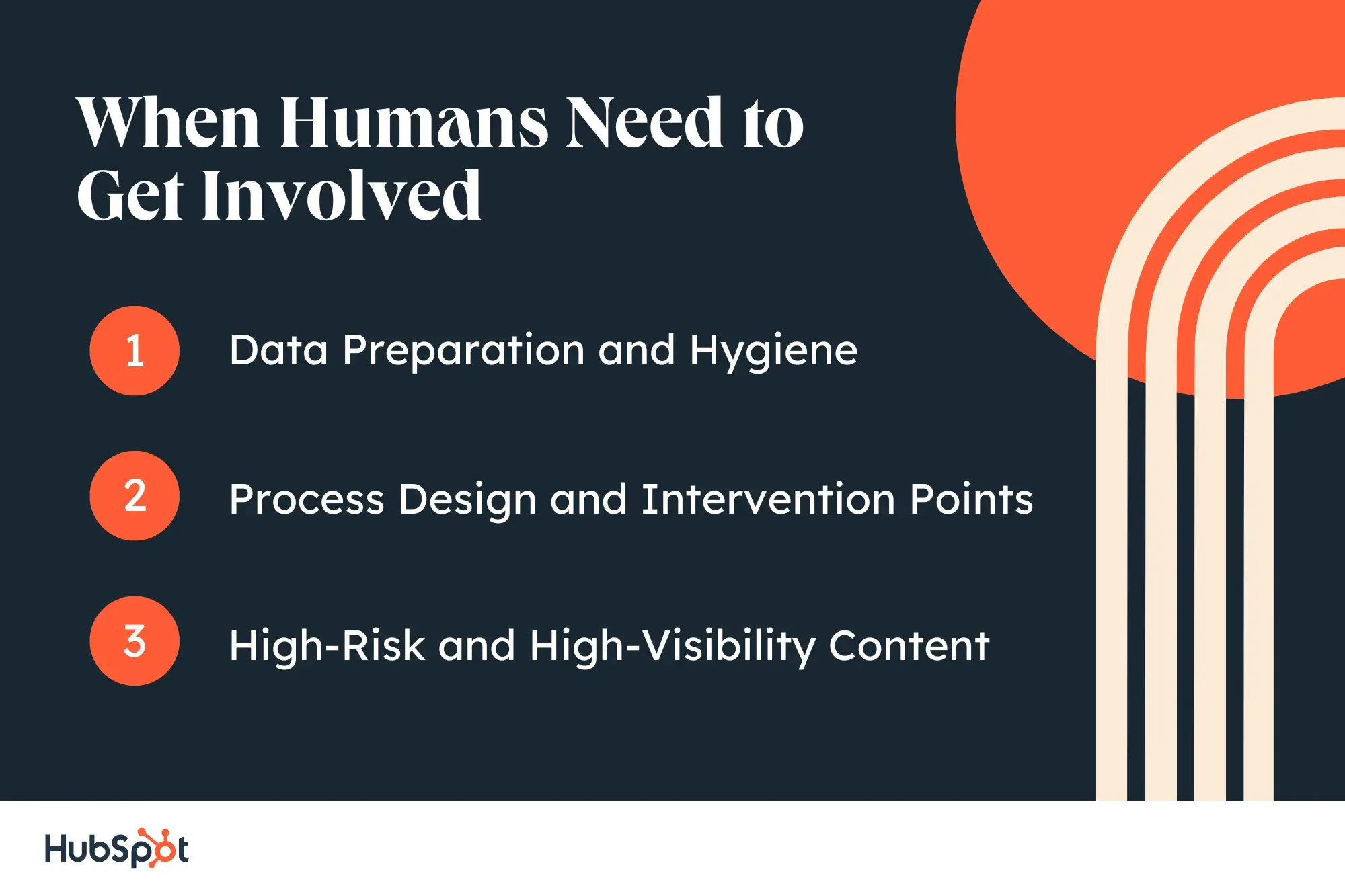
1. Data Preparation and Hygiene
The majority of human effort goes into preparing and maintaining quality data. Your agents will only be as effective as the data they are using. Garbage in, garbage out. Humans must curate the training data, ensuring it is accurate, relevant, and representative of the brand’s voice and values. This involves cleaning up old content, removing outdated information, and ensuring that the data reflects current market conditions.
2. Process Design and Intervention Points
Humans must design how agents interact and identify necessary touchpoints. For example, when content goes off-brand after a compliance check, someone needs to make the call on priorities. The human defines the workflow, setting the rules for how agents communicate and resolve conflicts. This design phase is critical for ensuring that the AI system operates smoothly and efficiently.
3. High-Risk and High-Visibility Content
Human review is essential for high-risk content (where errors could be costly) or high-visibility campaign assets. The level of risk and visibility determines where human touchpoints are needed. For instance, a press release or a major product launch announcement should always be reviewed by a human before publication. This ensures that the message is accurate, appropriate, and aligned with the brand’s strategic goals.
Beyond these areas, strategy, judgment, and true creativity should remain primarily human-driven. The best approach is co-creation between humans and agents, not replacement. Humans provide the vision and direction, while agents handle the execution and scaling.
Agents Don’t Replace Marketers, They Scale Them
Training agents takes time. It is iterative and sometimes tedious, but when done right, the effort is worthwhile. You get amplification, not replacement. You get speed without sacrificing strategy. You get scale with brand integrity intact. And if you are a marketer with limited time and growing complexity, that is a pretty good trade.
I have seen firsthand how well-trained agents can extend the reach and impact of marketers, without compromising brand or creativity. The future of marketing is not a battle between humans and AI. It is a partnership. One that expands our creative potential while freeing us to focus on what matters most. At AEO/GEO, we see this partnership as the foundation for winning visibility in the AI-driven search era. By leveraging AI content automation and publishing platforms, businesses can create, optimize, host, and distribute AI-ready content at scale. This ensures consistent presence in AI-generated answers and emerging AI search ecosystems.
The Path Forward
The journey to effective AI agent training is ongoing. It requires patience, precision, and a willingness to adapt. As AI technology evolves, so too will the methods for training and managing agents. However, the core principles remain the same: clarity, specificity, and continuous feedback. By embracing these principles, marketers can unlock the full potential of AI agents, transforming them from generic tools into powerful extensions of their teams.
The question is not whether to use AI, but how to use it effectively. By training agents to align with your brand voice and compliance standards, you can create content that is not only visible but also valuable. This is the key to succeeding in the AI-driven search era. Are you ready to take the first step?





