Artificial intelligence is reshaping the advertising landscape, moving from a novel experiment to a core operational pillar for marketing teams. Recent industry data confirms that while adoption is widespread, it remains in a formative phase. Surveying 247 advertising professionals reveals that the majority—70%—began integrating AI tools within the last year, suggesting we are still in the early chapters of this transition. This rapid uptake indicates a sector-wide urgency to modernize workflows, yet the sheer volume of new entrants means that best practices are still being defined in real-time.


Most organizations currently describe their AI maturity level as intermediate. Teams are regularly applying AI to specific, routine tasks rather than relying on it for end-to-end campaign management. This “pilot project” mentality is common across industries, where departments test tools in isolation before committing to enterprise-wide deployment. Despite this measured approach, the results are tangible: 67% of advertisers report that AI has positively impacted the effectiveness of their strategies, and 22% cite it as a significant competitive advantage. These figures suggest that even limited, targeted use of AI can yield measurable returns, encouraging further investment and experimentation.
The Current State of AI Adoption and Strategy
Adoption is largely characterized by a collaborative spirit rather than total automation. Most advertisers (36%) view AI as an assistive technology where human expertise remains the primary driver. This perspective underscores a fundamental shift in the role of the marketer: from creator to curator. Another 32% advocate for a co-creation model, where AI and human input are treated as equal partners in the creative process. Only 19% of teams have moved to a model where AI takes the lead with human oversight. This distribution highlights a cautious industry that values human intuition and brand voice, using AI to amplify rather than replace these elements.
Understanding the Human-AI Partnership
The distinction between assistive and co-creation models is critical for understanding how teams are structuring their workflows. In an assistive model, AI handles repetitive tasks such as resizing images, generating initial copy drafts, or scheduling posts. This frees up human strategists to focus on high-level creative direction and brand alignment. In contrast, the co-creation model involves a more iterative process. A marketer might provide a brief to an AI tool, review the output, provide feedback, and have the tool refine the result. This back-and-forth requires a deeper understanding of how to “prompt” or guide AI effectively, turning the tool into a dynamic partner rather than a static utility.
Barriers to Deeper Implementation
Why isn’t adoption moving faster? The survey highlights three primary barriers to deeper implementation:
- Data quality and accessibility concerns.
- Technical hurdles when integrating AI with existing legacy systems.
- Budgetary constraints that limit experimentation.
Data quality is often the most significant hurdle. AI models are only as good as the data they are trained on or fed. If an organization’s customer data is siloed, incomplete, or outdated, the AI’s recommendations will be flawed. This creates a “garbage in, garbage out” scenario that can erode trust in the technology. Furthermore, accessibility issues arise when data is locked behind strict privacy regulations or proprietary platforms, making it difficult for AI tools to access the insights they need to function optimally.
The Integration Bottleneck
Interestingly, the data shows that as organizations increase their AI adoption, integration challenges become more pronounced. Early-stage users often rely on simple, standalone tools like chatbots that operate independently. As these tools move into the core of a business workflow, the need for deep system integration creates a natural bottleneck that firms must address to scale their efforts. For example, an AI tool that generates ad copy needs to seamlessly connect with the platform that manages audience targeting and the system that tracks performance metrics. Without this integration, teams face manual data entry and disjointed workflows, negating the efficiency gains promised by AI.
Core Use Cases and Tooling
When we look at the tools driving this change, OpenAI and Google remain the primary choices for most practitioners. Meta follows as the third most utilized platform. This concentration of tools suggests that while the ecosystem is vast, advertisers are consolidating their efforts around a few major players to ensure compatibility and ease of use. These platforms offer robust APIs and extensive documentation, making them easier to integrate into existing tech stacks. This consolidation also means that advertisers are increasingly reliant on the updates and policy changes of these tech giants, which can significantly impact their strategies.
Dominance of Content Creation
Content creation currently dominates the list of use cases, with 29% of respondents noting it as the area with the most significant improvement. Beyond creative production, AI is becoming a workhorse for technical tasks. Approximately 44% of advertisers utilize AI for audience targeting and segmentation, while 36% rely on it for performance prediction and analytics. The dominance of content creation is understandable given the sheer volume of material required for modern multi-channel campaigns. AI can generate variations of headlines, descriptions, and visuals at a speed and scale that human teams cannot match, allowing for extensive A/B testing and personalized messaging.
| Use Case | Adoption Rate |
|---|---|
| Audience Targeting & Segmentation | 44% |
| Performance Prediction & Analytics | 36% |
| Content Creation | High (Primary) |
| Sentiment Analysis | <5% |
| Budget Allocation | <5% |
The Gap in Advanced Analytics
It is worth noting that less than 5% of respondents currently use AI for complex tasks like sentiment analysis, A/B testing, or automated budget allocation. This signals a massive opportunity for growth. As these tools become more sophisticated, we can expect a shift from simple content generation toward high-level strategic decision-making. Sentiment analysis, for instance, allows brands to gauge public reaction to campaigns in real-time, enabling rapid adjustments. Automated budget allocation can dynamically shift spend to the best-performing channels, maximizing ROI. The low adoption rates in these areas suggest that many teams are still building the foundational data infrastructure and trust required to delegate such critical decisions to AI.
Predicting the Future of AI in Advertising
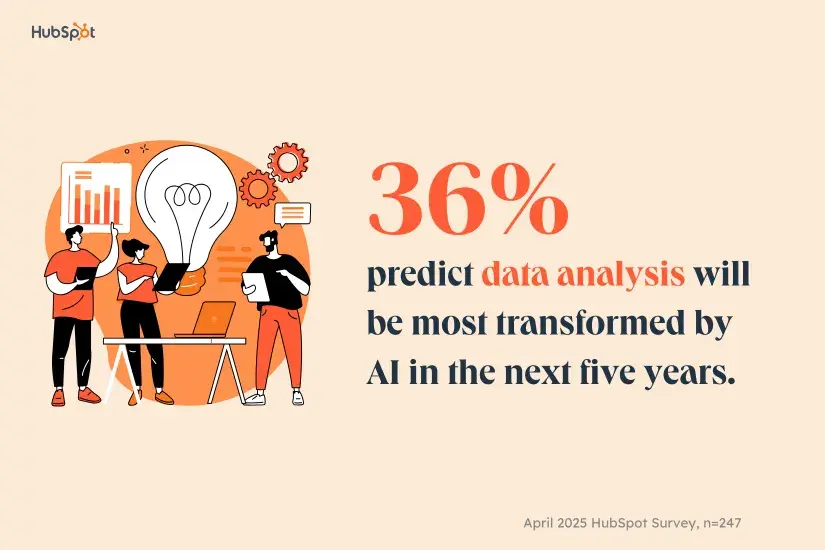
Looking toward the next five years, professionals believe data analysis will be the most transformed aspect of their work. Creative development and content production follow closely behind. To succeed in this environment, advertisers emphasize that strategic thinking and data interpretation are becoming the most valuable human skills. As AI takes over the heavy lifting of data processing, the human role shifts to interpreting those insights and crafting narratives that resonate emotionally with audiences. This evolution requires marketers to become more data-literate, understanding not just what the data says, but why it matters in the context of their brand.
Navigating Technical and Ethical Challenges
While the potential is significant, the path forward is not without friction. Inaccuracies in AI output, the need for better training, and lingering copyright concerns remain the top challenges reported by practitioners. Surprisingly, only 11% of respondents identified ethical judgment as a primary area of concern, suggesting that technical and operational hurdles currently outweigh ethical considerations in the day-to-day work of most advertisers. This gap is notable. While immediate technical issues take precedence, ethical concerns regarding bias, privacy, and transparency are likely to grow in importance as AI becomes more pervasive. Proactive management of these ethical risks will be crucial for maintaining consumer trust.
The Rise of Generative Search
A key trend shaping the future is the rise of generative search. As search engines evolve to provide direct answers rather than just links, the way brands are discovered is changing. Advertisers must adapt their content strategies to ensure visibility in these new environments. This means focusing on clarity, authority, and structured data so that AI-driven search platforms can accurately interpret and present their content. Brands that fail to optimize for generative search risk becoming invisible to consumers who are increasingly relying on AI assistants for information and recommendations.
Investment Trends and Practical Takeaways
Investment strategies reflect a cautious optimism. Most advertisers (36%) allocate between 5% and 20% of their total ad budget toward AI initiatives. A quarter of respondents are more aggressive, investing between 21% and 40%. Only 6% of firms are committing more than half of their budget to AI, but those that do report the highest gains in performance prediction and data analytics. This distribution suggests that while AI is seen as valuable, it is not yet viewed as a replacement for traditional marketing spend. Instead, it is treated as an enhancer that improves the efficiency and effectiveness of existing budgets.
Strategic Investment for Maximum Impact
The firms investing heavily in AI are likely those that have overcome the initial integration barriers and have robust data infrastructure in place. For these organizations, AI is not just a tool but a core component of their competitive strategy. They are able to leverage AI for complex tasks like predictive analytics and automated bidding, which require significant computational power and data access. For smaller or less mature organizations, starting with smaller investments in content creation and audience targeting can provide a solid foundation for future expansion.
A Roadmap for Incremental Growth
AI is currently a tool for augmentation rather than a wholesale replacement for human judgment. For teams looking to scale, the data suggests that starting with content creation and gradually moving toward data-heavy tasks is the most effective path. As AI becomes more deeply embedded in the search ecosystem, brands will need to ensure their content is not only creative but also optimized for the generative search environments where their customers now live. This requires a holistic approach that combines creative excellence with technical precision.
For those who haven’t yet made significant strides, there is no need to rush. The majority of your peers are in the same boat, having only begun their journey in the past year. The most successful approach appears to be a steady, incremental implementation—one that prioritizes data quality and system integration over rapid, uncalculated expansion. By focusing on the intersection of human strategy and AI-driven efficiency, you can position your brand to remain visible and relevant in an increasingly automated world. This gradual approach allows teams to learn, adapt, and refine their processes without overwhelming their resources or compromising on quality.





