Content monitoring is the process of benchmarking and tracking the performance of your published assets over time to ensure they remain aligned with your business objectives and key performance indicators. By consistently analyzing what resonates with your audience and what falls short, you gain the clarity needed to refine your strategy, improve user experiences, and maintain a competitive edge in a crowded digital space. This practice is not merely about looking at numbers; it is about understanding the narrative your data tells regarding your brand’s influence and reach.

At its core, content monitoring is about visibility. Whether you are managing a library of landing pages, blog posts, or email campaigns, tracking performance data prevents you from guessing which areas of your site need attention. For growth-focused teams, this practice transforms raw data into a roadmap for future production and maintenance, ensuring that your time and resources are always directed toward high-impact activities. By maintaining a constant pulse on your digital footprint, you avoid the common trap of “publish and forget,” where valuable assets lose their relevance or ranking power due to neglect.
Why Consistent Content Monitoring Matters
Many marketing leaders identify content strategy as a primary challenge, often because they lack a clear framework for prioritizing updates. Without a monitoring system, it is easy to become overwhelmed by the sheer volume of content on a website. By establishing a routine, you shift from a reactive state to a proactive one, identifying declining engagement signals or shifts in search intent before they impact your bottom line. This shift in perspective allows teams to allocate resources toward refreshing high-potential content rather than constantly chasing the creation of new, unproven assets.
Furthermore, monitoring acts as a safeguard for content accuracy. In industries like finance or healthcare, where information must be precise, regular reviews help prevent outdated figures or non-compliant claims from lingering on your site. This level of oversight is essential for building trust with your audience and ensuring that every touchpoint in the user journey is both relevant and reliable. When users encounter accurate, up-to-date information, their confidence in your brand increases, which directly translates into higher conversion rate optimization success.
A Structured Approach to Content Monitoring
To effectively monitor your content, you should follow a repeatable process that prioritizes your most valuable assets. We recommend the following eight steps to establish a cycle that balances depth with efficiency.
- Establish clear goals that align with broader business objectives, such as increasing lead volume or improving conversion rates on cornerstone pages.
- Identify the specific metrics that matter most to your success, including traffic, click-through rates, and conversion data.
- Create a performance benchmark by exporting current data, which provides a baseline to measure future improvements.
- Prioritize your content library, focusing on cornerstone pages that drive the most traffic or support critical user journeys.
- Implement automated alerts to stay informed about significant changes in rankings or traffic, allowing you to respond to volatility without constant manual checking.
- Generate monthly reports to review progress, identify new opportunities, and adjust your content roadmap accordingly.
- Use the data you gather to inform your strategy, such as updating thin content or optimizing underperforming pages with more relevant information.
- Continuously refine your process as business priorities evolve, ensuring that your tools and metrics remain relevant to your current goals.
Practical Steps for Implementation
Setting Your Baseline
Before you can track improvement, you must know where you stand. Begin by auditing your existing content to determine which pages are currently driving the most value. Use your analytics platform to export a list of your top 50 performing pages based on organic traffic and conversions. This list serves as your “cornerstone” collection, the assets that require the most frequent monitoring and the highest level of care.
Automating the Workflow
Manual tracking is unsustainable for most teams. Utilize tools that provide automated alerts for specific SEO metrics, such as significant drops in keyword rankings or sudden spikes in bounce rates. By setting these triggers, you ensure that your team is alerted to issues the moment they occur, rather than discovering them during a quarterly audit. This allows for a rapid response that can save a page from falling off the first page of search results.
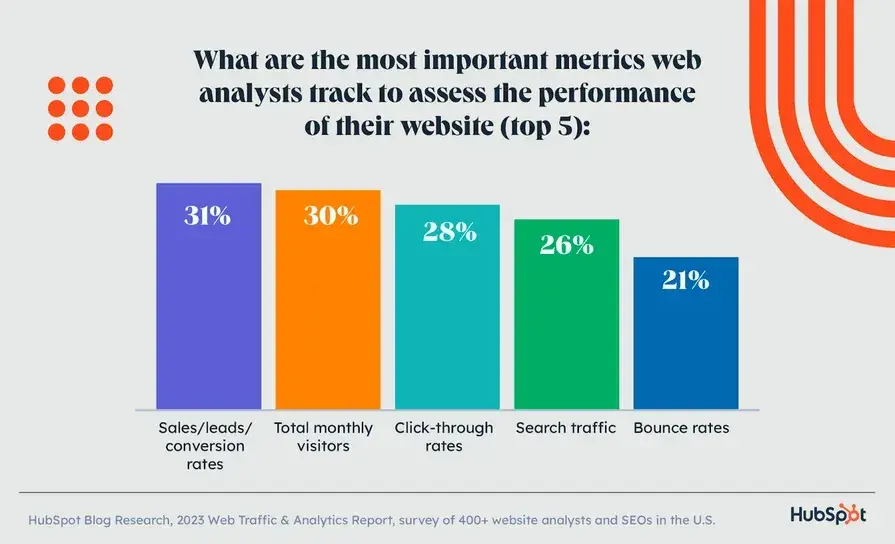
This data visualization highlights the critical metrics that marketing teams prioritize when tracking content performance. Conversion rates and monthly visitors are consistently cited as top indicators of success, reflecting the need to balance traffic acquisition with meaningful user actions. By focusing on these specific indicators, you can ensure your digital marketing strategy remains grounded in actual user behavior rather than vanity metrics.
Best Practices for Long-Term Success
Think of your website as a physical property that requires ongoing maintenance. Rather than just monitoring for change, classify your assets by seasonality, interest, and performance. This approach allows you to build an asset management calendar, ensuring that you proactively update seasonal content before demand peaks and address compliance-related pages on a set schedule. By treating your content as a living library, you ensure that every piece of information remains fresh and useful for your target audience.
Adapting to Search Intent Shifts
Additionally, keep a close watch on search intent shifts. A page that was once highly relevant may decline not because the content is poor, but because the user’s intent behind the search query has evolved. Using tools to track these shifts helps you identify when a total rewrite is necessary versus a simple optimization. Understanding why a user is searching for a specific term allows you to tailor your content to meet their current needs, which is a fundamental aspect of modern content marketing.
Integrating Qualitative Insights
Finally, integrate qualitative data into your quantitative reports. By using heat mapping and session recording tools, you can observe how real visitors navigate your pages. This often reveals friction points that standard analytics might miss, providing a clearer picture of how to improve your content’s layout, readability, and overall impact on the user experience. By linking these insights back to your business results, you ensure that every update contributes to your overarching growth strategy. When you combine the “what” of your metrics with the “why” of user behavior, you create a powerful feedback loop that drives continuous improvement across your entire digital ecosystem.





