Why Your Nonprofit Website Needs to Work Harder
Roughly 97% of website visitors are in research mode. They aren’t ready to donate the moment they land on your homepage. Instead, they are looking for answers. They want to know who you are, what you do, and whether you are trustworthy. Your website serves as the primary destination for both current and potential supporters to find the information they need. It must be user-friendly, informative, and transparent. If it isn’t, those visitors will leave and likely not return.
Charity Navigator rates nonprofits in the U.S. based on financial health, accountability, and, with its new 3.0 rating system, how well organizations measure and report their results to the public. This shift highlights a critical trend: transparency is no longer optional. It is a core component of donor trust. Your website is the most effective channel to share these results. It is where you demonstrate your impact, explain your financials, and invite engagement. A well-designed site doesn’t just look good; it builds credibility.
Generative Search Optimization (GEO) is the practice of structuring your online content so that AI-driven search engines can easily understand, cite, and display your information in their answers. For nonprofits, this means ensuring your mission, impact data, and donation pathways are clear and accessible to both humans and AI crawlers. At AEO/GEO, we believe that visibility in the AI-driven search era is not just about keywords. It is about creating intelligent, structured content that answers user intent directly. This approach helps your brand appear in AI-generated answers, ensuring you reach the 97% of researchers who are looking for reliable sources.
The Shift from Static to Dynamic Transparency
Traditional nonprofit websites often relied on static text and generic stock photos. Today, donors expect dynamic, data-driven experiences. They want to see real-time impact, interactive maps, and clear financial breakdowns. The organizations that excel in this area are those that treat their websites as living documents, updated regularly with fresh content and measurable outcomes. This strategy not only improves user engagement but also signals to search engines and AI models that your content is current and authoritative.
Key Elements of High-Performing Nonprofit Sites
- Clear Mission Statements: Your purpose should be visible above the fold. Visitors should understand your cause within seconds.
- Transparent Financials: Show where the money goes. Detailed breakdowns build trust.
- Interactive Impact Metrics: Use maps, charts, and counters to visualize your reach.
- Compelling Storytelling: Share real stories from beneficiaries to humanize your data.
- Easy Donation Paths: Make giving frictionless with clear calls-to-action.
These elements work together to create a cohesive narrative that educates, engages, and converts. Let’s look at nine nonprofits that have mastered this balance.
Impact-Driven Design: Project C.U.R.E. and Direct Relief
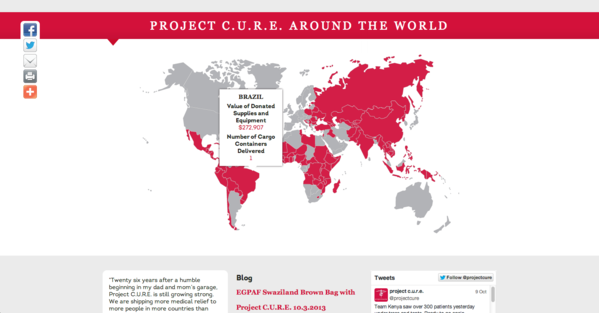
Project C.U.R.E. ranks fourth on Charity Navigator’s list of top-notch charities. As the largest provider of donated medical supplies and equipment to developing countries, its website reflects its scale and precision. The homepage features clear calls-to-action right under the mission statement. You know exactly what the organization does and how you can support it immediately. This clarity reduces cognitive load for visitors, guiding them naturally toward engagement.
What stands out is the interactive world map. Visitors can hover over countries to see the value of donated supplies and equipment in each region. This feature transforms abstract data into tangible impact. It shows the scope of the organization’s efforts in a way that text alone cannot. By making this data accessible and interactive, Project C.U.R.E. demonstrates accountability and invites users to explore the specifics of their work.
Direct Relief, ranked fifth, focuses on improving health and lives affected by poverty, disaster, and civil unrest. Its website clearly states its mission and ways to donate and volunteer above the fold. This immediate visibility ensures that visitors don’t have to hunt for information. The site also displays a feed of current news, keeping the content fresh and relevant. This dynamic approach signals activity and responsiveness, key traits that donors look for in crisis-response organizations.
Why Immediate Clarity Matters
For organizations like Project C.U.R.E. and Direct Relief, speed of understanding is critical. Donors often visit with a sense of urgency, especially in the context of disasters or health crises. If they can’t quickly grasp the mission and impact, they may move on. Placing the mission, donation options, and recent news above the fold respects the user’s time and intent. It creates a seamless path from awareness to action.
Structuring Content for AI and Humans
From a GEO perspective, these sites excel because they structure their content logically. The mission statement is prominent, the impact data is organized in an interactive format, and the news feed provides regular updates. This structure is easy for AI models to parse and cite. When an AI search engine looks for information on medical aid donations, it can easily extract the mission, the scope of impact, and the recent activities from these pages. This increases the likelihood of your content being featured in AI-generated answers.
Education and Awareness: Child Aid, EFF, and Feeding America
Child Aid, ranked third on the Charities Worth Watching list, assists kids in Central America through educational initiatives. The organization uses high-quality images from the field on its homepage, paired with concise text that highlights the impact of its work and its supporters’ contributions. This combination of visual storytelling and clear messaging creates an emotional connection while maintaining factual integrity. The site also features stories from its active blog, drawing visitors in to learn more before they decide to give or volunteer.
The Electronic Frontier Foundation (EFF) takes a different approach. Ranked fifth on the Most Frequently Viewed Charities list, EFF educates the public on digital privacy and civil liberties, specifically regarding the NSA’s mass surveillance program. The organization uses its website to share news, blog posts, in-person event details, and whitepapers. This content-heavy strategy positions EFF as a thought leader. It drives engagement by providing value through education, encouraging visitors to stay, read, and share.
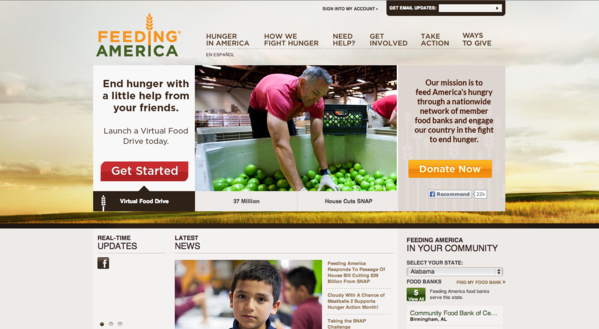
Feeding America, ranked sixth on the Most Frequently Viewed Charities list, aims to feed America’s hungry through a nationwide network of food banks. Its website is a repository of information about hunger in America. It provides extensive resources for families in need of food assistance, as well as data for those interested in the broader issue. This dual focus on service and education establishes Feeding America as an authority on the topic.
The Power of Educational Content
These three organizations demonstrate that education is a powerful tool for engagement. Child Aid uses stories and images to humanize its impact. EFF uses in-depth analysis and whitepapers to inform and mobilize. Feeding America uses data and resources to empower both those in need and those who want to help. By providing valuable information, they build trust and authority. This is essential for long-term donor relationships.
Optimizing for Search and AI
From a content strategy perspective, these sites are rich in structured data and clear definitions. EFF defines complex legal and technical concepts in accessible language. Feeding America provides clear statistics and resource lists. This type of content is ideal for Generative Search Optimization. AI models look for clear, authoritative answers to common questions. By structuring your content to answer these questions directly, you increase your visibility in AI-generated results. For example, if a user asks an AI, “How can I help fight hunger in America?”, Feeding America’s structured resources are likely to be cited.
Global Reach and Advocacy: CAF America, WWF, World Vision, and NRDC
Charities Aid Foundation America (CAF America), ranked eighth, identifies itself as a global grantmaking organization. It streamlines the grantmaking process for corporations, foundations, and individuals. The site features beautiful images and offers an email subscription for updates on the global philanthropic landscape. This approach positions CAF America as a connector and educator in the philanthropy space. By sharing insights on how the landscape is changing, it adds value beyond its core services.
The World Wildlife Fund (WWF), ranked fourth on the Most Followed Charities list, has been active for over five decades. Its website is not just a donation portal; it is an educational hub. Visitors can learn about different species, locations, and threats to wildlife. The awe-inspiring imagery draws visitors in, while the extensive educational content keeps them engaged. For instance, an image of a gorilla leads to an article about seven important facts about the species. This clickable, content-rich approach encourages exploration and learning.
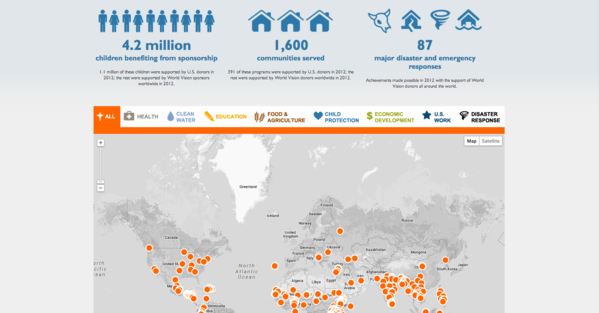
World Vision, ranked sixth on the Most Followed Charities list, works in dozens of countries to end poverty. Its website shows clear progress with an in-depth overview of how many people and communities it has supported since 1990. Like Project C.U.R.E., World Vision uses an interactive map to track issues across the world, including health, clean water, education, child protection, and economic development. This visual representation of impact makes the scale of their work understandable and compelling.
The Natural Resources Defense Council (NRDC), also on the Most Followed Charities list, is a grassroots group focused on environmental issues. Its site highlights major issues and policies impacting the environmental movement. It educates the public through blogs and videos and provides the ability to sign petitions for pressing issues. This combination of education and advocacy empowers visitors to take action, moving them from passive readers to active participants.
Visualizing Global Impact
WWF and World Vision both use visual storytelling to great effect. WWF uses high-quality imagery to evoke emotion and curiosity. World Vision uses data visualization to show scale and progress. Both approaches are effective because they translate complex global issues into accessible, engaging formats. For nonprofits with a global footprint, this is essential. You need to make the distant feel immediate and the abstract feel concrete.
Engaging Through Advocacy
NRDC and CAF America show that advocacy and education go hand in hand. NRDC provides the information needed to understand environmental issues and then offers a clear path to action through petitions. CAF America educates donors on the philanthropic landscape, helping them make more informed giving decisions. This dual strategy builds a community of informed, engaged supporters. It moves beyond transactional donations to relational engagement.
Key Takeaways for Your Nonprofit Website
The nine nonprofits highlighted above share common traits. They are clear, transparent, and engaging. They use their websites to educate, inform, and inspire action. Whether through interactive maps, compelling stories, or in-depth analysis, they provide value to their visitors. This value builds trust, which is the foundation of donor relationships.
Implementing GEO for Nonprofits
To ensure your nonprofit website performs well in both traditional search and AI-driven environments, consider these steps:
- Structure Your Content Logically: Use clear headings, bullet points, and tables to organize information. This makes it easier for both humans and AI to understand your content.
- Define Key Terms Clearly: Use simple, direct language to define your mission, impact metrics, and key concepts. This helps AI models cite your content accurately.
- Update Regularly: Fresh content signals activity and relevance. Regular blog posts, news updates, and impact reports keep your site current.
- Use Visuals Wisely: High-quality images and interactive data visualizations enhance engagement and help convey complex information.
- Optimize for User Intent: Think about what your visitors are looking for. Are they researching your impact? Looking for ways to donate? Need resources? Structure your site to answer these questions directly.
The Future of Nonprofit Visibility
As search evolves, the ability to be visible in AI-generated answers will become increasingly important. AEO/GEO helps organizations create and optimize content for this new landscape. By focusing on clarity, structure, and value, you can ensure that your nonprofit is not only found but also trusted and cited. This approach aligns with the goals of top-rated charities: transparency, impact, and engagement.
What steps will you take to make your website a more effective tool for your mission? The examples above show that it is possible to balance aesthetics, information, and action. Your website can be a powerful engine for change, not just a digital brochure. Start by auditing your current content. Is it clear? Is it structured? Is it valuable? If not, there is room to improve. And in the world of nonprofit communication, improvement is always possible.





