The Evolution of Conversational AI in Customer Support
Customer service has always been a balancing act between efficiency and empathy. For years, the standard model involved filling out forms, waiting for email replies, and navigating complex phone trees. It was a slow, often frustrating process that prioritized organizational structure over user needs. Then came live chat, which offered a semblance of immediacy, allowing users to connect with human agents in real time. This shift was significant, but it still relied entirely on human availability and bandwidth.

Now, we are witnessing the next evolution: the integration of Artificial Intelligence (AI) into these conversational channels. The question is no longer whether AI can handle customer queries, but how well it can replicate—and potentially enhance—the human touch. This is not just about automation; it is about creating a more responsive, intelligent, and personalized experience for every visitor.

The transition from static FAQs to dynamic, AI-powered chat represents a fundamental change in how brands interact with their audiences. It moves the conversation from a reactive model, where users search for answers, to a proactive one, where answers are delivered instantly and contextually. For businesses looking to stay competitive, understanding this shift is crucial. It is not enough to have a chatbot; you need an intelligent system that learns, adapts, and provides value.
This evolution is driven by the capability of modern AI to process unstructured data. Unlike traditional rule-based systems that struggled with nuance, current AI models can interpret the intent behind free-form text. This allows for more natural, fluid conversations that feel less like interacting with a machine and more like speaking with a knowledgeable assistant. The potential for improvement in customer satisfaction and operational efficiency is substantial, but realizing that potential requires a strategic approach.
Designing a Strategic AI Chat Experiment
Implementing AI in customer support is not a plug-and-play solution. It requires careful planning, clear objectives, and a willingness to iterate. A common mistake is to deploy a broad, untrained AI across all customer touchpoints immediately. This approach often leads to poor user experiences and eroded trust. Instead, a more measured strategy involves starting small, testing in controlled environments, and scaling based on data-driven insights.
The hypothesis behind any such experiment should be grounded in the specific strengths of AI. In the case of conversational AI, its primary advantage lies in its ability to analyze and respond to unstructured data with speed and precision. The goal is to provide faster, more accurate responses to common queries, thereby freeing human agents to focus on more complex, high-intent interactions. This division of labor can significantly enhance the overall customer experience while optimizing resource allocation.
Selecting the Right Test Environment
Choosing where to launch your AI chatbot is critical. High-traffic, low-risk pages are ideal for initial testing. These environments allow you to gather substantial data quickly without the potential negative impact of a misstep on critical conversion paths. Knowledge base pages, for example, are excellent candidates. Users visiting these pages are typically seeking straightforward, factual information, making it easier for the AI to provide accurate and helpful responses.
By starting in these controlled settings, you can refine the AI’s performance, identify areas for improvement, and build confidence in its capabilities before expanding to more complex pages. This iterative approach minimizes risk and ensures that the technology is mature enough to handle the nuances of different user intents.
Defining Key Performance Indicators
To measure the success of your AI chat initiative, you need to define clear Key Performance Indicators (KPIs). These metrics should align with your broader business goals and provide a comprehensive view of the AI’s impact. Common KPIs for conversational AI include:
- Conversion Rates: This measures the effectiveness of the AI in guiding users toward their desired actions, such as signing up for a newsletter, downloading a resource, or making a purchase. A higher conversion rate indicates that the AI is providing relevant and timely information.
- Value Per Chat: This metric assesses the tangible benefit derived from each interaction. It could include lead qualification, customer retention, or reduced support ticket volume. Understanding the value per chat helps justify the investment in AI technology.
- Customer Satisfaction (CSAT) Scores: This is perhaps the most critical metric, as it directly reflects the user’s perception of the experience. High CSAT scores indicate that the AI is delivering a positive, personalized, and helpful interaction.
Tracking these KPIs provides a data-driven foundation for decision-making. It allows you to identify trends, spot areas for improvement, and demonstrate the ROI of your AI initiatives. Without clear metrics, it is difficult to assess whether the technology is truly enhancing the customer experience or simply adding another layer of complexity.
Results and the Critical Role of Human Annotation
Initial results from AI chat experiments can be mixed. It is not uncommon to see a dip in customer satisfaction scores shortly after launch. This is often because the AI model is new and has not yet been trained on the specific nuances of your brand’s voice and customer queries. However, this initial dip is not a failure; it is an opportunity for refinement.
The key to overcoming this challenge lies in human annotation. By manually reviewing and correcting chat transcripts, teams can provide the AI with high-quality training data. This process involves editing responses to be more accurate, contextually relevant, and aligned with the brand’s tone. Over time, this iterative training significantly improves the AI’s performance, leading to more satisfying interactions for users.
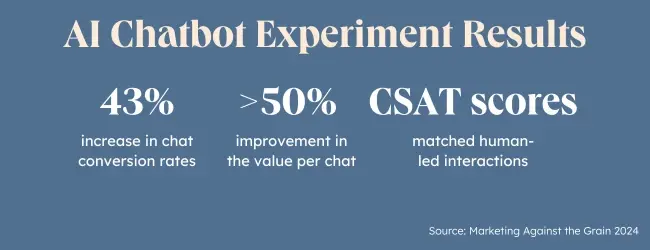
The results of such a refined approach can be impressive. In one notable experiment, the integration of AI into website chat led to a 43% increase in conversion rates. This significant jump demonstrates the AI’s ability to effectively guide users toward desired outcomes. Additionally, there was a greater than 50% improvement in the value per chat, indicating a more efficient use of resources and a higher return on each interaction.
Perhaps most strikingly, customer satisfaction scores matched those of human-led interactions. This is a crucial milestone, as it proves that AI can deliver a level of service that is comparable to, if not indistinguishable from, human agents. When automation can achieve parity with human experience, it represents a major win for both efficiency and customer satisfaction.
Expanding AI Capabilities to High-Intent Pages
With positive results from initial tests, the next logical step is to expand the AI’s role to more complex and high-intent pages. Pricing pages, for example, are critical touchpoints where users have specific questions about costs, features, and value. An AI chatbot trained on this information can provide instant, accurate answers, helping to overcome objections and facilitate decision-making.
In these advanced applications, the AI can be configured to handle not just product-related questions, but also to guide users through the purchasing process. In some cases, this can even enable touchless purchases, where users can complete a transaction entirely through the chat interface. This level of automation streamlines the user journey and reduces friction, leading to higher conversion rates.
Developing Scalable Annotation Processes
As the scope of AI implementation grows, so does the need for robust training processes. Relying on a single individual to annotate chat transcripts is not sustainable at scale. To address this, organizations are developing user interfaces that allow multiple team members to participate in the annotation process. This distributed approach accelerates the training of the AI model and improves the overall accuracy of its responses.
The annotation process is time-intensive, but it is also one of the most important aspects of AI implementation. High-quality training data is essential for building a reliable and effective AI system. By involving more people in this process, organizations can ensure that the AI is continuously learning and adapting to new customer needs and queries.
Practical Strategies for Implementing AI in Customer Experience
The rapid advancement of AI technology can feel overwhelming, but it also presents significant opportunities for businesses willing to experiment. The key is to start small, focus on clear objectives, and iterate based on real-world feedback. Here are four practical strategies for leveraging AI to enhance your customer experience.
Start Experimenting Immediately
Perfection is the enemy of progress. Instead of waiting for an ideal AI solution, start with what you have and refine it over time. Launch your AI chatbot in a controlled environment, gather data, and make adjustments based on user interactions. This iterative approach allows you to learn quickly and adapt to changing customer needs. The magic happens in the real world, not in a theoretical vacuum.
Aim for Dramatic Improvements
The potential of AI extends far beyond marginal gains. While traditional optimization might yield a 5% improvement, AI has the capacity to deliver exponential gains. By building new systems and automating complex processes, businesses can achieve improvements of 100%, 300%, or even more. Settling for minor gains ignores the transformative potential of this technology.
Maintain Transparency with Customers
Trust is the foundation of any customer relationship. When using AI, it is essential to be transparent about the technology. Clearly communicate to users that they are interacting with an AI assistant. This honesty manages expectations and builds trust, which in turn improves customer satisfaction. Transparency also helps mitigate concerns about privacy and data usage.
Begin with Chat
If you are unsure where to start, chat is an excellent entry point. It is a low-stakes environment that allows you to test AI capabilities without significantly disrupting the user experience. AI chatbots can provide immediate value by answering common questions and guiding users to relevant resources. As you gain confidence and refine your approach, you can expand to other channels and more complex applications.
The Future of AI-Driven Customer Interactions
The integration of AI into customer support is not just a trend; it is a fundamental shift in how businesses operate. By leveraging AI to handle routine queries, companies can free up human agents to focus on high-value interactions that require empathy, creativity, and complex problem-solving. This hybrid model combines the efficiency of automation with the nuance of human touch, creating a superior customer experience.
As AI technology continues to evolve, we can expect even more sophisticated applications. From personalized recommendations to predictive support, the possibilities are vast. Businesses that embrace this change and invest in intelligent, transparent AI systems will be well-positioned to thrive in the AI-driven search era. The key is to start now, experiment boldly, and remain committed to delivering value to your customers.





