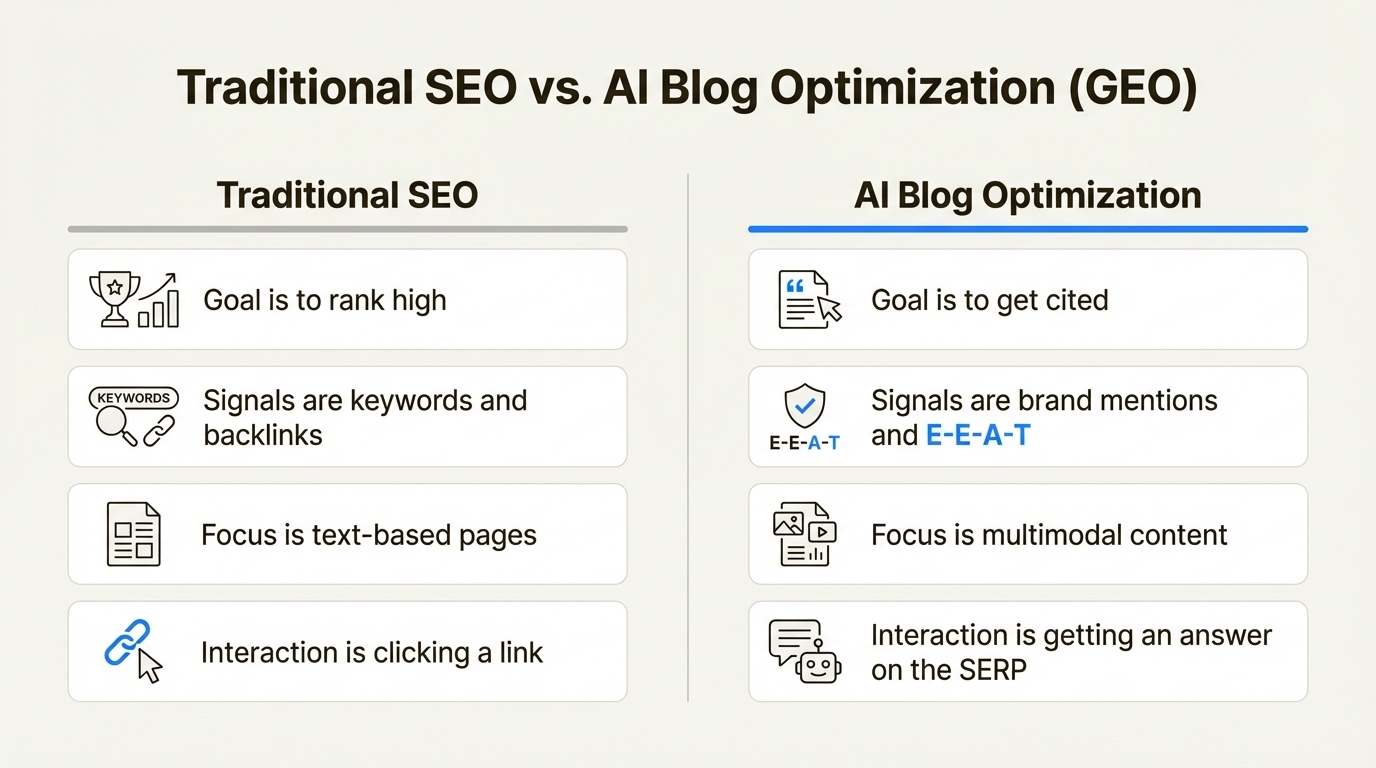
To remain visible in the era of Large Language Models (LLMs), businesses must shift their focus from human-centric SEO to machine-readable architecture. Generative Engine Optimization (GEO) relies on clear, structured signals that allow AI to interpret, verify, and cite your brand’s expertise.

How Generative Engines Parse and Prioritize Your Content
Modern search has evolved from matching strings of keywords to extracting complex entities. Generative engines process content through layers of semantic analysis to understand the relationships between concepts.
- Entity Extraction: AI models identify subjects, predicates, and objects to build a knowledge graph of your content.
- Machine Readability as the Baseline: If an engine cannot parse the logic of your page, it cannot reliably include your data in a synthesis.
- Structured Data: Schema markup provides the explicit context that disambiguates your content, helping AI verify your relevance to a specific user query.
The GEO Structural Checklist: Mandatory Formatting Protocols
Consistency is the primary signal for AI crawlers. Adopting a rigid structural framework ensures your content is indexed predictably.
- H-Tag Hierarchy: Use exactly one H1 tag per page. Follow this with a strictly sequential order of H2 and H3 subheadings. Do not skip levels (e.g., jumping from H2 to H4).
- Scannability Standards: Keep paragraphs between 3 and 4 sentences. Use ample white space to isolate specific ideas, which aids the model in identifying discrete information units.
- The Inverted Pyramid: Place the most critical answer or summary immediately after the H2 or H3 heading. AI models prioritize the leading sentences of a section when retrieving data for direct answers.

Deploying Schema Markup to Influence Answer Engines
Schema is not just for search; it is a direct instruction set for AI. Implementing the following schemas allows your content to be injected directly into generated answers:
- FAQPage Schema: Use this for question-and-answer pairs to provide definitive, ready-to-use content for AI snippets.
- HowTo Schema: Ideal for procedural or step-by-step content, clearly marking the stages of a process for easy retrieval.
- Article/BlogPosting Schema: Essential for defining your content as a primary source, establishing the topical authority required for consistent citation.
Content Design for Multi-Modal AI Retrieval
For your content to be pulled as a reference, it must be modular. AI retrieval systems scan for “atomic information units”—self-contained nuggets of fact that provide a complete, standalone answer.
- Modular Formatting: Each section should be able to stand alone. If an AI pulls one paragraph, does the user have enough context to understand the point?
- Information Density: Avoid filler phrases. Use lists and tables to present comparative data or technical specifications clearly.
- Balanced Architecture: Combine long-form depth for authority with distinct, indexable blocks of information that facilitate granular retrieval.
Measuring Technical SEO Health in the Generative Era
Traditional metrics are insufficient for tracking AI visibility. To validate your GEO efforts, you must monitor performance against the specific mechanics of generative search.
- KPIs for AI: Focus on citation frequency and LLM referral volume rather than traditional SERP rankings.
- Structural Hygiene Audits: Regularly scan your content against the GEO structural checklist to ensure no header drift or nesting errors have occurred.
- Iterative Testing: Test whether specific structural changes (like adding FAQ schema or reformatting a list) lead to a higher frequency of citation for your targeted keywords.
By treating your website as a technical knowledge graph rather than a collection of documents, you ensure your brand is prioritized by the AI engines shaping the future of information discovery.