Beyond Depth: Atomize Content for AI RAG Systems
The age-old debate between writing deep and writing broad has become irrelevant. For years, content teams chased word counts and keyword density to satisfy search algorithms that prioritized human traffic patterns. Today, those metrics are eclipsed by a new reality defined by Retrieval-Augmented Generation, or RAG. When AI agents look for answers to satisfy complex user queries, they do not “read” long-form essays; they scan databases for high-fidelity, modular information snippets.
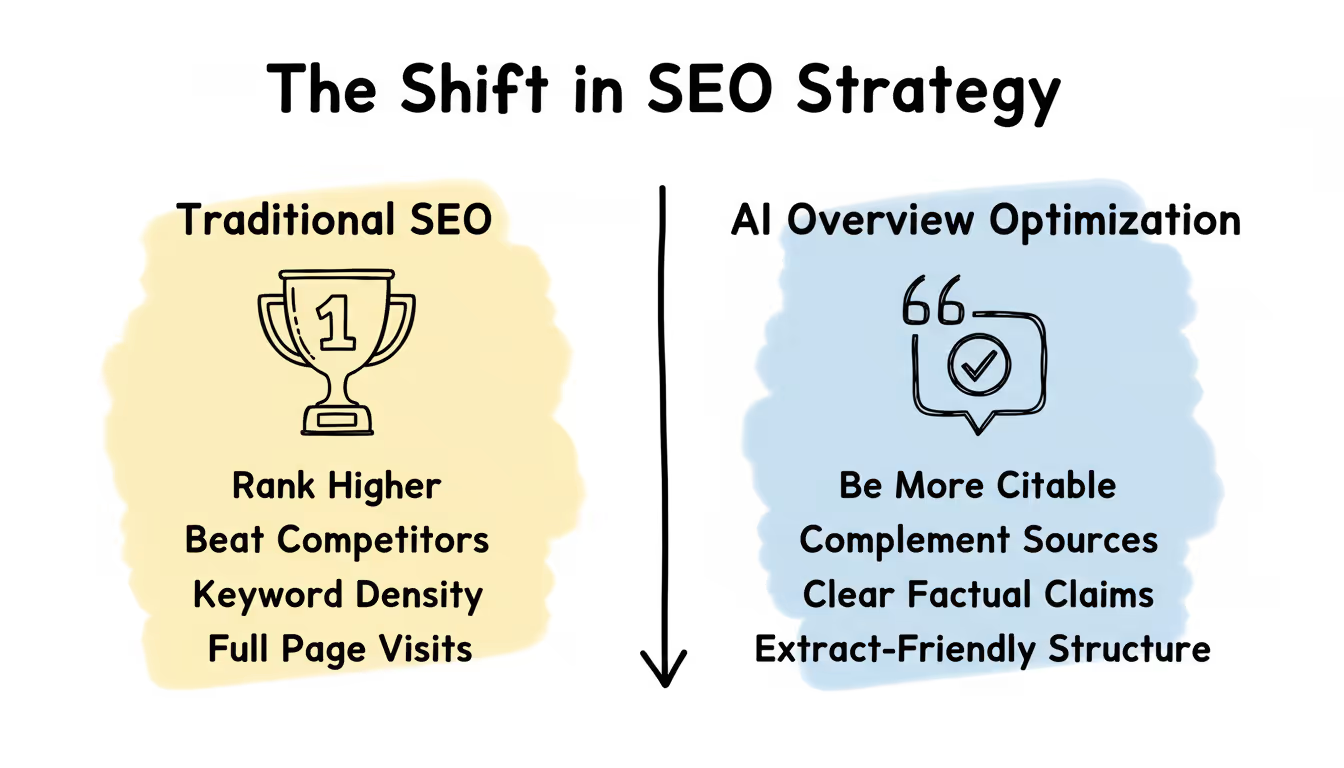
Trying to force a sprawling, monolithic guide into an AI-ready format is like fitting a puzzle piece into the wrong box. Instead of worrying about traditional length, successful brands are shifting their focus to creating atomic, modular content units that LLMs can instantly index, cite, and retrieve. This transition is the cornerstone of a modern AI Content Strategy for the AI Era. By reframing your library from a collection of essays into a query-aligned data architecture, you ensure your expertise remains the definitive source of truth for the machines powering the next wave of search.
The Death of ‘Deep vs. Breadth’: Understanding the RAG-First Reality
In the past, SEO success often felt like a race to see who could write the longest, most exhaustive guide. We measured quality by depth and breadth, believing that a 3,000-word monolith would satisfy every possible user intent. However, the rise of RAG has rendered this approach obsolete. LLMs do not read articles the way humans do; they retrieve specific segments of data to answer a query in real-time. If your content is buried inside a massive, sprawling guide, it becomes invisible to the retrieval mechanisms that power AI answer engines.
Why RAG Prioritizes Efficiency Over Volume
When an AI engine processes a prompt, it does not return an entire webpage. Instead, it scans its database to find the most relevant “chunks” of information—atomic units that directly resolve the user’s intent. Because these models prioritize retrieval efficiency, they favor content that is concise, factually dense, and clearly labeled. Writing a general guide often results in diluted relevance scores. When you cover twenty sub-topics in one article, the AI struggles to isolate the definitive answer, leading to poor citation rates.
The Shift to Content Atomization
Content atomization is the strategic process of breaking down monolithic content into smaller, modular, and query-aligned data units. Think of it as dismantling a brick wall into individual, stackable bricks that can be rearranged or deployed to answer specific questions. By focusing on one concept per unit, you ensure that your information is easily indexable. This approach is a core pillar of a modern AI Content Strategy for the AI Era, moving your brand from publishing essays to building a searchable knowledge base.
Traditional SEO vs. RAG-Optimized Structures
To succeed, you must understand how your structural choices influence AI visibility.
| Feature | Traditional Long-Form | RAG-Optimized Atomic Units |
|---|---|---|
| Primary Goal | Maximize Time-on-Page | Optimize for Citation Accuracy |
| Structure | Long narrative arcs | Independent, modular nodes |
| Keyword Focus | High-volume clusters | Specific query-answer pairs |
| Data Delivery | Buried in paragraphs | Structured lists and schemas |
Broad, unfocused content often fails to rank in AI-driven search environments because it lacks the semantic precision required for successful retrieval. If an engine cannot confidently isolate a single, high-quality answer from your page, it will skip over your content. By moving toward atomic structures, you change how the AI sees your brand.
Designing Atomic Content Units: The Tactical Framework
To build a robust AI Content Strategy for the AI Era, you must shift away from writing for a linear human experience and start designing for machine consumption. The “One Concept per Node” principle is your primary tool. By focusing every specific section on a single, well-defined query, you ensure that LLMs can extract your content as a precise, authoritative answer. When content is fragmented into tight, query-aligned units, you minimize the “noise” that often confuses models during the retrieval process.
Refactoring Legacy Content Into Indexed Silos
Turning your existing library into a database of AI-ready content requires a methodical approach. Use this framework to transition your legacy articles:
- Audit and Identify: Scan your high-performing pages for multiple distinct sub-topics. If a page covers three separate “how-to” questions, it is a prime candidate for splitting.
- Isolate the Core: Extract the most valuable “node” from each legacy post. This should be a self-contained answer to one specific user intent.
- Create Dedicated Anchors: Build a new, focused page or section for each isolated node, ensuring it contains its own unique H1 or H2, metadata, and body copy.
Checklist for AI-Extractable Definitions
For an LLM to cite your brand as an expert source, your content must be structured for easy extraction. Use this checklist for every factual claim:
- Declarative Framing: Avoid hedging. Start with the definition directly: “[Concept] is [clear definition].”
- Scoped Parameters: Mention the specific industry, time frame, or use case to avoid ambiguity.
- Structural Clarity: Use unordered lists for features and tables for comparisons.
- Schema Implementation: Use appropriate Schema markup to explicitly tell search engines what the text represents.
Leveraging Semantic HTML for Retrieval
LLMs rely heavily on the underlying structure of your page to understand how information is organized. A page that uses H1, H2, and H3 tags effectively is significantly easier to index than one that uses bold text for visual hierarchy. By ensuring that your headings act as clear signposts, you define the “topic boundaries” of each node. When you use semantic HTML, you provide an AI agent with a map, allowing it to navigate directly to the most relevant snippet of information.
The Anatomy of a High-Fidelity Data Node
To succeed in an AI-driven search ecosystem, treat your content as a collection of high-fidelity data nodes rather than a series of essays. A high-fidelity node is a self-contained unit of information that provides a definitive, verifiable answer to a specific query. When your content is structured this way, you make it easier for RAG systems to identify, rank, and cite your brand as the primary authority.
The Power of Declarative Writing
AI models struggle with ambiguity. When your content is filled with hedging—using phrases like “it seems” or “generally speaking”—you dilute the factual density that algorithms prioritize. For an LLM to confidently cite your content, it needs clear, factual, and direct assertions.
| Style | Vague/Hedged Approach | Factual/Citable Approach |
|---|---|---|
| Clarity | It might be helpful to use long-form content. | Long-form content provides higher semantic density. |
| Authority | Many people believe that AI will change search. | AI models prioritize retrieval-based accuracy. |
| Precision | You should try to update your site often. | Updating content every 30 days maintains higher relevance. |
Retrieval Magnets: Data-Rich Structures
LLMs are pattern-matching engines; they are trained to seek out structured data. You can signal to these models that your node contains the “source of truth” by using formatting elements that act as retrieval magnets. Incorporate these structures into every data node:
- Comparison Tables: Contrast features or metrics to allow models to generate structured comparisons.
- Numbered Steps: Use these for sequential processes that LLMs can easily replicate for “How-to” queries.
- Specific Data Points: Use hard numbers and percentages to increase retrieval potential.
- Bulleted Fact Sheets: Summarize key takeaways so information remains modular.
Maintaining Context Without Monoliths
When you break content into atomic units, you risk losing the broader narrative. To avoid this, shift from a traditional hierarchical blog structure to a knowledge-graph-style internal architecture. By using descriptive, semantic internal linking, you create a web of relationships that allows AI models to traverse your site like a neural network.
Building a Semantic Knowledge Graph
Every internal link should function as a declarative statement that explains the relationship between two nodes. Instead of generic “read more” links, use anchor text that explains the dependency. This approach builds a machine-readable structure that helps AI search systems identify the depth of your authority. When an AI agent hits one of your nodes, it should see clear paths to related, supporting facts.
Balancing Human Navigation with Machine Paths
Creating a structure that is both human-friendly and machine-optimized requires balance. Humans appreciate storytelling, while machines crave explicit connections. Use a dual-layer strategy:
- The Human Layer: Use context-rich prose that guides the reader through a logical journey.
- The Machine Layer: Implement a structured “Related Concepts” section at the end of every node.
By treating your site structure as an evolving AI Content Strategy for the AI Era, you move away from the limitations of legacy blog formats. You stop writing for a chronological feed and start building a database of truth. When your nodes are connected by clear links, it becomes trivial for RAG systems to synthesize your content and cite your brand as a source.
Successfully mastering this strategy requires a fundamental shift in how you perceive your digital presence. To remain relevant, you must stop treating your blog as a collection of long-form narrative essays and start viewing it as a structured database of query-answer pairs. When your content is organized as modular, high-fidelity data nodes, you make it effortless for LLMs to crawl, index, and cite your brand. Start building your repository of intelligence today, and ensure your brand remains the foundation upon which future AI-driven insights are built.
AEO/GEO
Want to learn more?
Contact us for direct consultation and support.