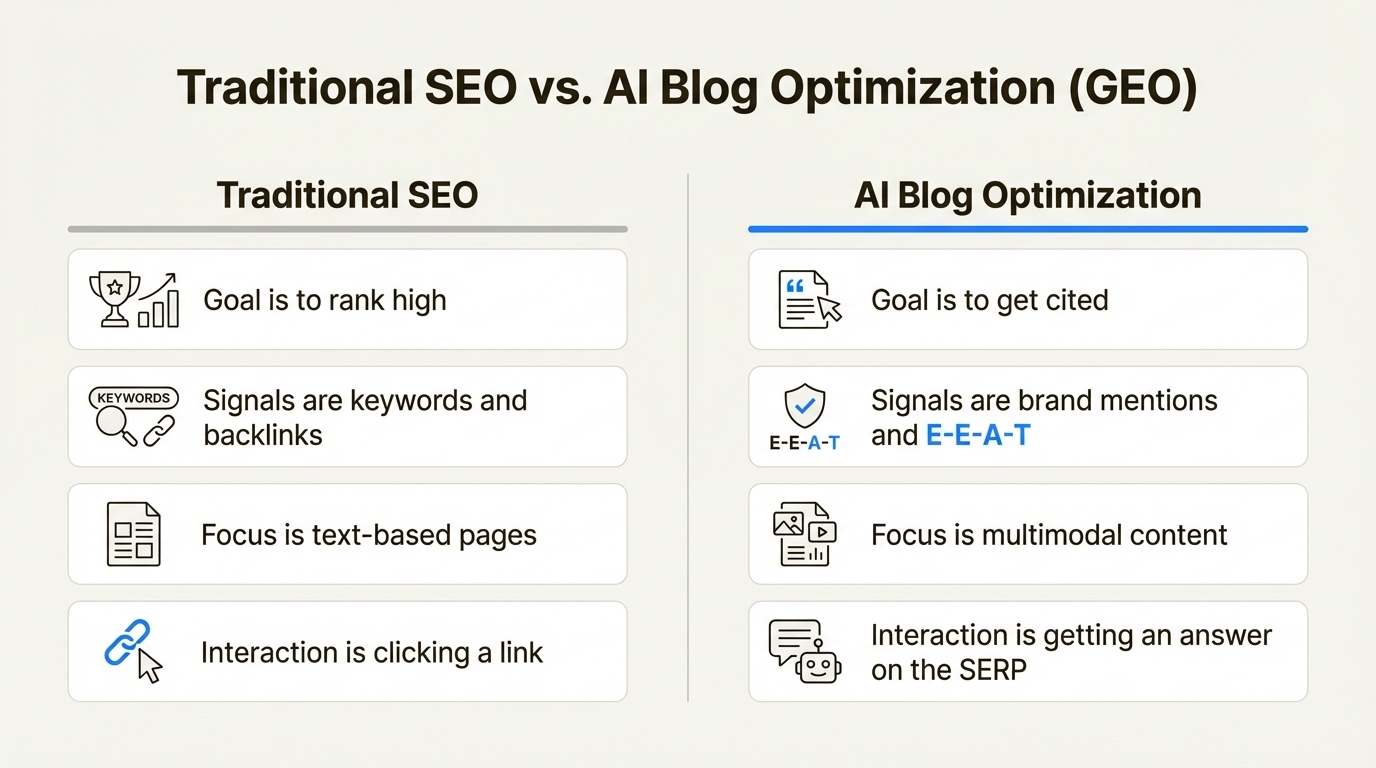
The search landscape has shifted. Users now expect immediate, synthesized answers directly on their results page, often bypassing traditional links entirely. This transition to a zero-click environment—driven by AI models like Perplexity, Gemini, and Google’s AI Overviews—requires a fundamental rethink of what success looks like for your digital presence.
The New Search Reality: Deconstructing the Zero-Click Environment
The internet is no longer just a collection of links; it is becoming a network of answers. In a traditional search, your success was defined by a blue link that funneled a user to your domain. In the zero-click era, the search engine becomes the destination.
- Zero-Click vs. Traditional: Traditional search relies on curiosity and the need for further exploration. Zero-click search provides a definitive summary, resolving the user’s need instantly.
- AI Displacement: AI models ingest vast datasets to deliver concise, conversational responses. When a user’s query is fully resolved by these summaries, the impulse to click out vanishes.
- The Metric Trap: Relying solely on clicks or sessions is now a flawed strategy. These metrics ignore the “silent” traffic where your brand is mentioned, cited, or positioned as an expert without the user ever landing on your page.
Architecting Content for Generative Visibility vs. Direct Conversion
To thrive, you must stop treating all content the same. You need a dual-strategy that satisfies both the AI and the human.
Writing for Two Audiences
AI models crave high-density facts, clear headings, and logical hierarchies. Humans, however, crave persuasion and nuance.
- AI-Ingestion Content: Focus these assets on clarity. Use concise, bulleted, and structured data that answers “what” and “how” questions directly.
- User-Engagement Content: These are your deep-dives. Once the AI has hooked the reader, your destination page must provide the depth and emotional connection that a summary cannot.
By identifying which topics serve as “trigger” content—perfect for AI summaries—you can strategically link them to your “conversion” content, which requires a visit to your site to unlock full value.
Tactical Methodologies for Retaining Traffic in a Summary-First Landscape
If the search engine gives away the answer, how do you get the user to visit your site? You must create a reason to leave the search environment.
- The Curiosity Gap: Structure your content so the AI summary provides the “what,” but leaves the “why” or the “how-to” just out of reach, encouraging a click for deeper context.
- Interactive Utility: Embed tools like calculators, custom quizzes, or benchmarking diagnostics on your site. AI can explain a concept, but it cannot perform a personalized assessment for the user.
- The Trust-Based Backlink: AI models rely on cited authority. By consistently providing original data and unique viewpoints, you make yourself an indispensable source. Being the “quoted expert” builds brand recall that persists long after the search session ends.
Redefining Success: Metrics for the Post-Click World
If clicks aren’t the only goal, how do you measure performance? You must shift your focus toward brand visibility and assisted conversions.
- Brand Recall & Sentiment: Track how your brand name appears in AI responses. Is it associated with authority, accuracy, and innovation?
- Assisted Conversions: Use attribution modeling to see if organic search traffic increases when your brand is frequently cited in AI summaries.
- The Long-Tail Effect: Recognize that every AI citation is an enduring digital asset. Unlike a search ranking that can fluctuate, being embedded in an AI’s knowledge base creates long-term, compounding visibility.
Conversion Optimization Strategies for Non-Traditional Journeys
A user arriving via an AI citation is different from one coming from a keyword search; they are often “half-informed.” Your landing page needs to welcome them as such.
- The Trust-First Welcome: Avoid repeating the AI’s summary. Instead, validate the information they just read and immediately bridge the gap to your specific solution.
- Micro-Conversion Focus: If the user is already informed, guide them to a low-friction action, such as downloading a resource, subscribing to a newsletter, or engaging with a specialized tool.
- Influence the Pre-Search Cycle: By flooding your industry with unique thought leadership, you prime the AI models to associate your brand with specific topics. You become part of the AI’s “internal” knowledge, ensuring your brand is recommended before the user even considers their options.