The 2021 Summer Business Performance Analysis
Business leaders have long anticipated the traditional summer slump, a period where consumer activity slows and internal productivity dips due to vacations and heat. In 2021, this anxiety was compounded by post-pandemic reopening challenges and widespread employee burnout. With 41% of employees reporting burnout and 48% feeling mentally exhausted, the concern was not just about external market forces but also internal capacity. Did the anticipated drop-off in performance materialize, or did the unique conditions of 2021 create a different reality?

To answer this, we analyzed web traffic and deal data from over 103,000 anonymous HubSpot customers globally, comparing their summer 2021 performance against pre-pandemic benchmarks from 2019. The results reveal a nuanced picture: while web traffic generally declined, deal closings actually increased across many industries. This divergence suggests that while fewer people were browsing online, those who were engaging were more ready to buy.
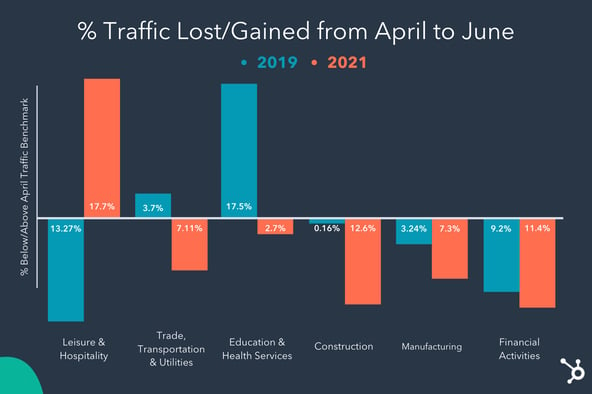
The data shows that global web traffic dipped across almost all industries in June 2021 compared to 2019 levels. However, the Leisure and Hospitality sector stood out as a major exception, seeing a 17.72% traffic increase between April and June 2021. This contrasts sharply with 2019, when the same sector saw a 13.27% decrease during that period. Other sectors like Construction (-12%), Financial Activities (-11%), and Manufacturing (-7.2%) saw significant initial dips. This indicates that while general browsing habits changed, specific industries tied to reopening and travel saw sustained interest.
Web Traffic Trends by Industry
Web traffic trends varied significantly by industry and geography. June emerged as the month with the most pronounced seasonal shifts. Trade, Transportation, and Utilities saw a 7.11% loss in traffic from April to June 2021, compared to 3.7% growth in the same period in 2019. Education and Health Services also shifted from 17.52% growth in 2019 to a 2.7% loss in 2021. Construction saw the most dramatic shift, moving from a negligible 0.16% decrease in 2019 to a 12.06% loss in 2021.
Geographically, these traffic dips occurred across most territories, with notable exceptions in Asia and Australia. These regions either saw steady growth or leveled out their traffic rather than experiencing large dips. This may be attributed to ongoing lockdowns and stay-at-home orders in these areas, which kept consumers online despite the summer season. For businesses operating globally, understanding these regional nuances is critical for adjusting marketing spend and content strategies accordingly.
The Rise in Deal Closings
Contrary to the traffic dip, deal closings across industries climbed during the summer of 2021. Leisure and Hospitality led with a 44.7% increase, followed by Manufacturing (+13.65%) and Trade, Transportation, and Utilities (+10.62%). Even sectors with slower growth, like Construction and Financial Activities, saw modest increases of just under 2%. This is a significant shift from 2019, when five of the eight studied segments saw at least a 3.5% dip in deal closings.
This inverse relationship between traffic and deals suggests that while fewer people were visiting websites, those who did engage were further along in the buyer’s journey. It also highlights the importance of looking beyond top-of-funnel metrics. During seasonal slumps, a drop in web traffic might not indicate a problem if qualified leads and closed deals remain stable or increase. Leaders should monitor the entire funnel—from traffic to deals created, qualified leads, and closed deals—to get a complete picture of performance.
Strategies for Navigating Seasonal Business Shifts
Seasonality is an inevitable part of business, whether it’s a summer slump or a winter slowdown. Rather than viewing these periods as dead zones, successful leaders treat them as opportunities to prepare, optimize, and strengthen relationships. The key is to have a proactive strategy that addresses both immediate challenges and long-term growth.
Preparation and Resource Planning
One of the most effective ways to handle seasonal shifts is through thorough preparation. Alicia Butler Pierre, CEO of Equilibria, Inc., emphasizes two main approaches: contingency planning and resource planning. Contingency planning involves creating premortems, failure modes and effects analyses (FMEA), and disaster recovery plans to prepare for unexpected dips or upticks caused by external factors. This helps businesses remain agile when faced with news events or other disruptions.
Resource planning, on the other hand, relies on data. By collecting transaction dates, sale amounts, product types, and customer demographics, businesses can identify recurring patterns. If you notice the same trends year after year, you can forecast seasonal slumps and adjust inputs like labor and inventory accordingly. This data-driven approach allows you to expand or contract resources proactively, rather than reacting to problems after they occur.

Butler Pierre also advocates for using slow periods to improve business infrastructure. It’s difficult to make upgrades when everything is moving at full speed. During a slump, you can focus on technology upgrades, process automation, and even relocating your physical workspace. These improvements ensure that your company can handle the chaos of a seasonal uptick without compromising quality or customer service. The 2020 surge in online shopping highlighted this point: businesses that were already online could fulfill orders, while those rushing to build online stores struggled to keep up.
Launching Demand Plays
When macro trends slow down demand, there’s often little you can control. Emmy Jonassen, HubSpot’s VP of Acquisition, notes that you can’t force prospects to visit your site if they’re on vacation. However, you can still take actions to lift demand in the short and long term. For immediate relief, consider increasing paid spend temporarily, simplifying lead forms to improve conversion rates, or launching campaigns that offer timely, unique value. These incremental lifts at the top of the funnel can help you get through the slump.
In the long term, use periods of soft demand to audit your key acquisition drivers. If your mobile conversion rates are lagging behind desktop, now is the time to plan a mobile-optimized site. Improving search rankings and landing page conversion rates will not only help you generate incremental demand during the slump but also position you to capture more traffic when it picks up again. Periods of slowed demand often reveal holes in your demand-generation engine; use this time to patch them.
Leveraging Data for Strategic Decisions
Data should guide your response to seasonal trends. Tools like HubSpot Traffic Analytics allow you to examine historical patterns and prepare for predictable dips due to vacations and holidays. The HubSpot Blog team, for example, uses summer to focus on historical optimization, long-term conversion plays, and trend-responsive content that can gain quick bursts of traffic when search engines are impacted by seasonality. Winter, on the other hand, is often used for end-of-year planning and team recharge.
It’s also important to look at multiple KPIs, not just web traffic. If traffic is down but leads or deals are up, you may not need to pivot your entire strategy. However, if everything is declining, it’s time to take a deep look at your overall processes. Digging into your analytics helps you determine whether a dip is due to seasonality or a more fundamental issue. This data-driven approach allows you to respond with precision rather than panic.
Maintaining Relationships and Team Well-being During Slumps
A seasonal slump is not just a time to focus on external demand; it’s also an opportunity to strengthen internal processes and customer relationships. Many businesses make the mistake of disengaging during slow periods, but this can lead to lost opportunities and weakened team morale.
Focusing on Current Customers
When new business slows down, turn your attention to existing customers. Dan Tyre, Director at HubSpot, suggests looking for ways to upsell or cross-sell to customers acquired in the first six months of the year. You can also use this time to work your referral program. Calling top customers in July to check in on the relationship and identify other divisions that could benefit from your services is a simple but effective strategy.
This approach not only generates revenue but also strengthens customer loyalty. Tools like HubSpot’s Sales or Service Hubs can help you track deal creation, contact activities, and service inquiries, ensuring you don’t lose sight of your existing clientele. By maintaining regular communication, you keep your brand top-of-mind and position yourself as a partner rather than just a vendor.
Strengthening Team Communication
Communication is vital during both slumps and upticks. Poor communication can halt processes, while great communication can speed up revenue-generating projects. Regardless of how busy you are, take time to check in with your team through meetings, Slack, Zoom, or email updates. Ensure that calendars are up to date with meeting times, blocks for solo work, and time off. This transparency helps everyone manage their workload and avoid bottlenecks.
Balancing Results with Employee Well-being
As seasonal trends fluctuate, it’s easy to get swept up in work and forget about well-being. Tyre emphasizes the importance of managing expectations and understanding who’s available when. Taking time off is advantageous for reducing stress and increasing productivity. No-meeting Fridays or work-from-home Fridays can help salespeople recharge and perform better. Alex Girard, Senior Product Marketing Manager at HubSpot, adds that prioritizing important work and aligning the team on what’s essential ensures that things keep moving during periods of high vacation time.
Tools to Navigate Seasonal Slumps and Upticks
Having the right tools in place can make a significant difference in how well you navigate seasonal shifts. These tools help you measure performance, identify snags, and maintain communication even when business is slow.
| Tool Category | Examples | Primary Benefit |
|---|---|---|
| Business Software | HubSpot CRM, Marketing, Sales, Service, Content Hub | Measure performance, identify slumps, move customers through the buyer’s journey |
| Productivity Suites | Google Workspace, Microsoft Outlook | Streamline communication, project management, and process creation |
| Task Management | HubSpot, Trello, Asana, Jira | Track progress, identify blockers, manage multiple projects |
| Communication Platforms | Slack, Microsoft Teams, Zoom | Stay in contact with dispersed teams, even when meetings are scarce |
HubSpot’s suite of tools, for instance, allows you to measure performance across marketing, sales, and service, helping you identify where slumps or upticks are occurring. Google Workspace or Microsoft Outlook can keep your documents, calendars, and emails in one place, streamlining communication and project management. Task management tools like Trello or Asana help you track progress and identify blockers, while communication platforms like Slack ensure you stay connected with your team even when face-to-face meetings are limited.
By leveraging these tools, you can maintain visibility into your business operations and respond quickly to changes. This preparedness ensures that when the next seasonal uptick arrives, you’re ready to capitalize on it without compromising quality or customer experience. The goal is not just to survive the slump but to emerge from it stronger and more resilient.
Ultimately, seasonal slumps are not failures; they are natural cycles. By preparing in advance, launching targeted demand plays, leveraging data, focusing on current customers, and supporting your team, you can turn these periods into opportunities for growth and optimization. The key is to stay proactive, data-driven, and human-centered, ensuring that your business remains resilient year-round.





