As AI-powered answer engines like ChatGPT, Perplexity, and Google AI Overviews become central to how people discover information, the role of traditional SEO metrics is being re-evaluated. If you are responsible for digital growth, you have likely wondered if backlinks still matter for answer engine optimization, or if the rise of generative search requires a completely new authority playbook. The reality is that while backlinks remain a foundational element, they no longer operate as the sole indicator of quality or relevance.
Answer engine optimization is the process of improving a brand’s visibility and authority within AI-driven search interfaces to ensure the brand is recognized and cited as a reliable source. Unlike traditional search, which ranks pages primarily through link equity, answer engines synthesize information to ground their responses in factual, well-structured content. A high-authority backlink profile is a necessary starting point, but it is no longer sufficient on its own to guarantee visibility in AI-generated answers.
The Changing Role of Authority in AI Search
Traditional search engines rely heavily on backlinks as a primary signal of trust. A link from a reputable domain acts as a vote of confidence, weighted by the linking site’s authority and the relevance of the surrounding text. This mechanism, often referred to as PageRank, has been the cornerstone of SEO for decades. However, while answer engines respect this logic, they expand upon it by prioritizing sources that can reliably ground their answers. These systems favor content that is current, clearly structured, and consistently associated with specific entities and topics. The shift is not about discarding links, but about contextualizing them within a broader framework of semantic understanding.
This shift means that authority is now determined by a broader set of inputs. When an answer engine constructs a response, it evaluates whether a brand is consistently referenced in contexts relevant to the user’s query. A brand that holds a strong backlink profile but lacks clear entity association or structured, direct answers may find itself overlooked in favor of competitors who are more easily parsed by AI models. The AI does not just look for a link; it looks for a source it can confidently attribute a specific fact to. If the entity behind the content is ambiguous, the AI may choose not to cite it at all, regardless of the number of inbound links it possesses.
Understanding Entity-Centric Authority
In the context of AI search, authority is increasingly tied to entities rather than just URLs. An entity is a distinct, recognizable thing—such as a person, organization, product, or concept. Answer engines build knowledge graphs that connect these entities. When you earn a backlink, the AI system attempts to map that link to your brand entity. If your brand is well-defined and consistently presented across the web, the link strengthens that entity’s authority. If your brand is fragmented or poorly defined, the link’s value is diluted because the AI cannot confidently assign that trust to a specific source.
This entity-centric approach requires a more holistic view of your digital presence. It is not enough to have a few high-quality links; you must ensure that those links point to content that clearly defines who you are and what you know. This involves consistent branding, clear organizational structures, and content that explicitly connects your brand to specific topics. By aligning your backlink strategy with entity clarity, you ensure that the authority you build is correctly attributed and utilized by AI systems.
Why Relevance Outweighs Raw Link Volume
In the era of AI-driven discovery, the type of link matters significantly more than the total count. A high-authority link from a completely unrelated industry carries less weight in an AEO context than a moderately authoritative link from a source that is deeply embedded in your specific topic cluster. The latter provides a stronger semantic signal, helping AI systems understand the connection between your brand and the subject matter. For example, a link from a major news outlet about a celebrity scandal is valuable for general authority, but a link from a specialized industry journal about a technical innovation is far more valuable for establishing topical authority in that niche.
Comparing Link Influence in SEO and AEO
| Link Type | Classic SEO Influence | AEO Influence |
|---|---|---|
| High-DA, low-relevance link | High | Low |
| High-DA, high-relevance link | Very High | Very High |
| Industry publication link | High | High |
| Niche blog link | Moderate | High |
| Directory or aggregator link | Low-Moderate | Minimal |
Beyond traditional hyperlinks, brand mentions and co-citations are essential components of modern authority. An unlinked brand mention serves as a signal to an AI system that a source considers your brand relevant within a specific topical discussion. When these mentions occur repeatedly across credible publications, they build the entity authority required to earn citations in AI-generated answers, even when no direct link is present. This phenomenon, known as co-citation, occurs when two entities are mentioned together in the same context. If your brand is frequently mentioned alongside other recognized experts in your field, the AI infers that you belong to the same tier of authority.
The Power of Semantic Context
The context surrounding a link or mention is crucial for AEO. AI models analyze the text around a link to understand its purpose and relevance. A link embedded in a paragraph that discusses your specific expertise carries more weight than a link in a generic footer or sidebar. This means that outreach efforts should focus on securing placements where your brand is discussed in depth, rather than just getting a logo in a list. The goal is to create a rich semantic environment that reinforces your brand’s association with specific topics.
Furthermore, the diversity of sources matters. A backlink profile that includes links from a variety of relevant sources—such as industry blogs, news outlets, and educational institutions—signals to AI systems that your brand is widely recognized and respected. This diversity helps mitigate the risk of any single source being deemed unreliable or biased. By building a diverse and relevant backlink profile, you create a robust foundation for your AI visibility.
Building Authority Beyond the Backlink
While backlinks remain a key component of your strategy, they must be integrated into a wider effort that includes unlinked brand mentions, co-citations, and entity clarity. A brand that is consistently mentioned alongside recognized experts or authoritative publications is signaling to AI systems that it belongs in that tier of expertise. This broader approach to authority building ensures that your brand is recognized not just as a source with links, but as a trusted entity in your field.
Key Signals for AI Visibility
- Unlinked Brand Mentions: Every instance where your brand is named in a credible source helps map your entity to specific topics. These mentions act as implicit endorsements, reinforcing your relevance without the need for a direct hyperlink.
- Co-citations: Being referenced in the same context as other industry leaders reinforces your position within a topic cluster. This associative strength helps AI models understand your brand’s place in the broader industry landscape.
- Entity Clarity: AI systems require a clearly defined entity, supported by structured data like Organization or Person schema, to confidently attribute information to your brand. Without clear entity definition, even strong links may fail to boost your AI visibility.
- Quality Content: No number of backlinks can compensate for content that is ambiguous, outdated, or lacks direct answers to user questions. Content must be accurate, comprehensive, and well-structured to be cited by AI engines.
Entity confusion is a significant barrier to AEO success. If an AI system cannot confidently determine who you are or what your primary area of expertise is, it is unlikely to risk citing you as a source. This can happen if your brand uses multiple names, if your website structure is confusing, or if your content covers too many unrelated topics. Ensuring your brand is consistently named and linked to authoritative profiles across all digital channels is a foundational step in building the visibility necessary for generative search.
Mitigating Entity Confusion
To mitigate entity confusion, you should audit your digital presence for consistency. This includes ensuring that your brand name, logo, and contact information are identical across your website, social media profiles, and third-party directories. You should also use schema markup to explicitly define your organization’s details, such as its founding date, headquarters, and key personnel. This structured data provides AI systems with clear, machine-readable information about your brand, reducing the risk of misattribution.
Additionally, you should monitor how your brand is mentioned online. If you notice that your brand is being confused with another entity, you can take steps to clarify the distinction. This might involve creating content that explicitly differentiates your brand from competitors or reaching out to publishers to correct inaccurate mentions. By actively managing your entity identity, you ensure that the authority you build is correctly attributed to your brand.
Structuring Content for AI Extraction
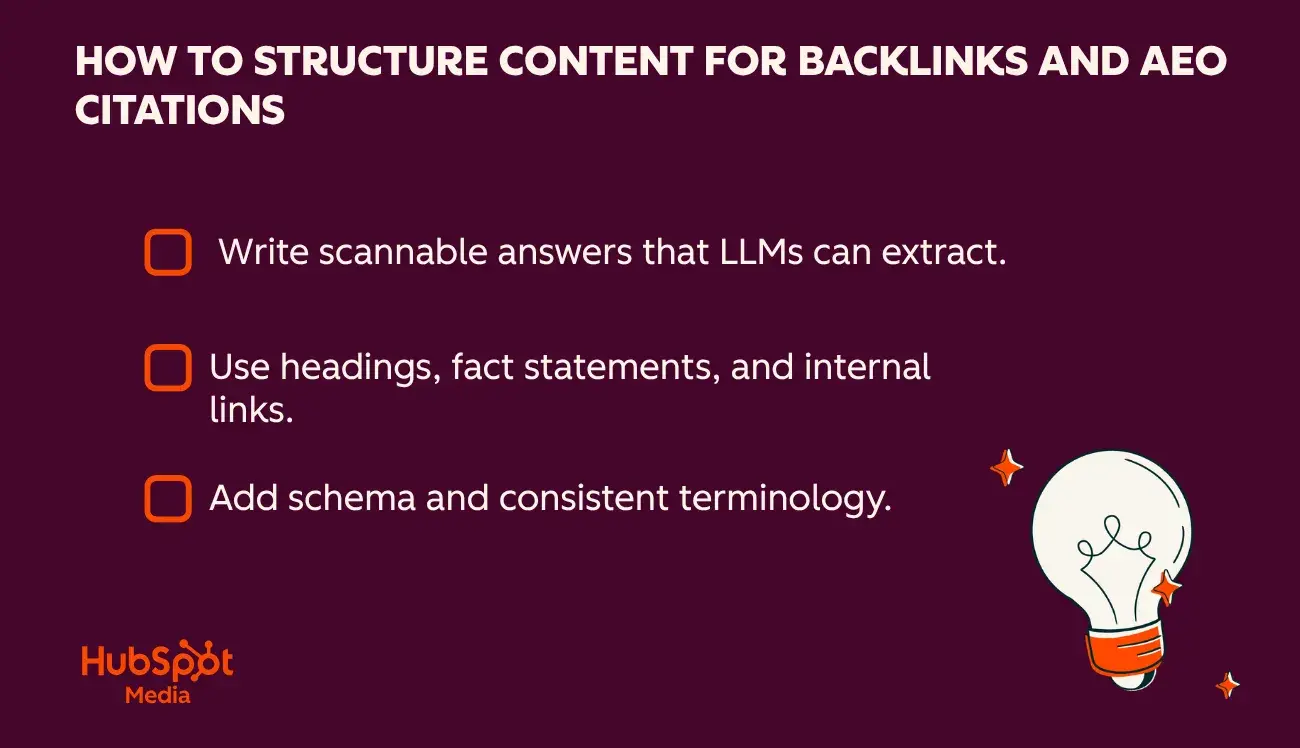
AI systems retrieve information from content that is easy to parse and directly responsive to user queries. To improve your chances of being cited, your pages should be organized to provide clear, scannable answers. Every major section of a page should lead with a declarative statement that addresses the specific question implied by the heading, followed by supporting context or data. This “answer-first” approach ensures that AI models can quickly identify the key information on your page, increasing the likelihood that it will be used to ground their responses.
Practical Steps for Content Structure
- Lead with the answer: Start your H2 and H3 sections with a direct response to the query. Keep paragraphs concise, ideally limited to three or four sentences. This makes it easier for AI models to extract the core information without having to parse large blocks of text.
- Utilize clear hierarchies: Use headings and subheadings to define the structure of your content, making it easier for AI to identify the topical focus of each section. A logical hierarchy helps AI models understand the relationship between different pieces of information.
- Implement structured data: Use schema markup, such as FAQPage or HowTo, to provide machine-readable metadata that clarifies the purpose of your content. Structured data acts as a roadmap for AI models, guiding them to the most relevant information on your page.
- Standardize terminology: Use consistent naming conventions for your products, services, and concepts across your entire site to prevent entity confusion. Consistency helps AI models associate your content with specific entities and topics.
By following an answer-first, evidence-second approach, you create content that is not only useful for human readers but also optimized for the extraction processes used by modern AI engines. This structure helps these systems identify your brand as a reliable source of information, increasing the likelihood that your content will be used to ground their responses.
Enhancing Content for AI Parsing
Beyond basic structure, you can enhance your content for AI parsing by using clear, concise language. Avoid jargon, complex sentence structures, and ambiguous phrasing. AI models perform best with straightforward, factual statements. You should also include specific data points, statistics, and examples to support your claims. This evidence-based approach reinforces the credibility of your content, making it more likely to be cited by AI engines.
Another important consideration is the use of lists and tables. AI models find it easy to extract information from structured formats like bullet points and tables. If you are presenting data or comparing options, use these formats to make the information more accessible. This not only improves the user experience for human readers but also makes it easier for AI models to identify and extract key information.
Developing a Repeatable Measurement Loop
Success in AEO requires an iterative approach. Because AI search is dynamic, you must establish a feedback loop that connects your content and outreach efforts to changes in AI visibility. Start by benchmarking your current presence—test how your brand appears in various AI answer engines for your most important queries and track your branded search volume. This baseline will help you measure the impact of your optimization efforts over time.
Once you have a baseline, document the impact of your activities. Track when you publish new content, update existing pages, or secure a notable placement, and monitor how these actions correlate with changes in your citation frequency. This data-driven perspective allows you to identify which content formats, such as original research or expert roundups, are most effective at driving AI citations for your brand. By analyzing this data, you can refine your strategy to focus on the tactics that yield the best results.
Tracking AI Citation Frequency
Tracking AI citation frequency involves monitoring how often your brand is cited in AI-generated answers. This can be done manually by testing key queries in various AI engines or by using specialized tools that track AI visibility. You should also monitor the context in which your brand is cited. Is it being cited as a primary source, or is it mentioned in passing? Understanding the nature of these citations can help you identify areas for improvement in your content and outreach strategies.
Additionally, you should track the performance of your backlink profile in the context of AEO. Are your new links leading to increased AI citations? Are certain types of links more effective than others? By analyzing the relationship between your backlink efforts and AI visibility, you can optimize your link building strategy to maximize its impact on answer engine optimization.
Ultimately, the goal is to shift your strategy from a one-time project to a compounding effort. By consistently refining your approach based on what is being cited and where gaps exist, you can build a sustainable presence in the evolving AI search environment. Backlinks will continue to provide the structural credibility needed to get your content indexed and trusted, but it is the broader combination of entity clarity, clear structure, and topical authority that will determine your visibility in the future of search.





