Latimer is a large language model designed to address the persistent issue of bias in artificial intelligence by centering Black history, culture, and perspectives within its training data. Often referred to as BlackGPT, this tool aims to provide more equitable interactions and mitigate the damaging stereotypes that frequently surface in mainstream AI models. By prioritizing representative data, Latimer seeks to build a more inclusive technological foundation that serves diverse demographics more accurately.
The emergence of Latimer marks a shift in how developers approach the training of generative search systems. Instead of relying on the vast, often unvetted, and historically skewed internet-wide datasets that power most models, this project establishes a framework where accuracy and cultural nuance are prioritized from the ground up. By focusing on the quality of information rather than just the quantity, the model provides a corrective lens for users seeking information on topics that have traditionally been misrepresented or omitted by standard platforms.
The Need for Representative AI
Mainstream AI models are frequently criticized for replicating societal biases, often leaning into harmful tropes due to the nature of their underlying training sources. While industry leaders like Google and OpenAI continue to refine their systems, the inherent bias in large, generalized datasets remains a critical challenge. Latimer approaches this problem by intentionally incorporating content that has been historically marginalized or overlooked in traditional AI development.
How Bias Manifests in Generative Search
When a large language model is trained on a broad corpus of internet data, it inevitably absorbs the prejudices, stereotypes, and power dynamics present in that data. If the primary sources of information are dominated by a single cultural perspective, the AI will naturally favor that perspective when generating answers. This leads to a feedback loop where marginalized voices are further pushed to the periphery, and historical inaccuracies are reinforced as objective facts. Latimer seeks to break this cycle by ensuring that the training data itself is balanced and verified by those who understand the nuances of the subject matter.
The Role of Specialized Architecture
Founded in mid-2023, Latimer is built on the Llama 2 architecture. Its scope extends beyond Black culture to include Indigenous and LatinX heritage, focusing on the intersections between these groups. By creating a specialized layer of technology, the platform intends to offer a more nuanced understanding of human history and culture that standard models often fail to capture. The use of Llama 2 provides a stable, performant base, while the proprietary data layer acts as a filter and a guide, ensuring that the model’s reasoning aligns with the goal of inclusive representation.
Why Context Matters
A key difference between Latimer and general-purpose models is the depth of context provided in its responses. While a standard model might provide a surface-level summary of a historical event, Latimer is designed to draw upon primary sources and expert-verified texts to offer a more comprehensive view. This is crucial for users who require accuracy in educational, professional, and research settings. By providing this depth, the model helps users understand the “why” behind historical events, rather than just the “what,” fostering a more meaningful interaction with the information.
Sourcing and Development Standards
To ensure the integrity of its information, Latimer relies on a curated approach to data acquisition. These efforts are led by academic experts, including African studies professor Molefi Kete Asante. The development team collaborates directly with universities—specifically Historically Black Colleges and Universities (HBCUs)—and various Black media companies to source credible, accurate, and culturally significant information.
The Importance of Academic Partnerships
By partnering with institutions like HBCUs, Latimer ensures that its data is vetted by scholars who are experts in their fields. These partnerships provide a layer of accountability that is missing from models trained on scraped web data. When a model’s training material is sourced from academic journals, historical archives, and expert-led publications, the output becomes more reliable. This academic rigor is a defining feature of the platform, distinguishing it from competitors that prioritize speed of ingestion over the quality of the source material.
Financial Incentives for Content Creators
This collaborative model serves two purposes: it ensures the accuracy of the data and provides a financial incentive for the publishers who own the original content. Historically, large AI companies have faced criticism for using copyrighted or proprietary data without compensation. Latimer’s approach respects the intellectual property of its partners, creating a sustainable ecosystem where content creators are recognized for their contributions. This model encourages more publishers to participate, further enriching the dataset and ensuring that the platform remains up-to-date with current perspectives.
Practical Steps for Implementation
For education centers and institutions looking to integrate technology that reflects their commitment to diversity and inclusion, Latimer offers a clear path forward. The platform is designed to be accessible, allowing institutions to adopt tools that align with their mission statements. By integrating a model that prioritizes diverse voices, schools and organizations can provide their students and employees with a more balanced view of history, ultimately contributing to a more informed and equitable society.
Access and Future Implementation
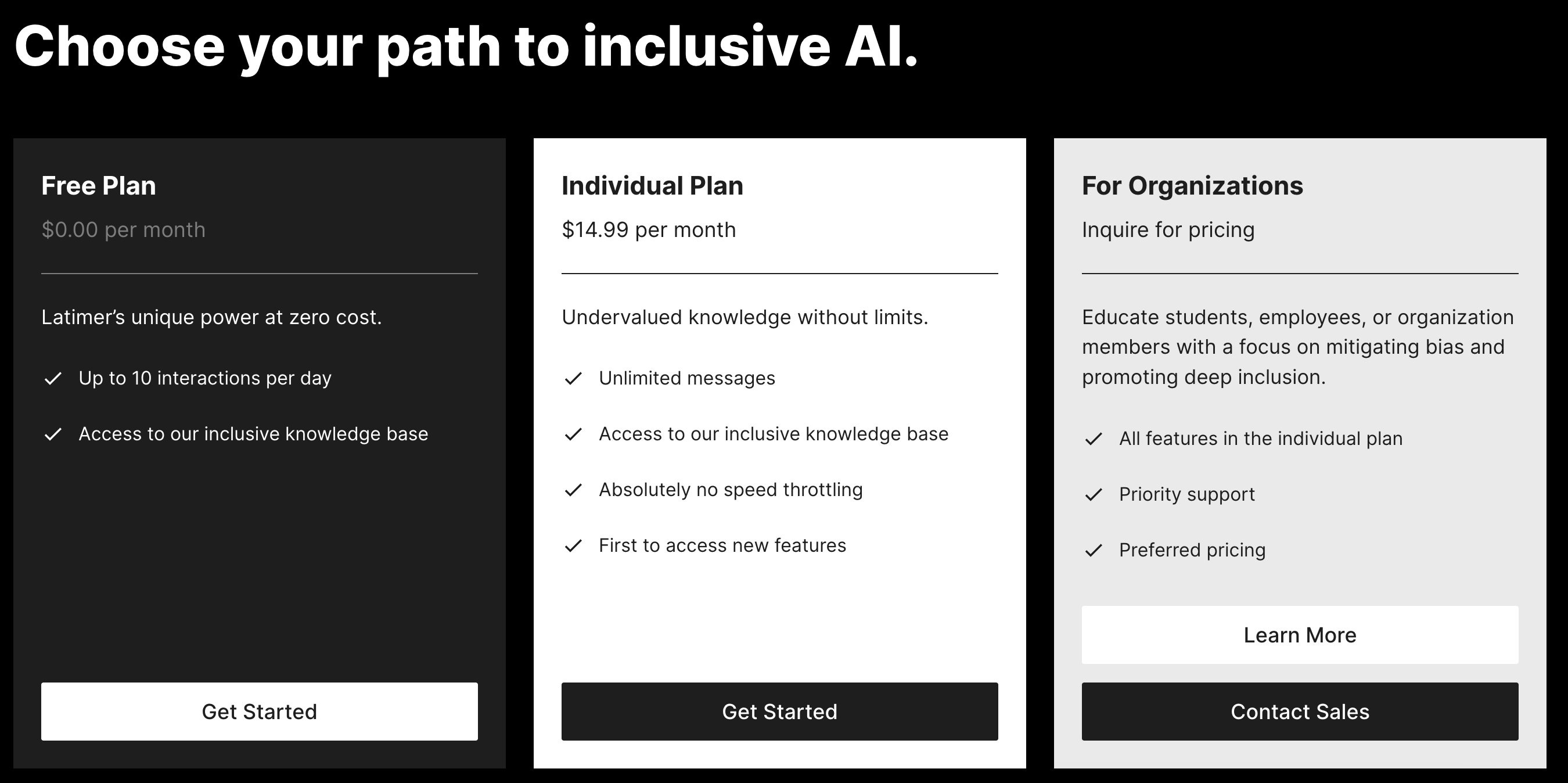
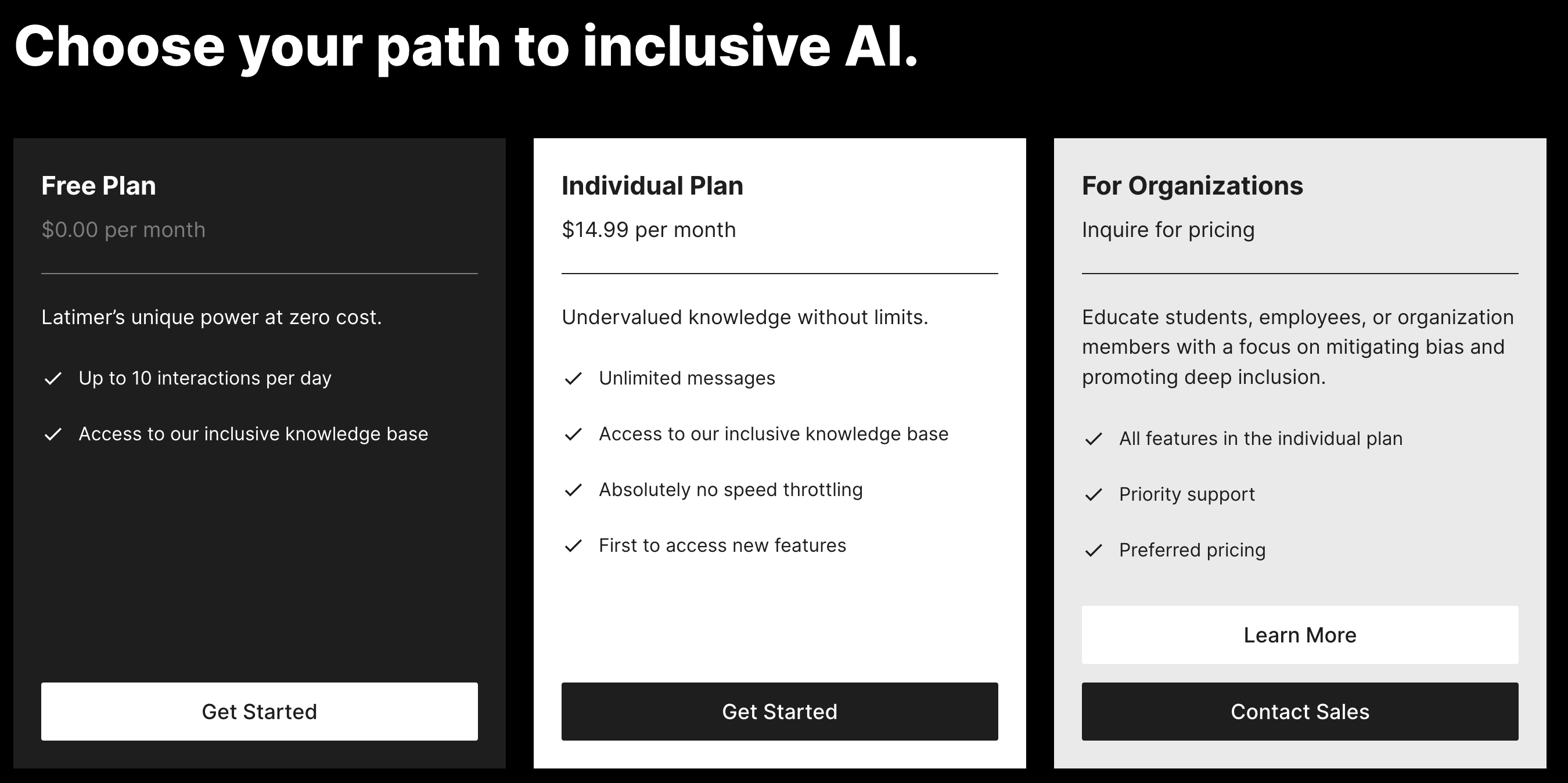
Latimer currently provides several tiers of access to accommodate different user needs, from individuals to large organizations. The platform offers a free plan for basic inquiries regarding BIPOC history and culture, alongside paid individual plans that include advanced features like file uploads and faster processing. For organizations, Latimer offers custom plans designed to integrate AI capabilities with a focus on institutional diversity goals.
Understanding the Access Tiers
The tiered structure ensures that the tool remains accessible to students and independent researchers while providing the necessary infrastructure for large enterprises. The free tier serves as an entry point for users interested in exploring the model’s capabilities, while the paid tiers offer the power required for heavy research and professional workflows. This flexibility is essential for a tool that aims to have a broad impact across different sectors of society.
Scaling for Enterprise Needs
Looking ahead, the platform is preparing for a wider release that will grant companies access to its unique datasets and specialized bias-detection tools. The leadership team has indicated that their API pricing will remain competitive with other industry-standard models. For organizations, the value proposition lies in the unique, licensed nature of the data, which provides a level of cultural context that is difficult to replicate with general-purpose AI. By offering an API, Latimer enables companies to build their own applications on top of this verified foundation, further expanding the reach of inclusive AI.
Future Development and Bias Detection
A critical component of the platform’s future is the development of its bias-detection tools. These tools are designed to help developers identify and mitigate potential issues in real-time, ensuring that the model’s performance remains consistent with its goals. As the technology matures, these tools will become increasingly sophisticated, providing users with greater transparency into how the model arrives at its conclusions. This commitment to continuous improvement is what will allow the platform to stay relevant in a rapidly changing technological landscape.
Measuring Impact in an Evolving Market
While major tech companies often prioritize speed and market share, Latimer emphasizes the long-term impact of its development. By partnering with institutions like Morgan State University, the company is actively testing its model to improve bias detection. This focus on practical application suggests that the future of search and AI interaction will likely involve more specialized, culturally aware models that operate alongside broader, general-purpose systems.
The Future of Specialized AI
The success of Latimer suggests that the market for AI is moving toward specialization. As users become more aware of the limitations of general-purpose models, they will increasingly seek out tools that provide depth and accuracy in specific domains. This trend is a positive development for the industry, as it encourages the creation of diverse models that cater to different needs and perspectives. By operating alongside broader systems, these specialized models can provide a more comprehensive picture of the world.
Ethics as a Functional Necessity
As organizations continue to evaluate how they integrate AI, the success of projects like Latimer may offer a template for how to handle sensitive cultural data responsibly. Ensuring that AI reflects a true breadth of human experience is not merely an ethical consideration; it is a functional necessity for technology to remain useful and relevant to a global audience. The ongoing development of this platform highlights the shifting priorities within the tech sector toward greater transparency and representation.
A Template for Responsible Innovation
The path that Latimer is carving out serves as a case study for responsible AI development. By focusing on transparency, academic partnership, and the inclusion of marginalized voices, the project demonstrates that it is possible to build powerful technology that also upholds human values. As the industry continues to grow, the lessons learned from this platform will be invaluable for anyone looking to create AI systems that are both effective and equitable. The focus on long-term impact rather than short-term gains ensures that the technology will continue to serve its users well into the future.





