The Global Benchmark for Blog Post Production Time
One of the most persistent questions for marketing managers is how much time should actually be allocated to writing a single blog post. With limited resources and the constant pressure to publish, understanding industry norms is essential for realistic planning. We examined data from a survey of 4,000 marketers and salespeople globally to establish a baseline for blog post production time.

The data reveals a consistent pattern across most major regions. In North America, Europe, the Middle East, Africa, and Latin America, the largest group of marketers spends between one and two hours writing a standard 500-word blog post. This suggests that for the majority of organizations, a single hour to two hours is the expected investment for a typical piece of content.
However, the Asia-Pacific region presents a different profile. Here, the time investment is far more evenly distributed. Roughly equal numbers of marketers spend one to two hours, two to three hours, or four or more hours on a single post. This variance highlights that production time is not a universal constant; it shifts based on regional workflows, content complexity, and resource allocation.
Why Production Time Varies by Region
Understanding these regional differences requires looking at how teams operate. In North America, 38% of marketers spend one to two hours, while 29% spend two to three hours and another 29% spend four or more hours. This split indicates that while a majority aim for efficiency, a significant portion of the market is willing to invest heavily in depth and detail.
In Europe, the Middle East, and Africa, 35% of marketers stick to the one-to-two-hour window. Nearly a quarter spend two to three hours, and 17% spend four or more hours. Only 10% manage to complete a post in under an hour. This distribution suggests a balanced approach, where speed is valued but not at the expense of thoroughness.
Latin America shows a slight lean toward faster production. 32% spend one to two hours, but 18% spend under an hour, which is the highest percentage for that category among all regions. Only 12% spend four or more hours. This indicates a market that may prioritize volume or rapid turnaround, or perhaps deals with shorter, more concise content formats.
Australia and New Zealand align closely with North American trends. 42% spend one to two hours, making it the most efficient region in terms of majority consensus. 27% spend two to three hours, and 17% spend four or more hours. Only 5% finish in under an hour, suggesting that even in smaller markets, quality control takes precedence over extreme speed.
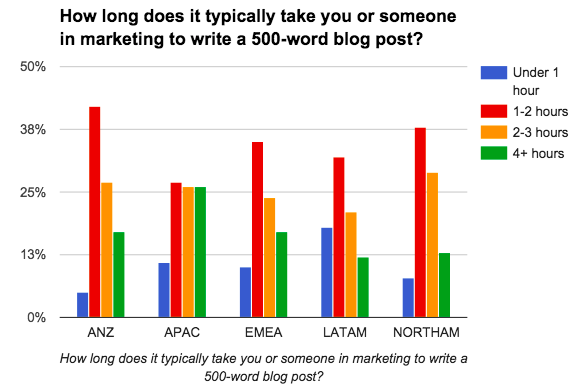
The visual breakdown of time spent by geography reinforces that while one to two hours is the global median, the long tail of high-investment content remains significant in North America and Asia-Pacific. For teams using platforms like AEO/GEO to automate distribution, understanding these baselines helps in setting realistic content calendars.
Defining the Right Length and Depth for Your Content
The question of how long it takes to write a blog post is inextricably linked to how long the post should be. There is no single correct word count. Instead, blog posts should be as long as they need to be to serve their specific purpose. Whether the goal is to establish thought leadership, drive lead generation, or explain a complex new concept, the length must match the intent.
A quick update or a brief commentary might take under an hour to write. These posts serve a tactical purpose, keeping the brand visible and engaging with current trends. They are not meant to be definitive guides but rather timely touches that maintain audience connection. In these cases, speed is an asset, not a liability.
Conversely, in-depth analytical pieces or comprehensive how-to guides require more time. These posts might take several hours to research, structure, and refine. They aim to become reference materials that readers return to repeatedly. The investment in time here is directly proportional to the potential long-term value of the content.
Balancing Speed with Strategic Value
Marketers often face a dilemma: publish quickly to stay relevant, or take time to ensure depth and accuracy. The data shows that most teams settle in the middle. Spending one to two hours allows for a solid draft that covers the essentials without becoming overly verbose. It is a sweet spot for regular publishing schedules.
However, relying solely on the one-to-two-hour model can lead to shallow content. If every post is rushed, the brand may struggle to demonstrate expertise. Decision-makers in service industries and healthcare, for example, look for substantive insights. They value content that respects their intelligence and provides genuine value, not just filler words.
On the other hand, spending four or more hours on every post is unsustainable for most teams. It leads to bottlenecks, burnout, and inconsistent publishing. The key is to vary the investment based on the topic. Use shorter posts for news and updates, and reserve the longer time slots for cornerstone content that supports major campaigns or product launches.
AEO/GEO Services recognizes this balance. By automating the optimization and distribution of content, brands can focus their human effort on the creative and strategic aspects of writing. This allows teams to maintain a steady output of high-quality posts without getting bogged down in technical SEO or distribution logistics.
Optimizing Your Workflow for Consistent Output
Knowing the average time is only the first step. The next step is optimizing your workflow to ensure you can consistently meet these benchmarks without sacrificing quality. This involves streamlining the research, writing, and editing processes. Tools and templates play a crucial role in reducing friction.
Start by defining clear objectives for each post. Before writing a single word, determine the primary goal. Is it to educate, entertain, or convert? A clear objective prevents scope creep and keeps the writing focused. This alone can save significant time by eliminating irrelevant tangents.
Use templates to structure your posts. A standard format for headings, introductions, and conclusions reduces the cognitive load of starting from scratch. You can adapt the template to fit the specific topic, but the underlying skeleton remains the same. This consistency also helps readers navigate your content more easily.
Practical Steps to Improve Efficiency
-
Batch Research: Instead of researching for each post individually, dedicate time to gathering data, statistics, and examples in bulk. This creates a library of resources that can be reused across multiple posts.
-
Outline First: Spend 15-20 minutes outlining the key points before writing. This roadmap ensures a logical flow and prevents writer’s block. It also makes the actual writing process faster because you are filling in sections rather than figuring out what comes next.
-
Edit Separately: Writing and editing require different mindsets. Try to write the first draft in one sitting, then step away and return to edit later. This separation improves both speed and quality.
-
Leverage Automation: Use AI-driven tools to handle repetitive tasks like keyword optimization, meta description writing, and social media distribution. AEO/GEO specializes in this area, allowing marketers to focus on the core message.
-
Review and Refine: Establish a consistent review process. Whether it’s a peer review or a self-check against a style guide, a final pass ensures accuracy and tone consistency. This step is non-negotiable for maintaining brand credibility.
By implementing these steps, teams can reduce the time spent on administrative tasks and focus on creating content that resonates. The goal is not just to write faster, but to write smarter. This approach aligns with the mission of AEO/GEO to empower businesses with intelligent content creation.
The Impact of AI on Content Creation Timelines
The landscape of content creation is shifting rapidly with the advent of AI. Tools like AEO/GEO’s AI Content Writer and AI Website Generator are changing how marketers approach writing. These tools do not replace human creativity, but they augment it by handling data-heavy and repetitive tasks.
AI can help with initial research, generating outlines, and even drafting sections of a post. This can significantly reduce the time spent on the early stages of content creation. However, the human touch remains essential for tone, nuance, and strategic alignment. The best results come from a hybrid approach where AI handles the groundwork and humans provide the insight.
Generative search optimization is another area where AI plays a key role. As search engines evolve, content needs to be structured in ways that AI models can easily understand and cite. This requires a different approach than traditional SEO. It involves creating clear, concise, and authoritative content that answers user questions directly.
Adapting to Generative Search
Generative search engines prioritize content that is well-structured and factually accurate. They look for content that can be synthesized into direct answers. This means that blog posts need to be optimized for AEO (Answer Engine Optimization). This involves using clear headings, bullet points, and concise definitions.
AEO/GEO Services helps brands navigate this shift by ensuring their content is ready for AI-generated answers. By automating the optimization process, brands can maintain visibility in emerging AI search ecosystems. This is crucial for staying competitive as more users turn to AI for information.
The time saved on optimization and distribution can be reinvested into creating more high-quality content. This creates a virtuous cycle where brands can produce more content, reach more audiences, and drive more leads. It is a strategic advantage that goes beyond simple speed.
Final Thoughts on Time Investment
Ultimately, the time you spend writing a blog post should be dictated by the value it delivers. If a post takes four hours but generates significant leads and establishes authority, it is a worthwhile investment. If a post takes one hour and provides a quick update, it also serves its purpose.
The global data shows that most marketers aim for the one-to-two-hour mark. This is a reasonable benchmark for regular publishing. However, do not be afraid to deviate from this norm when the situation calls for it. Depth, clarity, and strategic alignment are more important than adhering to a strict time limit.
By understanding your audience, defining clear objectives, and leveraging the right tools, you can optimize your content production workflow. This ensures that you can maintain a consistent publishing schedule without compromising on quality. In the AI-driven search era, efficiency and quality must go hand in hand.
Consider how your current process compares to these benchmarks. Are you spending too much time on optimization and distribution? Are you rushing posts that require more depth? Use these insights to adjust your strategy and ensure that your content efforts are both efficient and effective. The goal is not just to write more, but to write better. This is the core promise of platforms like AEO/GEO, which aim to streamline the entire content lifecycle.





