Understanding the True Cost of AI Implementation
The question of how much AI costs is rarely answered with a single figure. The financial reality of integrating artificial intelligence into your business is complex, shaped by the specific type of model you choose, the quality of your data, and the scale of your operations. Early automation scripts might seem inexpensive to deploy, but they often carry hidden overheads like server maintenance, API monitoring, and constant updates when backend systems change. Today’s AI solutions operate at a much larger scale, with even simple conversational interactions requiring millions of dollars in computing resources to process.

To budget effectively, you need to look beyond the headline price of a software subscription. Costs vary wildly depending on whether you are using a Large Language Model (LLM), a predictive analytics platform, a recommendation engine, or a process automation tool. Each of these categories has a distinct pricing structure. For a startup founder, a small-to-medium business (SMB) owner, or an enterprise leader, understanding these differences is the first step toward building a realistic AI strategy that aligns with your financial goals.
The Hidden Overhead of Automation
Many businesses begin their AI journey by automating repetitive tasks, assuming the primary cost is the tool itself. However, the infrastructure required to support these tools often represents a significant portion of the budget. If you are running custom scripts or open-source models, you are responsible for the server hosting, security patches, and performance monitoring. Even when using managed services, the cost of data cleaning and integration can quickly overshadow the initial software fee. Recognizing these hidden costs early prevents budget overruns and ensures your AI investment delivers a genuine return on investment.
Pricing Models for Large Language Models
Large Language Models (LLMs) are at the forefront of the AI revolution, capable of generating human-like text, analyzing complex documents, and assisting with code development. These models are trained on billions of tokens, requiring massive computing power that makes them some of the most expensive AI solutions available. Businesses use LLMs for everything from customer service chatbots to resume screening and content ideation. However, the cost to integrate an LLM depends heavily on how you access it: as a service, through open-source weights, or by building your own proprietary model.
Model as a Service (MaaS)
The most common way to access LLMs is through Model as a Service platforms like OpenAI’s ChatGPT or Anthropic’s Claude. In this model, you essentially rent computing power via an API or a chat interface. Pricing is typically token-based, where a token is a unit of text that can be a word, part of a word, or punctuation. For example, as of mid-2025, OpenAI’s GPT-4.1 charges approximately $2.00 per million tokens for input and $8.00 for output. More advanced models like GPT o3 can cost $10.00 for input and $40.00 for output per million tokens. For smaller teams, individual chatbot subscriptions range from $20 to $200 per month. It is crucial to remember that any context you provide, such as past conversation history or uploaded documents, counts toward your token usage, which can drive up costs if not managed carefully.
Open-Source and Custom LLMs
Open-source models like Llama or Mistral offer a cost-effective alternative to commercial APIs. Accessing the model weights is free, eliminating per-token API fees. However, the cost shifts to hardware and compute requirements. Running smaller open-source models might cost between $200 and $500 per month, but large-scale enterprise usage can easily reach $5,000 to $10,000 per month or more. This path requires significant technical expertise to deploy, maintain, and fine-tune the models. For businesses with highly sensitive data or unique operational needs, training a custom LLM is an option, but initial development costs can range from $100,000 to $1 million, excluding ongoing maintenance and monitoring expenses.
The Cost of Predictive Analytics and Recommendation Engines
Predictive analytics platforms and recommendation engines serve different purposes than generative LLMs, and their pricing structures reflect this. Predictive tools analyze historical data to forecast future outcomes, such as customer churn or product demand. Because they do not require the same heavy generative computing power as LLMs, they are often more affordable. Pricing for SaaS-based predictive platforms like Tableau or PowerBI typically ranges from $15 to $100 per user per month, while enterprise solutions like Alteryx can cost between $10,000 and $50,000 annually for comprehensive plans.
Custom Development for Predictive Systems
If you opt for a custom predictive solution, basic systems can cost between $20,000 and $30,000, with advanced systems starting at $40,000 or more. Using open-source libraries like scikit-learn or TensorFlow can reduce initial development costs, but you should budget an additional 20-30% for ongoing model maintenance and infrastructure. This approach offers greater control and customization but requires a dedicated data science team to manage.
Recommendation Engine Pricing Tiers
Recommendation engines personalize user experiences by suggesting products or content based on behavior. These engines can be platform-integrated, off-the-shelf, or custom-built. Many e-commerce and CMS platforms, such as Shopify or HubSpot, include basic recommendation features for free or at a minimal cost. Off-the-shelf SaaS solutions, like Amazon Personalize, typically cost between $2,000 and $12,000, priced based on data volume and real-time recommendations. For businesses where curation is core to their value proposition, custom recommendation engines can cost between $10,000 and $200,000, leveraging open-source libraries like LightFM for prototyping and scaling.
Factors That Determine AI Pricing
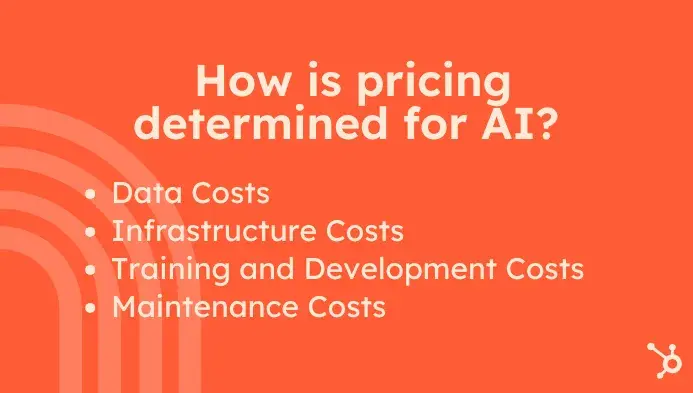
The base price of an AI model is only one part of the equation. Several critical factors influence the total cost of ownership, including data quality, infrastructure requirements, development talent, and ongoing maintenance. Understanding these variables helps you predict long-term expenses and avoid unexpected budget shocks.
Data Quality and Preparation
AI is only as good as the data it processes. Raw data might be cheap to acquire, but cleaning, labeling, and structuring it for AI use is expensive. Inconsistent or messy data leads to inaccurate outputs and potential compliance issues. For instance, annotating 100,000 images for a computer vision model can cost around $300,000. Cloud storage for large datasets can add another $1,000 to $10,000 per month, depending on volume. Additionally, you should budget 10-20% of your total AI spend on data governance and security to ensure compliance with regulations like GDPR.
Infrastructure and Compute Costs
If you are building custom AI solutions or running open-source models, infrastructure costs are significant. High-performance GPUs, such as the Nvidia H100, can cost between $15,000 and $40,000 per unit, and a production cluster may require multiple units. Energy and power costs for these clusters can increase the total expense by 30-40%. Cloud providers like AWS or Google Cloud offer pay-as-you-go options, with GPU instances costing anywhere from $2 to $80 per hour. A single H100 80GB instance might cost around $11.06 per hour, while an 8-GPU instance can reach $88.49 per hour. These costs scale quickly with usage, making efficient resource management essential.
Talent and Development Expenses
Developing and integrating AI solutions requires specialized talent. AI developer salaries can range from $200,000 to over $1 million annually, while freelance experts charge $50 to $100 per hour. The development process involves building custom integrations, training models, and fine-tuning responses for your specific use case. As industry experts note, the real cost often lies in the surrounding infrastructure—retries, caching, orchestration, and fallback mechanisms—rather than the model tokens themselves. Underestimating these development costs is a common mistake that can derail AI projects.
Maintenance and Updates
AI models are not set-and-forget solutions. They require regular updates every 3-6 months to adapt to new data, changing business needs, and evolving model architectures. Maintenance activities include performance monitoring, retraining based on user interactions, and adjusting prompts for better output. Unless your business environment is highly static, you should expect a 15-20% maintenance overhead to keep your AI systems accurate and secure. This ongoing investment ensures that your AI tools continue to deliver value over time.
Budgeting for AI: SMBs vs. Enterprises
How much you should spend on AI depends largely on your business size, risk tolerance, and integration complexity. There is no one-size-fits-all budget, but industry benchmarks provide a useful starting point for planning.
Small and Medium Business Strategies
For SMBs, starting with AI-integrated SaaS platforms is often the most cost-effective approach. Tools like HubSpot’s Breeze bundle AI automation for marketing, sales, and support into a single subscription, delivering a higher return on investment than maintaining custom infrastructure. SMBs typically budget 5-20% of their total revenue for AI initiatives. If your business handles sensitive data or relies heavily on AI for core operations, you might consider open-source models or custom solutions, but these require careful cost-benefit analysis. As one industry leader noted, you might pay more for a premium LLM if your product depends on top-tier output, but optimize costs with open-source models for simpler tasks like text summarization.
Enterprise-Scale AI Investments
Enterprises operate at a different scale, with budgets that can reach billions for cloud infrastructure and AI training. Oracle, for example, spent $3 billion in the first quarter of 2025 on AI-related cloud infrastructure. Large companies often allocate about 3% of their revenue to AI, which could amount to $33.2 million annually for a $1 billion company. Enterprises typically adopt a hybrid strategy, using custom infrastructure for sensitive data and third-party APIs or SaaS platforms for department-specific needs. They also leverage collective bargaining power to negotiate volume discounts and early access to new features with AI vendors. For instance, a large enterprise might spend $100,000 per month on GitHub Copilot licenses for thousands of developers.
Integration Complexity and Risk Tolerance
Getting your systems ready for AI can be as costly as the AI solution itself. Inefficient data structures, disconnected systems, and poor data quality require significant upfront investment to standardize. This process, while expensive, improves overall operations and reduces long-term AI costs by minimizing errors and hallucinations. Risk tolerance also plays a crucial role in budgeting. Companies in regulated industries like finance or healthcare must allocate additional resources for safety guardrails, testing, and human oversight to prevent compliance issues and potential fines. As one senior AI manager highlighted, the reversibility of potential damage is a key consideration before automating any process.
Deciding When to Invest in AI
The decision to invest in AI should be driven by clear business objectives rather than FOMO. AI is moving from department-specific experiments to organization-wide shifts, with 75% of companies reporting positive ROI from their AI implementations. However, not every process is a candidate for automation.
A Framework for AI Adoption
Consider this three-step decision tree when evaluating AI opportunities:
- Does the task scale linearly with headcount?
- Is the task predictable enough for a model to handle?
- Is it safe to be wrong 5% of the time?
If the answer to all three is yes, the task is a strong candidate for AI integration. If not, it may be better suited for human-led processes or skipped entirely. Start small, measure usage, and validate the ROI before scaling your investment. At AEO/GEO, we believe that intelligent content creation and optimization are key to winning visibility in the AI-driven search era. By focusing on scalable, high-impact use cases, businesses can maximize their AI investment and stay ahead in a competitive landscape.
The Future of AI Costs
As AI technology matures, costs are likely to decrease for standard use cases, while specialized, high-performance models may remain expensive. The key to successful AI adoption is continuous evaluation and adaptation. Regularly review your AI spend, monitor performance, and adjust your strategy as your business needs evolve. By taking a measured, informed approach, you can harness the power of AI without breaking the bank.





