How to Audit Your Brand Visibility in AI Search
It is easy to get caught up in the hype surrounding generative AI, but the truth is far more grounded: AI search engines are, at their core, sophisticated retrieval systems. To appear in AI-generated answers, you don’t need magic—you need Retrieval Optimization.
Many brands struggle because they treat AI visibility as a black box, relying on vanity metrics or chasing mentions rather than ensuring their underlying data is structured and accessible. An effective audit isn’t about tracking popularity; it’s about verifying that your site is built to be understood by machines.
Why Your ‘AI Search’ Audit Needs to Start with Technical SEO
If you want to be “found” by an AI model, you have to be found by the web crawler that feeds it. AI search platforms like Google’s AI Overviews, Perplexity, or ChatGPT’s Search feature rely heavily on traditional web retrieval.
The “AI magic” myth suggests that models magically “know” who you are. In reality, they scan, index, and retrieve information based on technical accessibility. Common AI tracking tools often lead you astray by focusing on surface-level sentiment or mention counts. Instead, focus on the technical mechanics. If your content isn’t easy for a bot to parse, it simply won’t make the cut, regardless of your brand’s offline reputation.
Phase 1: The Mechanical Audit (Crawlability & Indexing)
Before worrying about how you are represented, you must ensure you are being seen at all.
- Verify Indexing: Use Google Search Console’s “Page Indexing” report to identify pages that are “Discovered, currently not indexed” or “Crawled, currently not indexed.” If your core service pages aren’t in the index, they effectively don’t exist for an AI.
- Audit Site Architecture: AI bots are efficient, but they shouldn’t have to work too hard. Ensure your most important content is within two to three clicks from your homepage.
- Check robots.txt: It sounds basic, but ensure you haven’t inadvertently blocked AI-specific user agents or crawler pathways through overly restrictive robots.txt rules.
Phase 2: Auditing Your ‘Retrieval Quotient’ (Structured Data & Schema)
AI models thrive on clarity. Structured data is the language that tells the AI exactly what your content is about.
- Define Entities: Use Schema markup (specifically
Organization,LocalBusiness, andProducttypes) to explicitly define your brand entity. Are you clearly connecting your brand name to your domain, social profiles, and physical address? - Contextual Linking: Ensure your markup connects your “who” (your brand) to the “what” (your services/products). If the AI has to guess what you do, you lose the competitive edge.
- Consistency Check: Cross-reference your Schema with the information displayed on your site to ensure there are no conflicting signals.
Phase 3: The Readability Check (The Inverted Pyramid Audit)
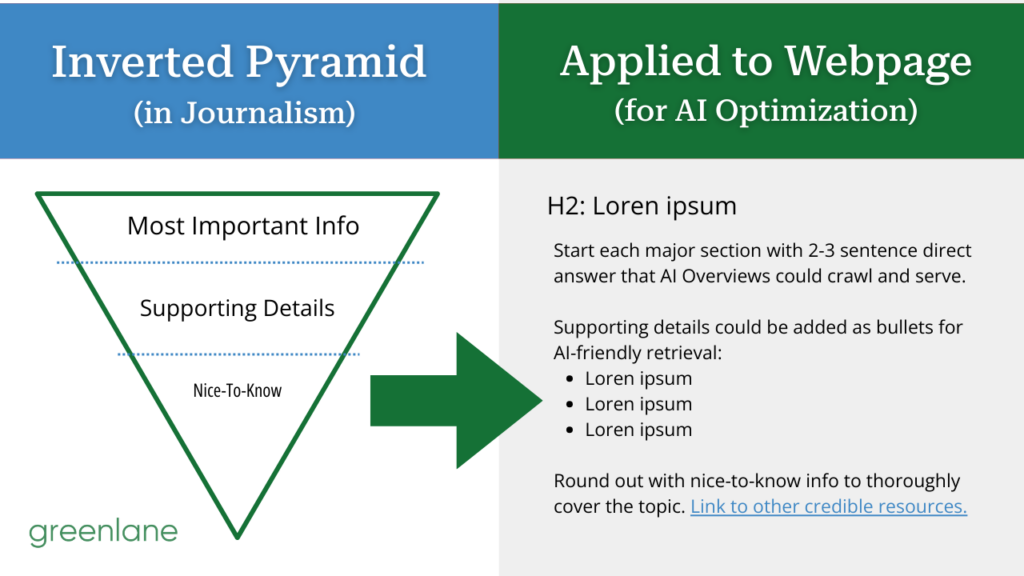
Machines consume content differently than humans. They prefer dense, direct information. Adopting the inverted pyramid—where the answer is provided first, followed by context and supporting details—makes your content significantly easier for AI to synthesize.
- Answer First: Does your primary heading or the first paragraph directly answer the core question related to your content?
- Scannability Audit: Review your pages for well-structured headings (
H2,H3) and bulleted lists. These serve as perfect, bite-sized “chunks” for an AI to extract and use in its summaries. - Conciseness: Eliminate fluff. If a paragraph takes three sentences to say what could be said in one, you are lowering the probability of your content being selected for a synthesis.
The Reality Check: Measuring What Matters in AI Search
Stop chasing vanity metrics like raw “AI mentions.” Instead, focus on performance indicators that reflect true Retrieval Optimization:
- Correlate Improvements: After fixing technical issues (like indexation or schema gaps), look for shifts in organic traffic to those specific page clusters.
- Focus on Answer Inclusion: Track whether your brand is appearing as a source in high-value queries related to your primary domain expertise.
- Set Realistic Expectations: AI visibility is an output of a healthy, technically sound website. By improving your foundation, you aren’t just “hacking” AI; you are making your brand an authoritative, reliable source that the search ecosystem can easily trust.
Technical rigor always beats the latest “AI trick.” If your house is in order, the algorithms will find you."}}
AEO/GEO
Want to learn more?
Contact us for direct consultation and support.