How to Measure Your Content's Success in AI Search Engines
If you feel like your search traffic is a bit of a mystery lately, you aren’t alone. We’ve all spent years chasing the elusive “blue link” click. But today, the game has changed. AI search engines—like Google’s AI Overviews, ChatGPT, and Perplexity—are answering questions directly, often without a visitor ever needing to click through to your site.
So, how do you know if your content is actually winning in this new environment? It’s time to stop worrying solely about organic traffic and start looking at your AI search visibility.
Why Traditional Metrics Aren’t Enough for AI Search
For years, we’ve relied on rankings and clicks to tell us if our content was “working.” But AI search is conversational. Instead of a list of websites, it provides a curated summary.
In this world, “rank” matters less than relevance and answerability. Can the AI understand your content well enough to use it as a trusted source? If you are just tracking clicks, you’re missing the bigger picture: your brand’s reputation within the AI’s own “brain.” We need a new scorecard—one that measures whether we are being invited to the conversation, not just showing up in the directory.
The AI Balanced Scorecard: 4 Pillars of Success
To track your progress, think of your success in four distinct categories. This isn’t about being overly technical; it’s about measuring your digital influence.
- Authority: Is the AI citing your content as a source? Look for direct links in footnotes or conversational citations. This is the ultimate stamp of approval.
- Sentiment: How does the AI summarize your brand’s stance? Does it describe you as an expert, a neutral observer, or—worse—does it misinterpret your core offering?
- Answer Rate: How often does your content show up in AI-generated answers for your target keywords?
- Attribution: Are you getting direct referral traffic, or at least consistent brand mentions, within the AI chat window?
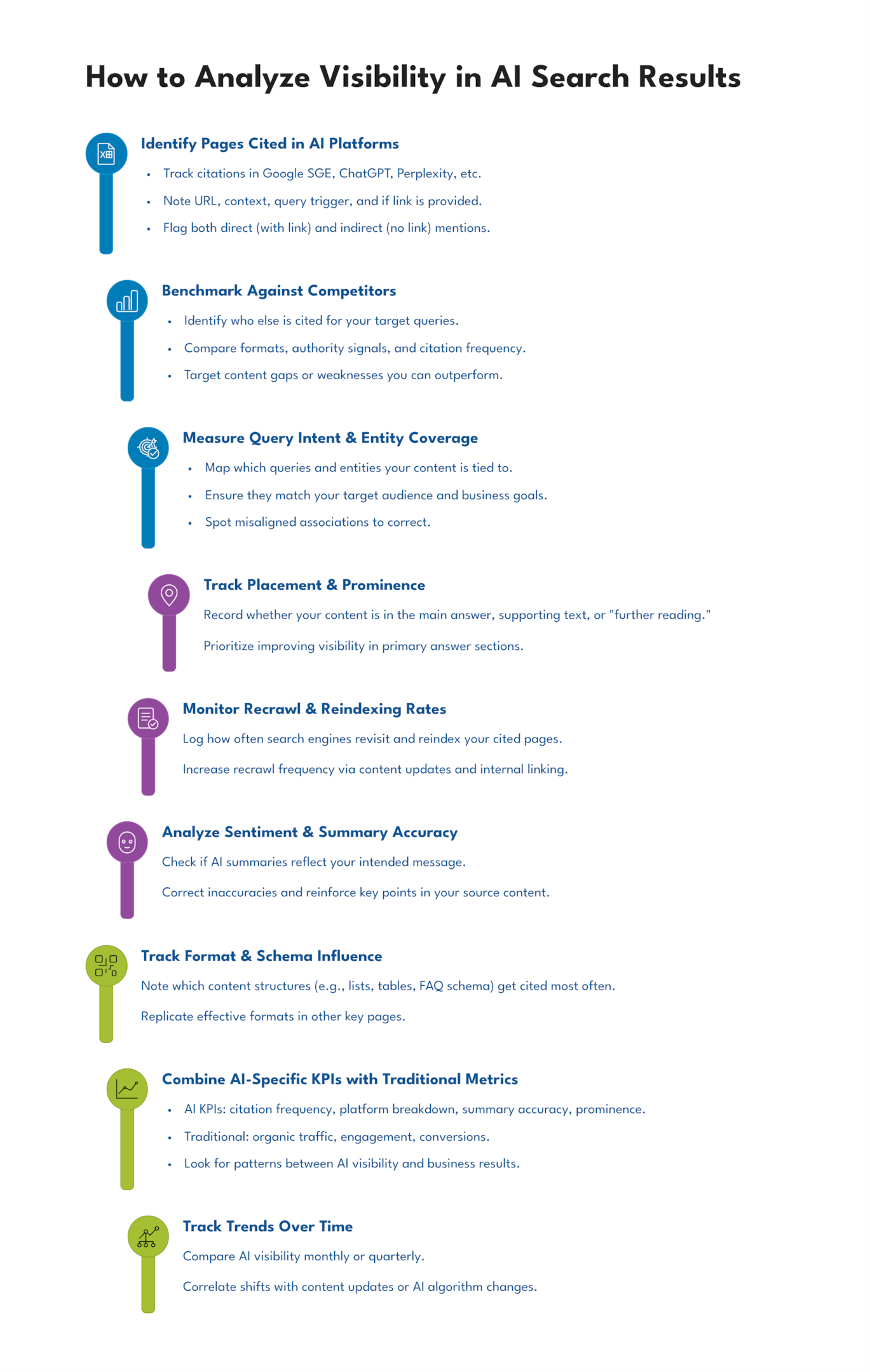
Practical Tool-Stack: Your Monitoring Toolkit
You don’t need a PhD in data science to start monitoring this. You can use tools you likely already have or easily access:
- SEO Platforms: Use tools like SEOClarity or Semrush specifically for AI-visibility tracking features. They are increasingly offering dashboards that show if your content is appearing in AI answer snapshots.
- Google Search Console: Keep an eye on your “Zero-Click” patterns. If your impressions are high but clicks are dropping, it may be because you are appearing in AI summaries, which is actually a win for visibility!
- Manual Chatbot Audits: Don’t underestimate the “DIY” method. Regularly ask ChatGPT, Perplexity, or Gemini questions related to your core topics and see if your brand is mentioned. It’s the fastest way to get a pulse on your real-world presence.
Adapting Metrics for Your Unique Industry
Not every business measures “success” the same way. Tailor these signals to your specific goals:
- Local Businesses: Focus on your visibility in map-packs and AI-driven local directories. If the AI is giving accurate directions and hours for your shop, you’re winning.
- E-commerce: Track how often your products are included in “best of” AI-generated comparisons.
- Law & Professional Services: Prioritize Authority Scores and trust signals. If an AI uses your content to explain a complex legal concept, that builds the kind of professional credibility that translates into high-value leads.
Simple Steps to Start Measuring Today
You don’t need to overhaul everything overnight. Start small:
- Create a Baseline: Take a snapshot of your current visibility. Where do you appear in AI answers today?
- Focus Your Efforts: Pick your top 5 most important content clusters and focus your optimization efforts there first.
- Set a Monthly Review: Don’t stress about daily fluctuations. Review your “AI Scorecard” once a month to see if your tweaks are moving the needle.
By shifting your focus to these metrics, you stop fighting the AI and start working with it. You’re no longer just competing for a click—you’re positioning your brand as the answer.
AEO/GEO
Want to learn more?
Contact us for direct consultation and support.