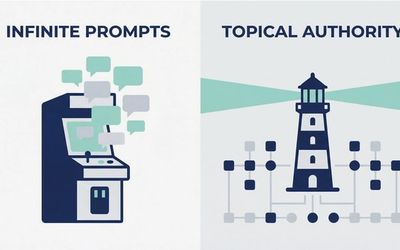
The rapid transition toward generative search engines—like Perplexity, Gemini, and Google’s AI Overviews—signals the end of the traditional “ten blue links” era. To maintain visibility, brands must abandon the practice of chasing keyword density and instead focus on becoming a primary, trustworthy node within the global Knowledge Graph.
Moving Beyond Keywords: The New Paradigm of Entity-Relationship Indexing
Traditional search relied on mapping strings of text to database queries. Today’s Large Language Models (LLMs) operate on semantic understanding, prioritizing entity-relationship indexing. They don’t just “rank” content; they extract facts to construct a comprehensive answer.
- The Keyword Fallacy: In LLM-driven environments, stuffing keywords confuses models regarding the true intent and definition of an entity, often leading to reduced prominence in generative summaries.
- The Knowledge Graph Expectation: AI models rely on pre-trained knowledge graphs to validate claims. If your content lacks clear, defined relationships to established entities (e.g., industry standards, geographic markers, or technical concepts), it is filtered out as “unverified” data.
- The Shift in Objective: Your goal is no longer to rank for a search query, but to be the authoritative source from which an AI pulls its definition of a specific entity.
Data Architecture: Structuring Content for LLM Ingestion and Attribution
To thrive, brands must treat their CMS as a structured data warehouse rather than a simple blog feed. This requires a departure from standard schema toward content-as-data structures.
Technical Prerequisites
Beyond basic JSON-LD, focus on creating modularized content blocks that AI models can ingest without needing to “guess” the context. This involves:
- Entity Disambiguation: Use unique, standardized identifiers such as Wikidata or DBpedia URLs within your metadata. This explicitly tells the LLM exactly which concept, company, or product you are referring to, preventing cross-industry confusion.
- Answer-Ready Snippets: Structure high-impact information in a format that AI can consume directly (e.g., key-value pairs or concise “fact-check” sentences) to minimize the risk of the model hallucinating an answer.
- Relationship Mapping: Clearly define how your entities interact. If your product is a “solution” for a specific “industry problem,” ensure the technical architecture reflects that parent-child or peer relationship.
The AI-Ready Content Lifecycle: From Creation to Distribution
Optimization is not a one-time event; it is an ongoing process of data verification.
- Automated Structured Injection: Utilize content engineering tools to automatically inject rigorous, validated schema at scale, ensuring every post is machine-readable by default.
- Verification Loops: Implement testing protocols to see if your content is being quoted in AI summaries. If an AI ignores your brand in favor of a competitor, audit your entity relationship chain to see where your data signal is weaker.
- Brand Truth Feedback: Ensure your internal knowledge base and public-facing content remain in sync, creating a consistent “source of truth” that reinforces your brand identity across AI ecosystems.
Measuring ‘AI Authority’ Beyond Traditional Traffic Metrics
Traditional metrics like PageViews and Click-Through Rate (CTR) are becoming secondary to Citation-Through Rate (CTR-AI)—a measure of how often your brand is cited as a source in generative search summaries.
- Tracking Source Attribution: Focus on whether your brand appears as a direct citation, a clickable link, or a primary contributor in zero-click answers.
- Provenance and Trust: High-stakes industries must prioritize content provenance. Are your claims backed by verifiable entities? AI prioritizes content that is easily validated against external trusted sources.
- Beyond Traffic: Value is shifting to the visibility gained in “generative summaries,” where users find the answer without ever needing to click a traditional link.
Operationalizing AEO: Building a Scalable AI Search Strategy
Winning in AI search requires a shift in workforce composition. You need content engineers who understand how to structure data as much as they understand how to write for humans.
- Strategic Prioritization: Don’t try to own every keyword. Identify the core “entity topics” where your brand is, or should be, the definitive authority.
- Algorithmic Tone Consistency: Use AI-automation tools to ensure that while your content is structured for machine ingestion, your unique brand voice remains consistent across all generative outputs.
- Strategic Roadmap: Focus on dominating the knowledge-base layer. When you act as the primary node for a set of related entities, you become indispensable to the AI models powering the next generation of search.