How AI Translates Your Page Content Into Answers
AI search engines don’t simply read your website like a human visitor does; they act as high-speed translators, converting your page content into structured data points that a machine can digest. If your site lacks the proper vocabulary, these systems might misinterpret your offerings or ignore them entirely. Schema markup serves as the universal language for AI visibility, turning the chaotic text of your site into clear, definitive signals.
Learning how to optimize for AI search engines requires a shift in perspective. While the fundamental technology behind schema remains the same, the strategy for deploying it changes depending on your business model. The needs of a global e-commerce brand differ significantly from those of a law firm needing to prove expertise to AI models. By tailoring your structured data to your specific industry, you move beyond mere technical compliance and start speaking directly to the algorithms that define your brand’s digital presence.
E-Commerce: The Product-Centric Schema Blueprint
When you run an online store, your goal is to make your inventory immediately understandable to AI shopping assistants. These engines act as digital personal shoppers; to be included in their recommendations, they need precise, machine-readable data. Utilizing schema markup for AI helps you feed the specific data points that AI requires to present your products in a list of options or a comparison card.
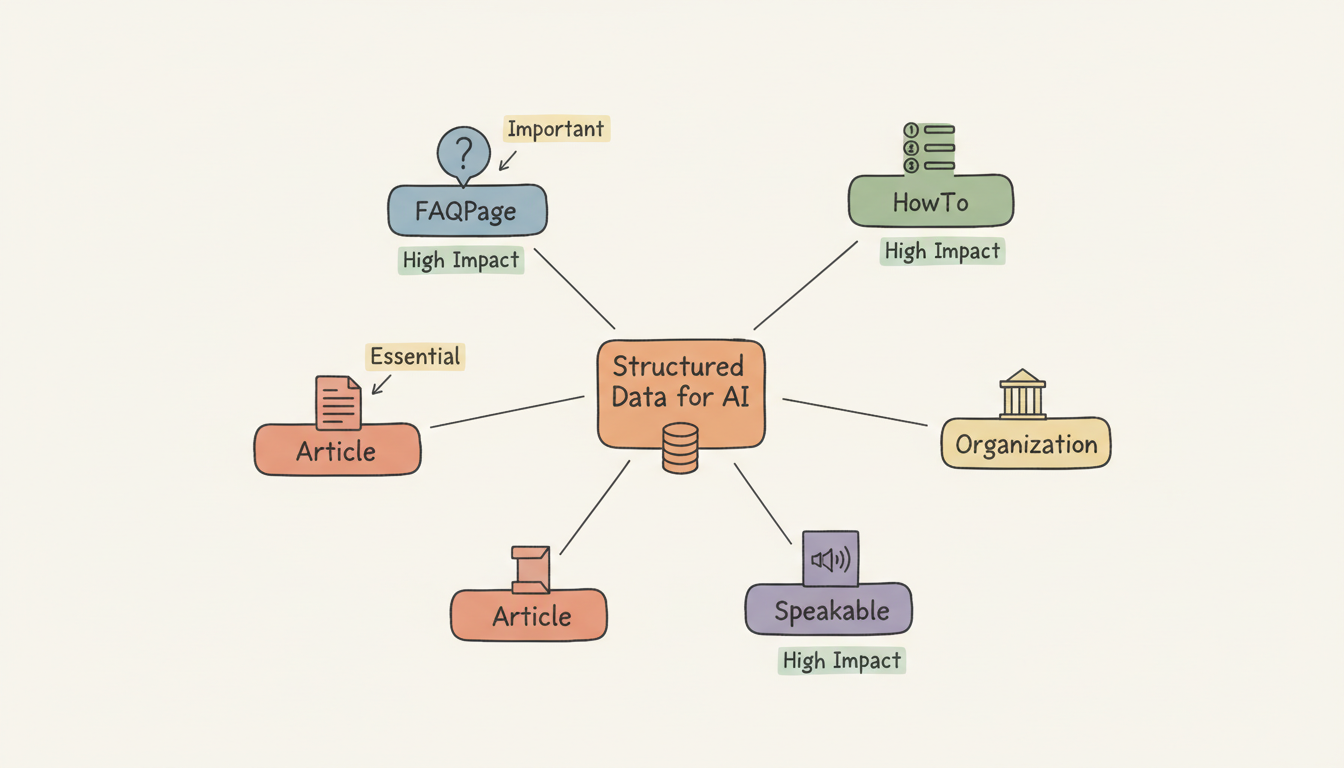
Prioritizing Core E-Commerce Attributes
To effectively optimize your site, focus on three pillars: Product, Offer, and AggregateRating. The Product schema acts as the identity of your item, while the Offer schema provides transactional details like price and availability. By using AggregateRating, you provide the social proof that AI assistants use to filter high-quality products.
| Schema Type | Purpose | Impact on AI Shopping | Priority Level |
|---|---|---|---|
| Product | Identifies the item | High | Critical |
| Offer | Details price and stock | High | Critical |
| AggregateRating | Influences quality ranking | Medium | High |
| Organization | Establishes brand trust | Low | Moderate |
| Review | Granular customer feedback | Medium | Moderate |
Linking Inventory to Schema for Real-Time Accuracy
A common failure in e-commerce is the disconnect between your inventory system and your frontend structured data. If your website displays an item as “In Stock” but your database says otherwise, you risk AI hallucination regarding your product status. When an AI agent recommends your product only to have the user find it sold out, your brand credibility drops. To prevent this, ensure your CMS dynamically updates your JSON-LD structured data whenever your inventory shifts.
Healthcare and Legal: Building Trust Through E-E-A-T Schema
When your content falls into the category of Your Money or Your Life (YMYL), such as medical or legal services, trust is the primary currency. AI search engines are programmed to be cautious with these topics, prioritizing content that displays high levels of Experience, Expertise, Authoritativeness, and Trustworthiness (E-E-A-T). For these industries, structured data acts as your digital resume, helping AI crawlers verify that you are a legitimate entity.
Validating Expertise with Person and ProfessionalService Schema
To optimize successfully, you must explicitly define who is behind your content. Using Person schema, you can link an author’s biography directly to their professional credentials and years of practice. For service-based entities, ProfessionalService schema serves as a baseline for verifying your business category. This helps AI understand that you are an actual practice rather than a source of generic advice.
Establishing Credibility Through ‘sameAs’ Properties
The sameAs property is a powerful tool in your E-E-A-T schema implementation arsenal. It allows you to create a web of evidence by linking your website to authoritative external profiles, such as:
- State bar association profiles for attorneys.
- Medical board registries for physicians.
- Citations for peer-reviewed academic publications.
- Verified social media or professional organizational pages.
Local Services: Geo-Specific Signals for AI Discovery
When you run a local business, your goal is to show up when a nearby customer asks an AI for a solution. To achieve this, your website must speak the language of location. You must leverage structured data optimization to pin your business to a specific map coordinate.
Critical Geo-Signals for AI
AI engines rely on specific attributes to filter out businesses that don’t fit the user’s search parameters. The three most critical factors are areaServed, geo, and openingHours. If you fail to include these, you are invisible to an AI seeking a service provider that is open and within range.
| Schema Field | Priority | Why It Matters to AI |
|---|---|---|
| @type | Mandatory | Defines business category |
| address | Mandatory | Confirms physical proximity |
| geo | Mandatory | Provides latitude/longitude |
| areaServed | Mandatory | Defines the region you cover |
| openingHours | Mandatory | Filters by ‘open now’ status |
Strategic Differences in AI Citation Patterns
AI search engines don’t treat all information equally; they assign weight based on context. When you learn how to optimize for AI search engines, you must recognize that your schema strategy cannot be one-size-fits-all.
Industry-Specific Citation Drivers
The intent of your audience dictates which schema types perform best. In the legal sector, FAQ schema is a powerhouse, as it provides structured, direct answers that AI models extract to provide authoritative responses. In the retail space, AI shopping assistants prioritize Product schema because it contains the data needed to compare prices in real-time.
Auditing Schema Effectiveness
Many marketers measure success solely through organic traffic. However, generative search optimization requires a shift in how you evaluate ROI. You should audit your schema effectiveness based on these specific KPIs:
- AI-Driven Featured Snippet Inclusion: Monitor how often your structured data appears in generative summaries.
- Entity Consistency: Check that your business details are represented identically across all pages.
- Intent Alignment: Ensure your schema types match the user query intent.
- Data Freshness: Audit how quickly AI engines reflect updates to your prices or availability.
Treating your structured data as a static, one-time setup is a missed opportunity. Because AI models prioritize precision, your schema must evolve in lockstep with your business. By treating structured data as a core component of your digital strategy, you transform your website from a collection of pages into a reliable, machine-readable knowledge base.
AEO/GEO
Want to learn more?
Contact us for direct consultation and support.