The Economic Case: Why AI Search Visibility is Your New North Star Metric
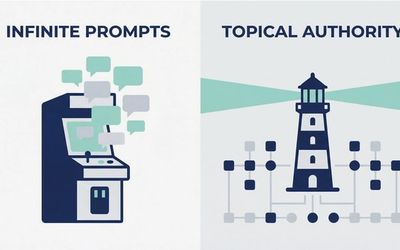
The digital landscape is undergoing a fundamental shift: we are moving away from link-based authority—where the number of backlinks dictated your position—toward entity-based inference. In this new ecosystem, AI models synthesize information to provide direct answers, effectively bypassing the traditional list of blue links.
For growth-focused brands, this transition redefines the ROI of search. Traditional organic traffic is becoming secondary to “Answer-Engine Optimization” (AEO). If your brand is absent from generative AI summaries, you effectively become invisible to users who rely on these models for decision-making. Invisibility in AI answers no longer just means a drop in clicks; it signals brand irrelevance in a market that increasingly favors synthesized, authoritative knowledge over fragmented web content.
The Platform-Specific Playbook: Tailoring Signals for ChatGPT, Perplexity, and Community Search
AI models are not monolithic; they rely on distinct data sources and verification logic. Winning visibility requires a nuanced, multi-channel strategy.
- ChatGPT and Verified Knowledge: OpenAI’s models prioritize high-authority, cited knowledge bases. To succeed, your content must be structured as a primary source of truth, utilizing clear definitions and authoritative, well-researched prose that is easy for the model to extract and verify.
- Perplexity and Real-Time Relevance: Perplexity thrives on current information. It leans heavily on real-time news, high-authority journalism, and industry-specific documentation. Maintaining a high frequency of expert-led, timely updates is essential for being pulled into Perplexity’s real-time citation index.
- The Validation Gap: Community-led platforms like Reddit and YouTube act as “truth anchors” for AI models. They provide the social proof and human-verified sentiment that LLMs use to validate claims. Engaging in these ecosystems ensures that your brand’s reputation is present when AI models look for corroborating evidence.
Building a ‘Citation Magnet’: Content Lifecycle Strategies for AI Supremacy
To remain relevant in AI summaries, you must move beyond static publishing. You need a content lifecycle that treats every asset as a potential citation source.
- The 30-Day Freshness Rule: AI models prioritize recent, accurate information. Establish a 30-day update cycle for your core pillar content to maintain citation velocity and prove your information is current.
- Answer Extraction Strategy: Structure your prose to facilitate “Answer Extraction.” Use direct, declarative statements for key insights, supported by clean schema markup that explicitly identifies entities and their relationships.
- Cross-Platform Consistency: Your brand entity must remain uniform across your own site, social media, and third-party databases. Maintaining this identity consistency across the entire search ecosystem prevents “authority decay” and ensures AI can confidently map your content to your brand.
Quantifying Success: The AI Search KPI Framework
Traditional ranking metrics fail to measure performance in generative search. You must adopt a new framework focused on presence and trust.
- Define Share of Voice (SOV): Measure your brand’s presence in AI-generated answers for your target queries. How often does your entity appear compared to your competitors?
- Track Citation Frequency: Monitor how often your content is specifically cited as the source for an AI answer. This is the new “backlink” equivalent.
- Execute the 4-Step Consistency Audit: Regularly verify that your brand name, core offerings, and descriptive language are consistent across your website, social profiles, and industry directories to ensure your entity footprint remains stable.
Moving Beyond Technical SEO: Orchestrating Your External Entity Footprint
Technical site architecture is only the baseline. Long-term dominance requires proactive management of how your brand is perceived across the broader web.
- Sentiment Auditing: AI models often ingest the collective sentiment of community-led search (Reddit, forums). Proactively monitor these channels to ensure your brand sentiment aligns with your desired messaging.
- Proactive Entity Suppression: Use targeted outreach and content cleanup to address outdated or inaccurate information about your brand that could dilute your entity authority.
- The Future of Automation: Integrate AI-native publishing tools to automate the delivery of high-salience, structured content, ensuring your entity footprint scales as your business grows. This transition from reactive SEO to proactive entity management is the key to sustainable visibility in the generative AI era.