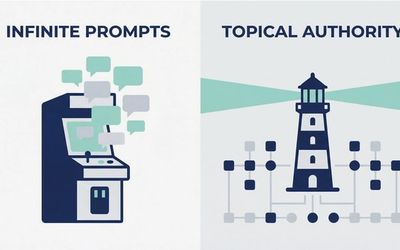
The Paradigm Shift: Moving Beyond Keywords to Answers
The traditional era of ranking for blue-link keywords is fading. Generative search engines now prioritize context-based response extraction over simple query matching. This transition demands a move from content that “ranks” to content that “answers.”
Traditional SEO structures, designed to capture search intent through repetitive keyword usage, often hinder AI indexing. LLMs (Large Language Models) struggle to parse convoluted, narrative-heavy prose. To remain visible, content must be re-engineered around the Answer-First framework:
- Direct Resolution: State the core answer in the opening paragraph.
- Contextual Relevance: Support the answer with specific, high-utility details.
- Machine-Readable Logic: Organize information to minimize the computational effort required for an AI to extract your content as a factual source.
Tactical Formatting: Structuring for Machine Ingestion
To secure your place in AI-generated summaries, your content must be structurally optimized for machine digestion. LLMs rely on predictable patterns to identify authoritative information.
How do I use question-based headers to mirror queries?
Map your H2 and H3 tags directly to the common questions your target audience asks. By framing headers as direct queries (e.g., “What are the core benefits of X?” instead of “Benefits of X”), you provide an immediate signal to the AI that your section contains the specific answer to a potential prompt.
The ‘Answer, Then Expand’ Structure
Prioritize the summary in every section. Begin with a concise, declarative statement that fulfills the user’s intent. Follow this with supporting data, examples, or nuance to add depth. This hierarchy ensures that even if the AI only pulls the first few sentences, your brand remains the primary source.
Signaling Authority with Structured Data
Use formatting elements as metadata for the AI.
- Lists: Convert complex processes into numbered steps.
- Tables: Summarize comparative data for rapid extraction.
- Structured Markup: Use Schema.org to define entities, relationships, and technical specifications explicitly.
Operationalizing AI-First Content Production
Moving from a narrative-driven approach to an information-dense model requires a significant shift in production workflows. Content teams must prioritize high-utility density over creative storytelling.
Mapping Topics to User Questions
Stop planning content around “keyword gaps.” Instead, map content production to “answer gaps.” Analyze your niche to identify the specific queries currently receiving poor or incomplete AI responses, then produce content that fills those exact voids.
The Iterative Loop
Content is no longer “set and forget.” You must treat your content as a dynamic dataset. Monitor which pieces are being cited in AI responses and identify those that are not. Use these feedback loops to refine headers, clarify definitions, and update your structured data to improve your citation frequency.
The Content Integrity Checklist: Validating AI-Readiness
Before publishing, subject your content to a rigorous AI-readiness audit. Use this checklist to ensure your brand is positioned for machine-driven discovery.
- Does the primary takeaway stand on its own in the first paragraph?
- Are all major headers written as direct questions users actually ask?
- Is the content free of fluff? (AI evaluators penalize excessive word counts that do not contribute to the answer).

Future-Proofing Your Presence in Emerging AI Ecosystems
The ultimate goal of Generative Engine Optimization is to move beyond traffic-centric KPIs. Success is now measured by trust and citation-based metrics.
Build your content engine to be modular and data-driven. By focusing on entity-based authority and structural precision, you create a robust foundation that remains resilient as retrieval models evolve. This is not just about keeping pace with algorithms; it is about building a scalable infrastructure that makes your brand the go-to source for AI agents and human users alike.