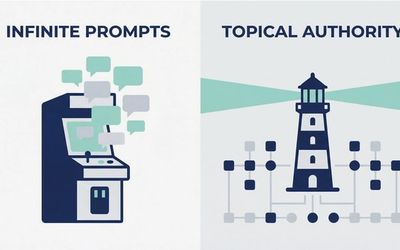
The era of chasing blue links is over. In generative search, visibility is no longer a metric of ranking; it is a measure of entity authority. For content leaders, this shift requires moving from manual, keyword-focused production toward high-leverage content systems.
The Shift: Why Entity Strategy is a Content Operations Challenge
Generative AI does not index pages; it synthesizes knowledge. To compete, your organization must transition from a “content factory” mindset to an entity-first system.
- Redefining Visibility: Success in AI search is defined by how clearly your brand is recognized as the definitive subject matter expert (the entity) in the AI’s knowledge graph.
- Systematization over Production: High-volume publishing is useless if the content is semantically disjointed. Your team must focus on creating, maintaining, and mapping interconnected entity structures.
- The Leadership Mindset: Modern content leaders must act as systems architects, prioritizing the “semantic signal” of their content over traditional SEO vanity metrics.
Designing the Living Entity Map: Moving Beyond Static Topic Clusters
Stop viewing your content in silos. Instead, treat your core topics as living business entities.
- Pillars as Entities: Map your pillar pages to core brand competencies or user problems, not just high-volume keywords.
- Relationship Mapping: Every piece of cluster content must explicitly define its relationship to the parent entity. Use semantic linking to signal depth to AI models.
- Entity-Driven Briefs: Before a word is written, briefs must specify the target entity, the desired semantic associations, and the specific “truth” the content must anchor for the reader.
Systematizing Execution: Integrating AI Workers into Your Workflow
To maintain speed at scale, you must delegate the heavy lifting of semantic structure to AI agents.
- AI-Driven Research: Use AI to map the knowledge gaps between your current pillar content and the evolving landscape of your industry.
- Semantic Brief Generation: Automate the creation of briefs that define the required entity relationships, ensuring every writer follows a consistent semantic blueprint.
- Operational Loops: Integrate your content creation tool with an automated distribution platform (like AEO/GEO Services) to ensure that every asset is optimized for AI discovery at the moment of publication.
Operational KPIs: Measuring Entity Health and Authority Growth
Standard ranking reports are insufficient for this new landscape. Move toward metrics that measure your actual footprint in the generative ecosystem.
- Entity Authority Score: Monitor the frequency and position of your brand or products in AI-generated answers for your core categories.
- Cluster Breadth & Depth: Track the percentage of your content map that is fully covered. Are you becoming the “go-to” source for the entire entity network?
- Generative Performance: Measure the “cite-ability” of your content—how often your site is referenced as a primary source in AI summaries.
Sustainability at Scale: Auditing and Refreshing Your Knowledge Graph
Entity strategy requires constant maintenance. Without a system for “entity hygiene,” your content map will experience decay.
- Automated Audits: Use AI to periodically crawl your content library, identifying outdated entity definitions or broken semantic links.
- Refresh Cycles: Treat pillar content as dynamic software; update your core entity maps quarterly to reflect new industry innovations.
- Mitigating Entity Drift: Ensure that all new content adheres to your established semantic schema to prevent the dilution of your authoritative signal.
Actionable Jumpstart: Transitioning Your Content Ops Today
Transforming your operations doesn’t happen overnight. Follow this 30-day roadmap to align your team with an entity-first model:
- Weeks 1-2 (Audit & Map): Define your primary “Pillar Entity.” Audit existing content to see how well it supports this core subject.
- Week 3 (Standardize): Build an AI-assisted editorial workflow that mandates entity relationship mapping for all new briefs.
- Week 4 (Launch): Publish the first “Entity-Ready” cluster and establish a benchmark for your visibility in generative search tools.
By evolving into a systems-driven entity manager, you secure your brand’s presence in the AI search ecosystem, ensuring you remain an indispensable source in the age of generative intelligence.