On This Page· 4
The era of optimizing for blue links is officially behind us. In the age of generative search, AI models do not index keywords; they synthesize entities. To achieve consistent visibility in AI-generated answers, you must transition from traditional keyword-focused production to a rigorous, entity-first technical architecture.
The AI Diagnostic: Decoding Your Content Through NLP Analysis
Modern SEO is no longer about keyword density; it is about proving your topical authority through Named Entity Recognition (NER). AI search engines process your content by identifying specific entities—people, places, organizations, and concepts—and mapping them within a massive, interconnected Knowledge Graph.
To optimize effectively, you must first understand how your content is perceived:
- Move Beyond Keywords: Shift focus to entity clarity. If your content lacks explicit mention of the primary entities relevant to your industry, AI models will struggle to categorize your page correctly.
- Leverage NLP APIs: Use advanced NLP tools to measure the Salience of your brand entities. Salience scoring provides a data-driven look at which entities the AI considers most important within your text. If your brand or core service isn’t the primary entity, your optimization strategy is failing.
- Identify Semantic Gaps: Audit your content to find discrepancies between your messaging and public Knowledge Graph expectations. If an AI search engine expects a specific set of relationships for your topic (e.g., a SaaS platform related to API integration), your content must explicitly articulate those connections to fill any semantic gaps.
Machine-Readable Infrastructure: Architecture as an Authority Signal
Even the most well-written content remains invisible if the machine cannot parse its context. Structured data (JSON-LD) serves as the bridge between human prose and machine comprehension, acting as an essential trust signal for LLM crawlers.
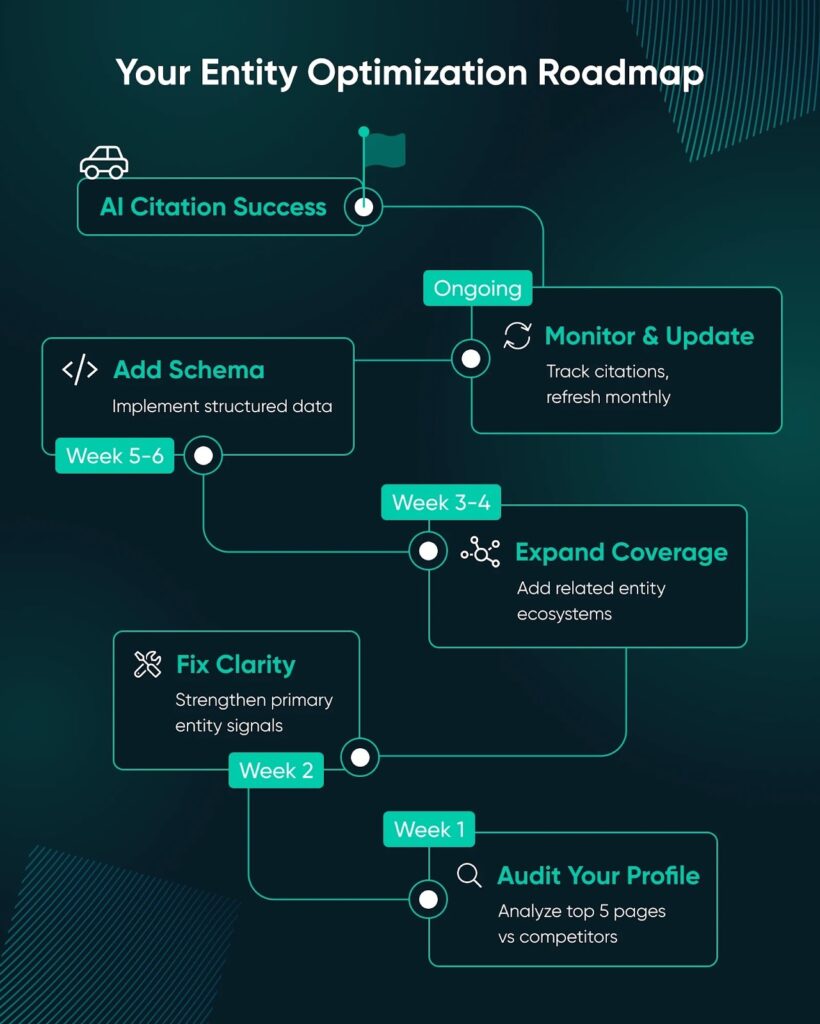
- Entity Disambiguation: Use JSON-LD to explicitly define who you are, what you offer, and how you relate to industry-standard concepts. This eliminates ambiguity and prevents your brand from being confused with others.
- SameAs Properties: Link your digital assets to public, authoritative knowledge sources. By using
sameAsschema, you inform search engines that your brand is the same entity referenced in Wikidata, Crunchbase, or other industry registries. - Trust as a Function of Context: Machines prioritize content that is easy to consume and categorize. By providing a clean, machine-readable infrastructure, you increase your trust score, making your content more likely to be cited in generative AI summaries.
Semantic Coherence: Mapping Entities for Generative Retrieval
Generative retrieval relies on how well you organize information. If your content is semantically disjointed, the AI will fail to retrieve your information when answering complex queries.
- Salience Distribution: Structure your prose so that primary entities are centered while peripheral entities provide relevant support. If the primary entity is buried, the retrieval logic may overlook your page entirely.
- Optimizing for LLM Crawlers: Write with clarity. Use headings and bullet points to establish a hierarchy that helps LLMs quickly map the relationship between your primary solution and the user’s intent.
- Avoiding Ambiguity: Consistent naming conventions are vital. Use the same nomenclature across your entire site to reinforce entity identity. If you describe your service differently on every page, you dilute your authority signal.
Systematizing Technical Execution: From Audit to Automation
Visibility in generative search is not a one-time project; it is an ongoing technical requirement. You must bake entity auditing into your standard publishing lifecycle.
- Automate Schema Injection: Use tools to dynamically inject Schema markup that aligns with the high-salience content segments of your pages. This ensures your metadata is always in sync with your actual content.
- Monitor via Technical Proxies: Shift from vanity keyword rankings to monitoring how your entities appear in AI-generated responses. Track the frequency of your brand citations in summarized answers.
- Entity Auditing: Regularly crawl your library to ensure that entity definitions remain consistent and relevant. As industry trends evolve, ensure your Knowledge Graph footprint stays updated to avoid authority decay.
By mastering the technical requirements of entity recognition and structured data, you move your brand from being a participant in the search landscape to an authoritative source in the generative ecosystem.