What is Business Valuation and Why It Matters
Business valuation determines the economic value of a company or asset by analyzing financial statements, market conditions, and growth potential. For managers, this process is essential for securing investment, planning mergers, and making strategic operational decisions, not just for selling a company.

The goal is an objective estimate reflecting the true worth of the enterprise. This figure serves as the baseline for negotiations with investors, partners, or buyers. Without a clear valuation, you risk undervaluing your hard work or overpricing your business, which deters serious interest.
 .png)
.png)
Key Factors Influencing Valuation
Profitability is often the most significant indicator. Investors examine net income and EBITDA (earnings before interest, taxes, depreciation, and amortization) to assess efficiency. Higher profit margins typically lead to higher valuations, suggesting a sustainable business model.
Revenue growth signals future potential. Companies in high-growth industries like SaaS or AI command higher multiples because investors anticipate substantial future earnings. The year-over-year revenue increase rate directly impacts the applied multiple.
Market traction and competitive advantage also matter. A strong brand, proprietary technology, or loyal customer base creates a moat that protects market share and reduces risk. Conversely, businesses relying on a single customer or lacking differentiation face higher risk premiums, lowering their worth.
Public vs. Private Company Valuation
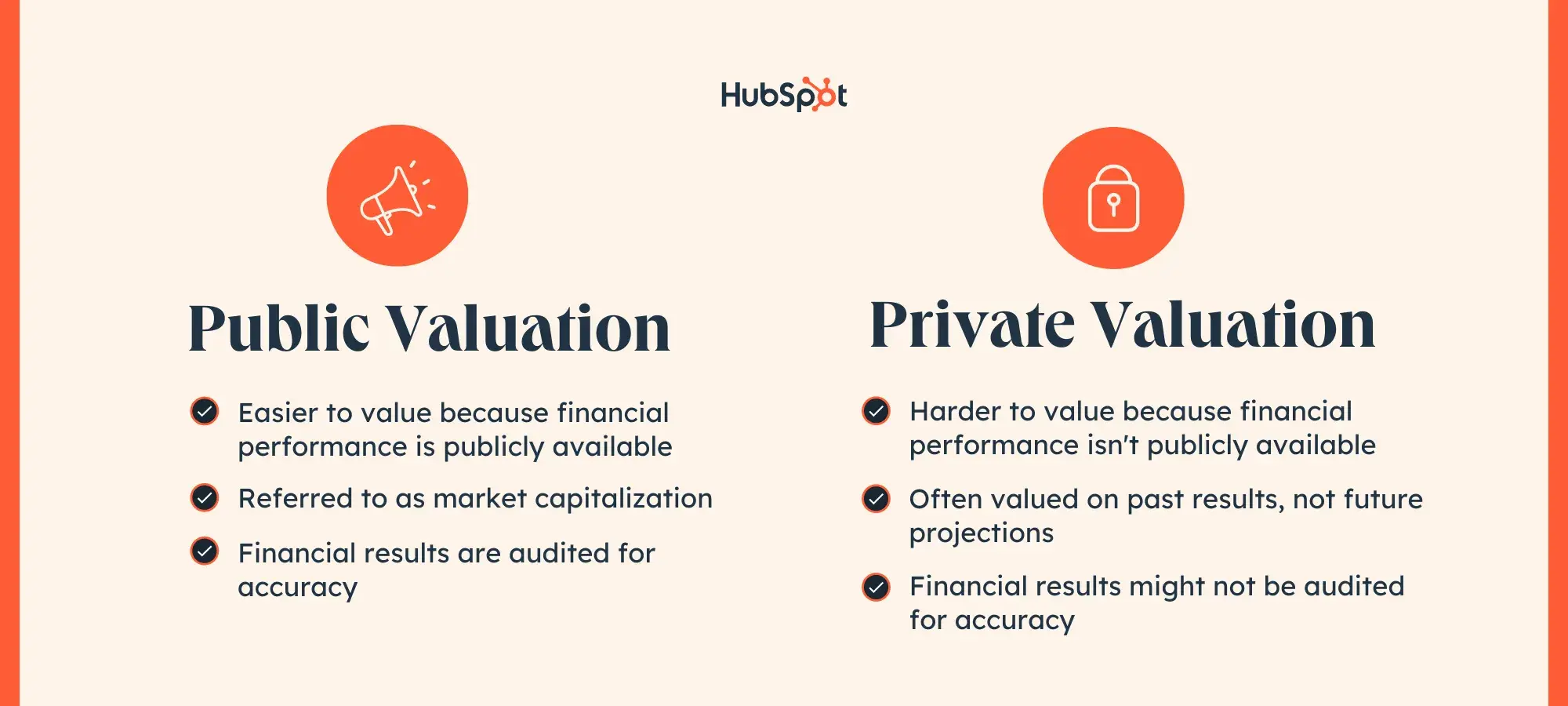
Public companies have their value determined by the market through stock prices. Market capitalization is calculated by multiplying outstanding shares by the current share price, providing a real-time, transparent valuation that fluctuates with sentiment.
Private companies lack public trading data. Their valuation is more subjective, relying on financial models, comparable company analysis, and negotiation. Investors often apply a discount for liquidity and risk, making the process more complex and dependent on thorough documentation and credible projections.
Core Methods for Calculating Company Value
Three primary methods value a business: market capitalization, the multiplier method, and discounted cash flow. Each has strengths suited for different company types and growth stages. Understanding these methods helps you choose the appropriate approach for your situation.
Market Capitalization
Market capitalization is the standard for public companies, representing the total market value of outstanding shares. The formula is straightforward: multiply shares by the current stock price. For example, 10 million shares at $100 each equals a $1 billion market cap.
This method is simple but volatile, reflecting investor sentiment rather than intrinsic value. For private companies, market cap is not applicable unless preparing for an IPO. Analysts might then look at similar public companies’ market caps to estimate potential valuation.
The Multiplier Method
The multiplier method, or revenue/EBITDA multiple, is widely used for private businesses. It involves multiplying a key financial metric, such as annual revenue or EBITDA, by an industry-specific factor. A tech startup might be valued at 3x to 5x revenue, while a manufacturing firm at 1x to 2x.
Choosing the right multiple requires considering industry standards, growth rates, and risk factors. High growth and low risk command higher multiples. Conversely, declining industries or high customer churn result in lower multiples. This method is quick but can oversimplify complex dynamics.
Discounted Cash Flow (DCF)
Discounted Cash Flow values a company based on future cash flows. It projects cash generation over five to ten years and discounts those amounts back to present value using a discount rate. This rate reflects investment risk and the cost of capital.
This method is ideal for companies with predictable cash flows, such as mature businesses or those with long-term contracts. It is less suitable for early-stage startups with volatile or negative cash flows. DCF requires detailed modeling and assumptions, making it complex but potentially more accurate for long-term value assessment.
Practical Examples of Valuation Calculations
Applying these methods to real-world scenarios clarifies their mechanics. Let’s look at two examples using market capitalization and DCF.
Example 1: Market Capitalization
Imagine a company with 250,000 outstanding shares trading at $11 per share. To find the market value, multiply shares by price: 250,000 x $11 = $2,750,000. If the stock price rises to $15, the market cap increases to $3,750,000, reflecting new investor sentiment.
Example 2: Discounted Cash Flow
Consider a company expected to generate $300 in cash flow per share over the next five years. With a 10% discount rate, calculate the present value: $300 / (1 + 0.10)^5. This results in approximately $186.27 per share. If the current market price is lower, the stock might be undervalued, presenting an investment opportunity.
Navigating Startup Valuation Stages
Startups face unique valuation challenges due to a lack of historical financial data. The process evolves as the company matures through ideation, proof of concept, and proof of business model stages.
Ideation Stage
At the ideation stage, a startup has little more than a concept and a business plan. Valuation is based on founders’ experience, idea novelty, and potential market size. Investors often negotiate valuations between $1.5 million and $6 million for first-time entrepreneurs. This stage is highly speculative, driven by future potential rather than current performance.
Proof of Concept
In the proof of concept stage, the startup has a product, a small team, and early operating results. Valuation shifts to focus on growth rate and execution. Investors compare performance to industry benchmarks and peer companies. Valuations are often based on revenue multiples or EBITDA, adjusted for growth speed and team strength. This stage provides more data, grounding the valuation process in reality.
Proof of Business Model
Once a startup proves its business model, it has several years of financial data, a scalable product, and measurable retention rates. Valuation becomes more precise, using methods like DCF or comparable company analysis. The ability to sustain growth and generate consistent cash flows becomes the primary value driver. This stage attracts larger investments, as risk is significantly lower than in earlier phases.
Tools and Resources for Valuation
Accurate valuation requires reliable data and tools. Several online calculators can simplify the process, especially for small businesses and startups.
Recommended Valuation Calculators
- CalcXML: Analyzes current and expected future earnings, considering risk levels and marketability. It provides a comprehensive valuation based on multiple factors.
- EquityNet: Looks at survival odds, industry trends, assets, liabilities, and predicted revenue to estimate value. It is useful for getting a quick, data-driven estimate.
- ExitAdviser: Uses the DCF method to discount future cash flows to their present value. It is ideal for businesses with predictable income streams.
These tools provide a starting point but should be used with professional advice. Valuation is both an art and a science, requiring judgment and context beyond simple formulas.
Final Thoughts on Business Valuation
Valuing a business is critical for strategic planning, fundraising, and exit strategies. It requires a deep understanding of financial metrics, market conditions, and growth potential. Using appropriate methods and tools helps you arrive at a fair and defensible valuation.
Valuation is not static; it changes with market trends, company performance, and investor sentiment. Regularly reviewing your valuation keeps you informed and prepared for future opportunities. Whether seeking investment or preparing to sell, a clear understanding of your company’s worth empowers you to negotiate effectively and make informed decisions.
What factors do you think will most influence your company’s valuation in the next year?





