Long-Tail vs. Broad Keywords: Which Wins AI Citations?
The traditional digital marketing dogma is absolute: chase high-volume keywords to maximize visibility. Businesses often pour resources into competing for broad terms like “software” or “insurance,” assuming that high-volume traffic naturally builds authority. This mindset is becoming obsolete in the era of generative AI.
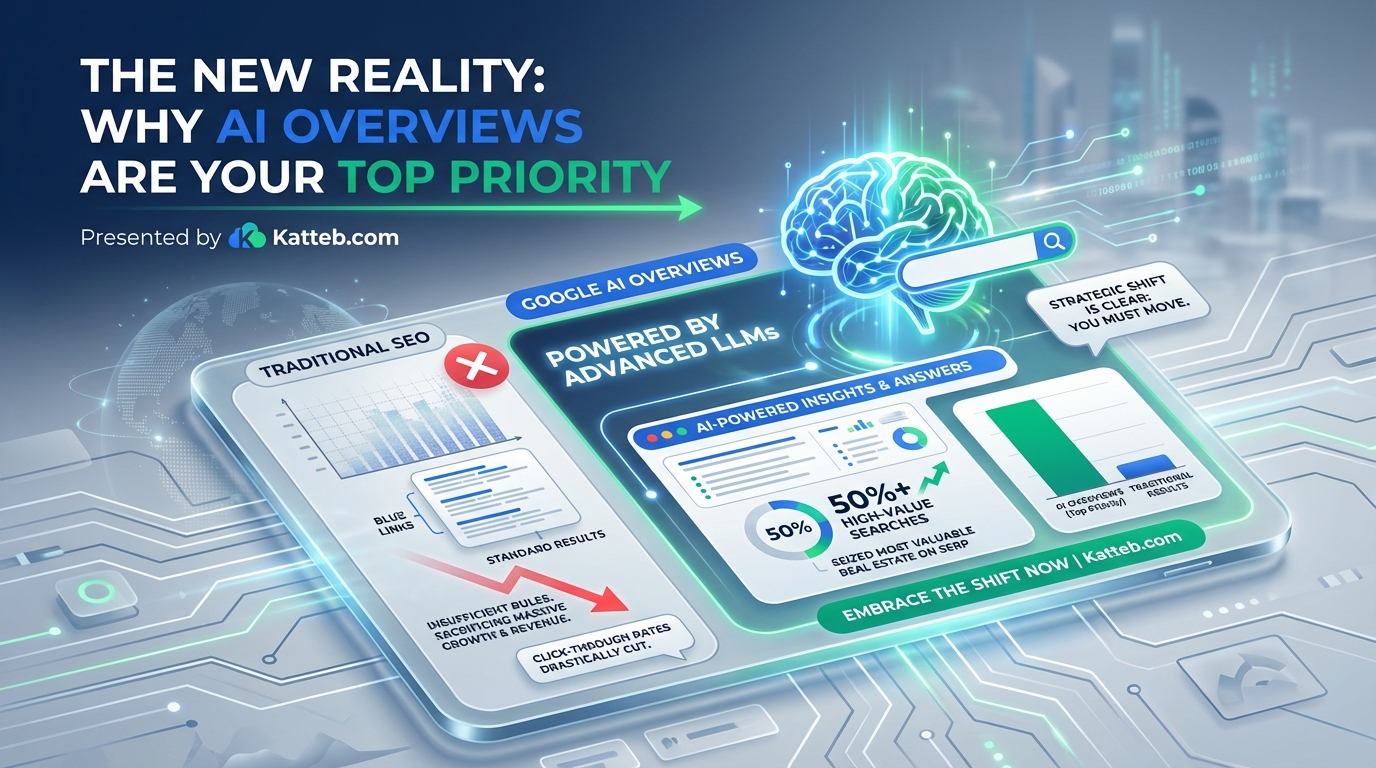
Modern search behavior tells a different story. Broad keywords still generate volume, but they rarely result in direct brand citations within AI-generated answers. Large Language Models (LLMs) synthesize information from multiple sources for general topics, often omitting specific brand attribution. In contrast, long-tail keywords—specific, conversational queries—demonstrate a significantly higher rate of being cited in AI Overviews. This is driven by content extractability: the ease with which an AI model identifies and quotes a self-contained answer. Understanding the difference between broad visibility and citation probability is now the foundation of a modern AEO strategy.
The AI Citation Gap: Why Keyword Type Matters More Than Volume
The traditional SEO focus on search volume is crumbling. In the era of generative AI, the new metric that matters to brands is citation probability. This fundamental shift defines the gap between traditional AI search SEO and the emerging discipline of Answer Engine Optimization (AEO). We are no longer just ranking for clicks; we are optimizing for citations.
Search engines have transformed from databases of links into sophisticated answer engines. When a user enters a query, the AI decomposes the intent into sub-questions, synthesizes information from multiple sources, and generates a direct answer. Your keyword choice dictates your likelihood of being quoted in this workflow.
The Shift: Ranking for Clicks vs. Optimizing for Citations
Traditional SEO targets “position one” to convince a human user to click through. AEO strategy optimizes for the AI snippet. When you target broad keywords, you compete for general authority. The AI may synthesize an answer using three different sources, giving you a 33% chance of being the sole citation. With long-tail queries, the AI often finds one perfect, self-contained answer. If that answer is yours, your citation probability approaches 100%.
How LLMs Decompose and Cite
Large Language Models (LLMs) process queries by breaking them down. If a user asks a broad question like “What is digital marketing?”, the AI summarizes generic information from a massive pool of sources. However, when the query is specific—“What is the difference between AEO and SEO?”—the AI looks for a definitive, distinct answer. The AI prefers to cite a source that best resolves the specific sub-question it identified within the broader user intent.
Citation Probability vs. Traffic Volume
Traffic volume measures how many people see a keyword, while citation probability measures the likelihood of an AI model naming your brand as the source. A high-volume broad keyword might bring thousands of visitors but yield zero direct citations. A low-volume long-tail keyword might bring fewer visitors but secure a citation that builds significant brand authority. For businesses focused on generative AI traffic, prioritizing content that the AI wants to cite is essential.
Broad Keywords: The Authority Gatekeeper
Broad keywords—single or two-word terms—represent the apex of search traffic, but they are also a trap for brands chasing AI citations. In AEO, broad terms function as a strict authority gatekeeper. The barrier to entry for being cited is exponentially higher than for specific queries because of the inherent limitations of LLM reasoning.
The Requirement for High Entity Authority
When an AI encounters a broad query, it faces a massive amount of conflicting information. To provide a safe, useful answer, the model relies on a weighted network of sources with proven entity authority. For generic terms, the model prioritizes established industry leaders. For a brand without this status, competing for a broad keyword citation is nearly impossible. You cannot “optimize” for this level of trust; you must build it over time through consistent, high-quality output and authoritative mentions.
The Synthesis Risk: Why Brand Attribution Disappears
Broad queries lack specific intent, forcing the AI to synthesize a comprehensive answer from multiple sources. This is known as “synthesis risk.” The AI blends your insights with competitors, leaving you with no distinct brand attribution. The user gets the answer, but they don’t know which specific content led them there.
Strategic Use Case: Awareness, Not Dominance
Broad keywords are tools for brand awareness and top-of-funnel visibility, not direct citation dominance. Use them to signal relevance to general topics and build the entity graph that connects your specific content to broader themes. Your AEO strategy should focus the bulk of its effort on specific, answerable questions.
| Feature | Broad Keywords | Long-Tail Keywords |
|---|---|---|
| Citation Probability | Very Low | High |
| Source Requirement | Dominant Authority | Niche Expertise |
| AI Behavior | Synthesis; low attribution | Direct extraction |
| Primary Goal | Awareness | Citations |
| Competition | Extreme | Moderate to Low |
Long-Tail Keywords: The High-Citation Engine
Long-tail keywords thrive on precision. In AEO, specificity is the ultimate lever for visibility. Long-tail queries—typically three or more words—act as a high-citation engine because they align perfectly with how LLMs process information.
The Mechanics of Content Extractability
Content extractability measures how easily an AI model can isolate a specific piece of text as a complete answer. Broad topics are too vast for an AI to answer directly without synthesizing dozens of sources. Long-tail questions allow for self-contained, definitive answers. Your content doesn’t need to be the only source of truth for the entire industry; it just needs to be the best answer to that specific, narrow question.
Structured, Concise Answers
LLMs are engineered to provide direct responses to user prompts. They prefer answers that fall within a 40-60 word window. Long-tail content naturally lends itself to this format because the scope of the question is limited.
Lower Competition, Higher Citation Share
Long-tail targets offer a higher citation share per query. Because the intent is specific, there is less likelihood the AI will synthesize an answer from multiple sources. Your content can capture 100% of the citation value for that query. For businesses looking to build authority in generative search, focusing on long-tail clusters allows you to accumulate citations efficiently.
Strategic Framework: Matching Keyword Types to Brand Authority
A successful AEO strategy requires understanding how your brand’s authority intersects with keyword specificity. Relying solely on broad keywords is risky for emerging brands, while focusing exclusively on long-tail keywords may limit your ability to establish broader category leadership.
The Hybrid Approach: Building Authority from the Ground Up
The recommended approach is to use long-tail keywords as the foundation for building content extractability and entity clarity. By creating deep, structured content around niche questions, you demonstrate specific expertise that AI models recognize. This builds your E-E-A-T signals incrementally. As you accumulate citations across a cluster of related topics, you create a web of authority that makes it harder for AI models to ignore your brand when answering broader queries.
Scaling to Broad Terms
Once you have established dominance in niche clusters, you can gradually expand into broad keywords. At this stage, your goal shifts from securing single-source citations to achieving brand association. AI models are more likely to include your brand in a synthesized answer because they have already seen your name associated with high-quality data points.
Optimizing for Extraction: Structuring Answers for AI
To maximize content extractability, you must engineer your pages so that an AI can identify, isolate, and validate the answer without context-heavy inference.
The Answer-First Formatting Technique
In a traditional post, the author might spend paragraphs building context before reaching the core fact. For an AI crawler, this is noise. The ideal AEO structure places a concise, self-contained answer—between 40 and 60 words—at the very top of the section. This signals that the paragraph contains the definitive answer to the query.
The Role of Schema Markup
Schema Markup acts as a universal translator between your content and AI crawlers. By embedding structured data like FAQPage or HowTo schemas, you provide a pre-processed summary of your content’s meaning. This significantly reduces the ambiguity inherent in natural language processing and increases your chances of verbatim reproduction in AI results.
The Necessity of Self-Contained Paragraphs
Avoid referential language like “as mentioned above” or “the process described earlier.” These force the AI to perform complex cross-referencing, which lowers extraction probability. Every paragraph that serves as a potential citation source must make complete logical sense if stripped from its page. By ensuring each key point is grammatically complete, you remove the cognitive load from the AI and make your content the path of least resistance for citation.
The debate between keywords is no longer about volume; it is about authority. By structuring your content to be self-contained and directly responsive, you position your brand as the trusted source in AI-driven search results.
AEO/GEO
Want to learn more?
Contact us for direct consultation and support.