Many of you have likely spent the last few months feeling overwhelmed
Many of you have likely spent the last few months feeling overwhelmed. Between the endless stream of new AI tools, the pressure to transform operations, and the fear that competitors are ahead, paralysis is common. Most businesses try to shoehorn artificial intelligence into every workflow, hoping something sticks. This frantic chase to do AI creates noise and alienates your audience.
Customers don’t care about the specific LLM you use; they care if their problems are solved efficiently. The real challenge is moving from technical chaos to a strategy that prioritizes the customer experience. How we Grow with Agent-first GTM offers a clear path forward. Instead of forcing your team to master complex prompts, you can deploy intelligent agents to handle manual tasks. This allows your human team to focus on building authentic, high-impact connections.
Moving Beyond the Hype: The Agent-first Philosophy
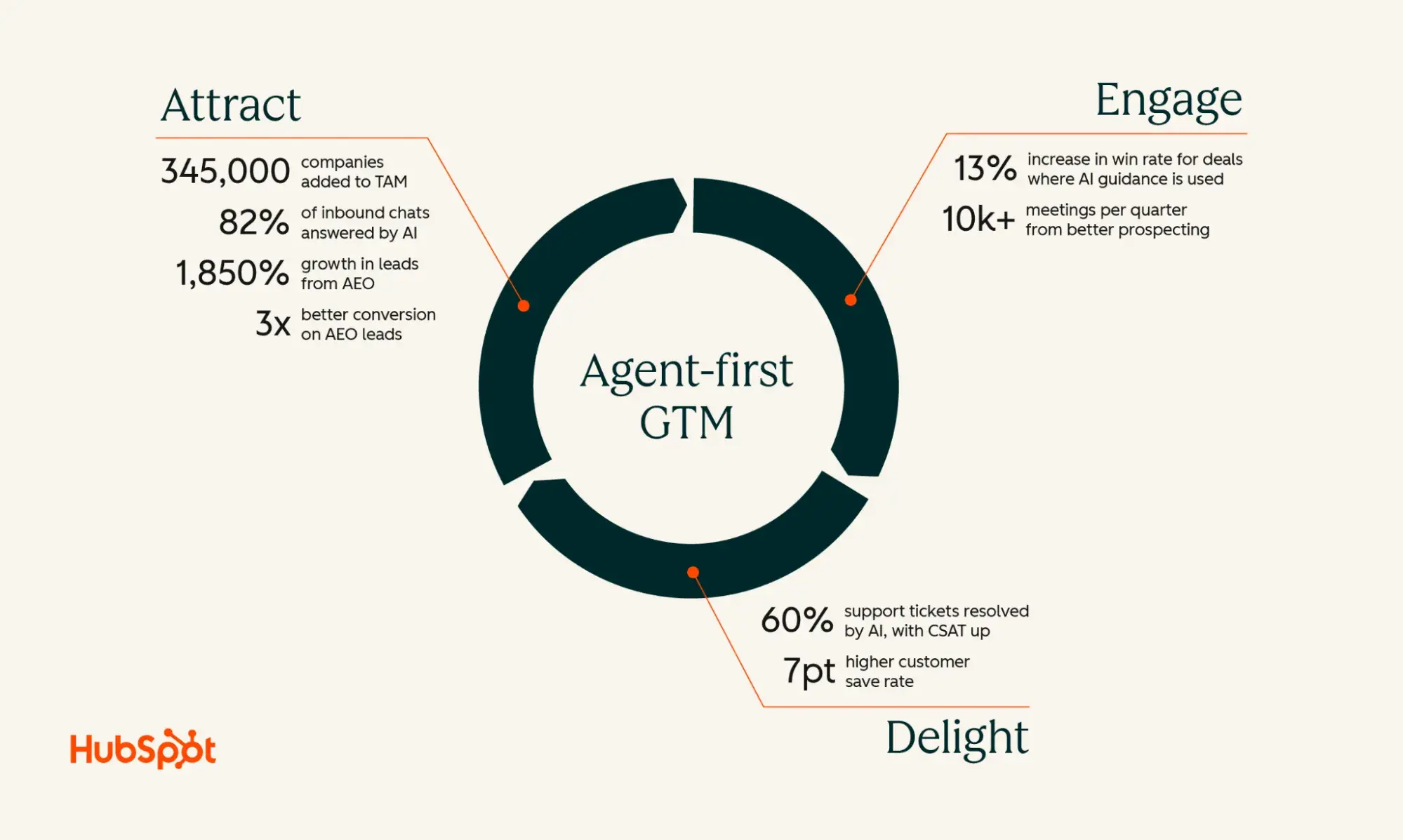
An Agent-first go-to-market strategy is a fundamental shift in how businesses operate. Rather than bolting new AI tools onto existing manual workflows, this philosophy prioritizes agent-led processes. Think of an agent as a digital colleague capable of executing complex tasks, making autonomous decisions within parameters, and iterating based on feedback.
Moving Beyond AI for the Sake of AI
Too many organizations treat artificial intelligence as a shiny object. They rush to implement the latest chatbot or automation script without identifying specific friction points. This approach often results in bloated tech stacks and confused teams who struggle to see the return on investment.
An agent-first mindset flips this script. It begins by mapping the customer journey and identifying human-centric pain points, such as long support wait times, delays in lead follow-up, or repetitive data entry. Once these friction points are identified, we deploy specialized agents to resolve them. This isn’t about replacing humans; it’s about removing the mundane tasks that keep your team from doing the work they enjoy.
Empowering Your Team Through Automation
When you successfully implement this philosophy, you liberate employees to focus on high-impact strategy. By offloading recurring, rule-based processes to intelligent agents, you create space for deep, creative, and interpersonal work that AI cannot replicate.
Consider a scenario where your sales team spends hours manually inputting contact data and drafting follow-up emails. By transitioning to an AI-powered growth flywheel, you allow agents to handle research, lead scoring, and initial outreach synchronization. Suddenly, your reps have extra time to build genuine, empathetic relationships. This transition represents the true promise of optimizing sales with AI agents, reclaiming your team’s time for human connections that drive growth.
Attracting Customers through Intelligent Demand Generation
Finding the right audience feels like looking for a needle in a digital haystack, but intelligent demand generation changes the rules. Instead of casting a wide, expensive net, you can use specialized demand agents to sift through massive data to identify ideal prospects with precision. These agents analyze intent signals, content consumption, and behavioral patterns to find people ready to engage.
Mastering Answer Engine Optimization
If you aren’t where your buyers start their research, you effectively don’t exist in the modern buyer’s journey. People now turn to AI-powered search engines—the answer engines—to solve problems. Answer Engine Optimization (AEO) is the practice of ensuring your brand provides the specific, authoritative, and helpful answers that these engines prioritize. Demand agents monitor the queries your prospects are asking, analyze the answers generated by AI, and help you refine content to align with those needs.
Traditional vs. Agent-first Demand Generation
| Feature | Traditional Lead Generation | Agent-first Lead Generation |
|---|---|---|
| Target Identification | Broad demographic | Real-time intent and behavioral data |
| Interaction Style | Manual outreach | Personalized, context-aware conversations |
| Timing | Static, campaign-based | Dynamic, triggered by activity |
| Scaling Factor | Proportional headcount | Automated agent workflows |
| Primary Goal | Quantity of leads | Quality and readiness of prospects |
By integrating AI in customer acquisition, you maintain a constant, helpful presence. While a human marketer has to rest, a demand agent is always online, processing intent data, and ensuring your brand is positioned perfectly when a high-value prospect starts their research.
Engaging Prospects with Contextual Intelligence
Contextual intelligence is the ability to synthesize disparate data points—from website behavior to product usage—into a coherent narrative. When you move beyond simple automation to an Agent-first go-to-market strategy, your agents act as intelligent conduits that interpret prospect intent in real time. They provide your sales team with the exact context needed to move the needle, effectively optimizing sales with AI agents to eliminate the guesswork of traditional manual outreach.
Dashboards vs. Conversational Interfaces
Sales teams are often forced to manually synthesize data from disconnected reporting tools, leading to dashboard fatigue. In contrast, conversational AI interfaces for sales reps act as an on-demand, intelligent partner. Instead of staring at charts, a rep simply asks the agent a specific question about a prospect. The agent synthesizes recent interactions and drafts a personalized follow-up, transforming data from a passive storage bin into an active asset.
Removing Pre-Sales Friction
Effective AI in customer acquisition occurs where agents step in to resolve technical hurdles before they stall a deal. Consider these ways agents handle pre-sales friction:
- Automated Technical Qualification: An agent instantly cross-references a prospect’s tech stack against your integration capabilities, providing a personalized technical brief immediately.
- Dynamic Content Personalization: If a prospect lingers on specific pricing pages, the agent adjusts the email sequence to prioritize relevant case studies, ensuring they receive the value proposition they seek.
- Instant Documentation Assistance: During a trial, agents can parse your entire technical library to answer specific questions from a developer lead instantly, keeping momentum high.
Delighting Customers and Scaling Success Efforts
Introducing AI into your service layer doesn’t strip away warmth or empathy. When implemented within an Agent-first go-to-market strategy, technology serves as a bridge. By automating routine inquiries, your team gains the freedom to show up more meaningfully during defining moments.
Prioritizing Human Connection Through Data
Instead of forcing Customer Success Managers (CSMs) to handle status checks, intelligent agents act as a first line of defense, monitoring account health indicators. When an agent identifies that a customer’s engagement has dropped, it automatically flags the account for human review. It pre-populates a dashboard for the CSM with a summary of the issue, ensuring they arrive with full context.
Scaling Success with Customer Success Automation
Digital success agents allow you to maintain proactive engagement across your entire user base, including long-tail accounts. They excel at handling critical yet time-intensive tasks:
- Onboarding milestones: Sending personalized tutorials based on specific user behavior.
- Proactive check-ins: Reaching out to see if a user needs help with specific features.
- Resource delivery: Sharing relevant content based on individual pain points.
By offloading these responsibilities, high-performing CSMs are freed from administrative bloat. They dedicate their energy to cultivating complex relationships and solving high-stakes problems that require human intuition.
Practical Steps for Adopting an Agent-first Model
Transitioning to an Agent-first go-to-market strategy is a methodical process. Start with the ‘Delight’ stage—specifically customer support. Focusing here offers the clearest path to value. Your support channels deal with consistent, repetitive queries, providing a controlled environment to measure success immediately.
Identifying Automation Candidates
Audit your current workflows for friction. Look for tasks that are repetitive, rule-based, and consume valuable time. Use this framework to evaluate candidates:
| Criteria | Why it matters |
|---|---|
| High Frequency | Frequent tasks offer the highest ROI on automation. |
| Rule-Based Logic | Clear if-this-then-that paths are best for agents. |
| Time-Intensive | Removing these allows staff to focus on high-impact work. |
| Data-Dependent | Agents thrive when they can pull from existing knowledge bases. |
Embracing the Build-Measure-Learn Cycle
Once you identify a task, adopt a build-measure-learn cycle. Start by deploying a narrow agent to assist a specific part of a workflow, like updating CRM records. Measure its performance against the human baseline. Refine the agent’s instructions based on the data. This approach is essential for optimizing sales with AI agents, ensuring your automation evolves alongside your business requirements.
Transitioning to an Agent-first go-to-market strategy is a fundamental shift in how your business functions. By treating agents as core operational team members, you move from chasing trends to building a genuine AI-powered growth flywheel. Start small by identifying one high-friction bottleneck where an AI agent provides tangible value. You aren’t replacing humans; you are empowering them to focus on the work that scales your human impact.
AEO/GEO
Want to learn more?
Contact us for direct consultation and support.