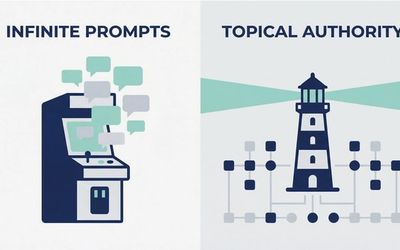
The Shift: From Keyword Targeting to Semantic Data Authority
In the era of Large Language Models (LLMs), search has evolved from a deterministic keyword-matching process into a probabilistic information retrieval system. Traditional SEO—long obsessed with keyword density and meta-tag manipulation—fails to account for how generative engines operate. Modern models do not look for exact matches; they perform inference based on latent space representations of data.

At the center of this transformation are Knowledge Graphs and entity extraction pipelines. AI models digest massive datasets to construct nodes and relationships, assigning weight to brands based on their defined “entity profile.” Consequently, keyword density is now obsolete. Visibility in AI-powered search is no longer about repeating phrases; it is about providing the high-fidelity training data necessary for a model to establish your brand as a definitive, cited authority on specific topics.
The AI Visibility Audit: Establishing Your Baseline Metrics
Optimizing for generative engines requires a pivot toward quantitative, AI-specific KPIs. You cannot manage what you do not measure, and the traditional “rankings” report has no bearing on how LLMs synthesize information.
To audit your current performance, you must shift your focus to three primary metrics:
- Entity Association Score: A quantitative measure of how strongly your brand is linked to core industry concepts within the model’s vector space.
- Citation Frequency: The count of how often your content is referenced as a source within generated answers across diverse LLM interfaces.
- Retrieval Relevance: The degree of alignment between your content’s semantic structure and the specific information requirements of the model’s retrieval-augmented generation (RAG) framework.
To perform a gap analysis, you must execute a “Semantic Gap” study. This involves querying target topics across top LLMs, extracting the citations used, and mapping your existing content against those model-preferred sources. If the gap between your content and these citations is wide, you lack the semantic authority required for consistent inclusion.

Infrastructure for Semantic Authority: Entity Modeling and Structured Data
True semantic authority is built through intentional information architecture, not just content production. You must design your digital presence to function as a structured knowledge base that machines can interpret effortlessly.
Moving beyond basic Schema markup, brands must build an internal knowledge model that mirrors how machines categorize information. This involves:
- Defining Entity Profiles: Clearly mapping your brand’s internal knowledge graph to external, authoritative schemas.
- Zero-Click Design: Structuring content to provide high-density, granular answers that satisfy the AI’s need for precise, citeable information fragments.
- Semantic Clustering: Designing content hubs that serve as structured training data, reinforcing the relational links between your core services and industry entities.
By creating interconnected data clusters, you provide the context needed for an LLM to accurately predict your brand’s relevance when a user query triggers a specific topic.
Continuous Measurement: The Feedback Loop for Generative Optimization
Visibility in AI-driven search is a dynamic engineering challenge, not a static achievement. As models undergo frequent updates—changing how they weight information and retrieve citations—your strategy must remain fluid.
You should implement a system that treats your brand’s AI footprint as a continuous monitoring loop. This requires moving away from static reports and towards real-time tracking of:
- Model-Specific Response Patterns: Monitoring how citation tendencies fluctuate following model updates.
- Automated Attribution Tracking: Utilizing automated scripts to scan generative outputs for brand mentions and source links.
- Feedback Integration: Regularly re-evaluating your content architecture based on observed citation failures or successes.
Treating AI visibility as a continuous engineering process allows you to pivot your semantic data structure in real-time, ensuring your brand maintains its position as a reliable source in the ever-changing landscape of generative search.